COPPER

A PS Audio Publication

Issue 154 • Free Online Magazine

Issue 154 The Mindful Melophile

The Goldilocks Chronicles

The Goldilocks Chronicles

Streaming has become the most popular audio format. It’s convenient. It’s easy. You can move immediately from one recording to another. But Gilad Edelman, in a recent article for Wired magazine, makes a case for continuing to listen to CDs and LPs:

“Streaming platforms just aren’t designed with the serious music fan in mind. Back when you had to buy a physical album to listen to it, you really listened to it— even the songs you didn’t like at first…In the pre-streaming era, I’d buy an album and listen to it over and over. With [a digital music service] I often discover a new artist, get really excited about them, and three months later forget about their existence entirely. If it doesn’t occupy space on your wall, it may not occupy space in your mind….”

“Where streaming turns songs into something ephemeral and interchangeable, a record is very much a thing. It’s big. You can hold it in your hands and admire the artwork on the sleeve. If the problem with [a web player] is the lack of friction [involvement], well, vinyl records are about as frictiony as you can get. They literally require friction to function….”

“This is not a nostalgia play. Vinyl has the nostalgia market cornered. But if you look past the visual aesthetics, you’ll admit that CDs accomplish the essential function of turntables, vis-a-vis streaming, without the hassle. That is, they allow you to build a library.” [1]

In order to get the greatest amount of enjoyment from the CDs and vinyl you play, top-quality sound should be a priority. Superior sound can make listening more interesting, realistic, and involving. It enables you to hear greater directionality and clarity, more natural timbres, the ambience of the recording studio or concert venue, the interplay among musical parts, the space around performers, and details or even lines of music that are hidden when the reproduction is inadequate. [2] You’ll also want sound that’s in line with your taste – a little more of this, a little less of that – whether or not what you like is considered to be “accurate.”

So, if you’re a serious listener building your first audio system or upgrading an existing one, how do you go about putting together components that will give you the best listening experience? Here’s a brief history of my search for superior sound that might help guide your own decisions when building or modifying a system that’s right for you.

The story

Once upon a time, several decades ago when I moved into my first New York City apartment, I didn’t want to set up a home music system centered on a boombox purchased from Crazy Eddie’s electronics discount store. I bought what I believed to be a good, affordable serious listener’s starter kit: AR speakers and turntable, [3] a Dynaco amp and preamp, and a Dynaco FM tuner. To get the most natural sound I moved the speakers an inch here, a quarter of an inch there, figured out how far away from them I should sit, and how high the chair I sat on should be. I really enjoyed this all-tube aural equivalent of comfort food – a sound sometimes referred to as “chocolaty.” The equipment might not have had the greatest detail or state-of-the art-specs found in more expensive brands, but it did have qualities I liked: depth, width, and warmth, and every instrument or voice was smooth and round even if it wouldn’t quite sound that way in reality.

I needed one other item to complete my system: a reel-to-reel tape recorder. The manager at a well-known audio store made two good recommendations: either a Revox or Tandberg tape deck. I listened to both and chose the Revox because of its sound, aesthetics, ability to handle 10-1/2-inch reels, and company reputation. The Revox sounded clear and expansive; the Tandberg had a quieter background and sounded like the performers were more forward on the soundstage (i.e., closer to the listener). The Revox came with a lifetime warranty that turned out to be very useful: the recorder I received was mechanically unreliable. After four trips to the repair shop, I finally exchanged it for a Tandberg, which was trouble-free for a couple of decades.

A classic Revox A77 reel-to-reel tape deck, introduced in 1967. Courtesy of Wikimedia Commons/s_p_a_c_e_m_a_n. A classic Revox A77 reel-to-reel tape deck, introduced in 1967. Courtesy of Wikimedia Commons/s_p_a_c_e_m_a_n.

When solid-state equipment became available I traded the Dynaco amps for a solid-state integrated amp with a variety of bells and whistles, including a tuner, bass boost, mute, and tone controls. I found the sound cold and constricted and didn’t live with it for very long, despite its versatility. I traded that and some other equipment for Conrad-Johnson tubed amps that had even greater warmth and detail than my original Dynaco equipment, [4] then eventually traded the C-J equipment for a Pathos Classic One Mk II hybrid integrated amplifier: a combination tube preamp-stage and solid-state power stage that, as one audio critic put it, “is one of those rare components that achieves a perfect balance of performance, style and value.” [5]
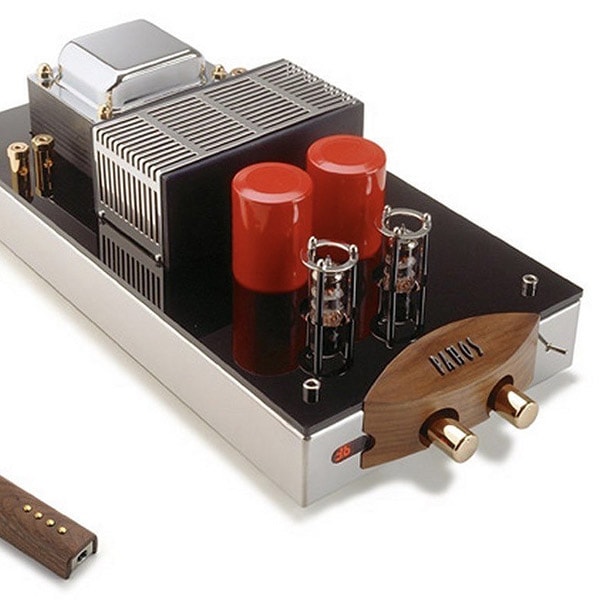
 

Pathos Classic One Mk II integrated amplifier. Pathos Classic One Mk II integrated amplifier.


After relocating to San Francisco, I discovered several high-end audio stores and a wide variety of equipment to choose from within walking distance of my new apartment. My electronic Philips turntable (which had replaced the AR) was replaced by a Bang and Olufsen turntable (a beautifully-designed piece of equipment whose sound turned out to lack body) which was replaced by a SOTA (with a fuller, more realistic sound), which was replaced by a Clearaudio Performance turntable. The AR speakers were traded for stand-mounted aluminum-honeycomb-enclosure Celestion speakers with a transparent upper and mid-range that almost made up for their lack of bass. The Celestions were followed by floorstanding Triangle speakers that projected a warm, clear sound, and were especially captivating when playing jazz and chamber music. As much as I enjoyed the Triangles, though, I always felt they didn't have enough power to support large orchestral music, so they, too, were eventually replaced – this time by Audio Physic Classic 10 speakers (tagline: “No loss of fine detail”) that are still part of my system.
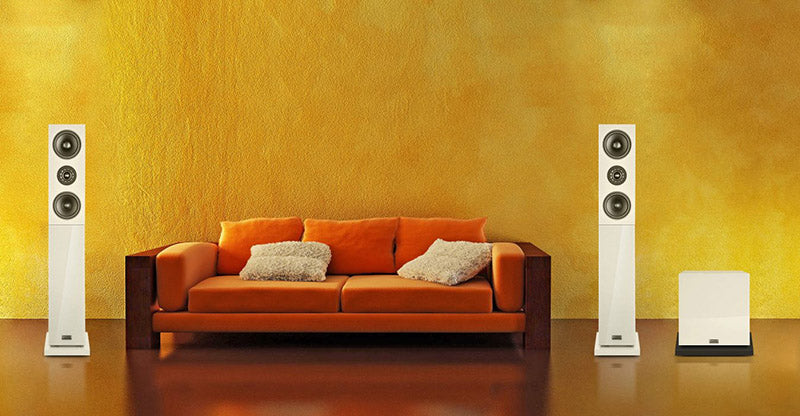
 

Audio Physic Classic 10 loudspeakers. From the Audio Physic website. Audio Physic Classic 10 loudspeakers. From the Audio Physic website.


My first CD player was manufactured by ADS and had a more liquid sound than most of the other early digital players I had been auditioning. When SACDs started to appear, I bought (but had trouble carrying) a 39-pound Esoteric SACD/CD player. It was superb: transparent, detailed, airy, and “accurate.” I could hear the felt-covered wood hammers striking the strings inside a piano, the rosin on violin bows, and the individual hairs of brushes on drums during jazz performances. Every attack on every instrument being played was instantaneous, and every note hung in the air after being played. The detailed Esoteric reinforced the sound of my detailed Audio Physic speakers and I reveled in this combination until (you knew that was coming) once again, I needed some of the cozy warmth of tubes in my system, even if the sound might not be as accurate.

When the Esoteric started having tray problems years later, instead of repairing it I looked for a different SACD player and chose a Marantz SA-14S1, one of the company’s higher-end products that has some tube-like warmth yet plenty of detail. [7] The first time I played a jazz CD on the Marantz I discovered I was tapping my foot – something I don’t recall happening while listening to the Esoteric. I was so impressed by the Esoteric’s reproduction I had been focusing more on the sound itself than on the soul of the music.

My current system includes the aforementioned Pathos integrated amplifier and Clearaudio Performance turntable (that “guarantees absolute speed stability and pure pleasure in listening” according to the manual and I have no reason to disagree), a Fosgate Signature Phono Preamp (all tubes) with a seductive 3-dimensional sound, the Marantz CD player and Audio Physic speakers referred to above, an Audience Adept Response power conditioner to plug everything into, and an Audience power cord to connect the conditioner to the wall outlet (it’s true: wall outlets are noisy and “audiophile” power cords, interconnects, and speaker wires can reduce noise throughout a system and allow more detail to be heard).


Fosgate Signature Phono preamplifier. Fosgate Signature Phono preamplifier.

There’s a new PS Audio SACD player [the PerfectWave SACD Transport – Ed.] I’m curious about. And speakers and amplifiers by other manufacturers I’d like to audition. Continuing the search for perfection is exciting, fun…and endless. Sometimes a change can be refreshing. But after decades of buying and trading components I’ve decided my time is better spent enjoying what I have. I’m pleased with my current mix and match, yin and yang, analog and digital system that also has great aesthetics I enjoy looking at every day. This system makes my foot tap. It draws me into the music. It has great sound and the sound qualities I enjoy most.

The moral of the story

Avoid building a system you think you should have. Whether you like chocolate (a tonal balance on the warmer side of neutral that has a rich sound), vanilla (a tonal balance on the cooler side of neutral that has exceptional transparency), or some other flavor, choose equipment you feel is just right for you.

[1] Gilad Edelman, “You Should Listen to CDs,” (Wired, 12/23/21).

[2] For example, after one of my many system upgrades, I was surprised to discover a musical line in Bartok’s Concerto for Orchestra I had never heard before because it had been obscured by equipment limitations.

[3] These “bookshelf” speakers were the perfect size for a studio apartment and could be placed on small stands and moved so they wouldn’t be blocked by furniture.

[4] The Dynaco and C-J amps often blew tubes and were costly to maintain. Contemporary vacuum tube equipment usually requires very little maintenance.

[5] Jeff Dorgay, TONEAudio magazine.

[6] I auditioned a larger-sized, positively-reviewed Triangle speaker that could handle orchestral music but lacked the transparent sound of my smaller Triangles, and would have been too large for my living room (they needed a greater distance between the speakers and listener in order for the sound to come together at the listener’s ears).

[7] Marantz was one of the best manufactures of vacuum tube gear before the company transitioned to solid-state designs. Even much of their solid-state equipment is notable for having a warm sound.

Header image: Marantz SA-14S1 SACD player.

More from Issue 154

View All Articles in Issue 154

Search Copper Magazine

#231 Piano Prodigy Jude Kofie Releases His Debut Album On Octave Records by Frank Doris Jun 01, 2026 #231 Underappreciated Artists, Part Two: City Boy by Rich Isaacs Jun 01, 2026 #231 Music and the Art of Creation: Talking With Saxophonist Rob Scheps by Joe Caplan Jun 01, 2026 #231 How to Play in a Rock Band, 24: Further Adventures at the 2026 Montauk Music Festival by Frank Doris Jun 01, 2026 #231 Courtney Barnett: Creature of Habit by Wayne Robins Jun 01, 2026 #231 Angine de Poitrine: Interstellar Guitar Rock Saviors Headed for Late-Night TV Pop Stardom? by Mark Lepage Jun 01, 2026 #231 My Impressions of AXPONA 2026, Part One by Frank Doris Jun 01, 2026 #231 2026 La Jolla Concours d'Elegance: Another Aesthetic Feast by B. Jan Montana Jun 01, 2026 #231 Country Music Icon Jo Dee Messina’s Bridges: A New Beginning by Ray Chelstowski Jun 01, 2026 #231 The Luxury Dispatch Hosts a Video Podcast With Ken Kessler by Ken Kessler Jun 01, 2026 #231 The Vinyl Beat: Tracking in the Motor City by Rudy Radelic Jun 01, 2026 #231 Lots of Fun With DSP: The Ferrum Audio WANDLA DAC and Its Tube Mode by Frank Doris Jun 01, 2026 #231 From The Audiophile's Guide: Digital Source Components and Streaming Audio by Paul McGowan Jun 01, 2026 #231 Onkyo’s Monster M-510 power amplifier by The Staff at Just Audio Jun 01, 2026 #231 PS Audio in the News by PS Audio Staff Jun 01, 2026 #231 Naming Convention by Peter Xeni Jun 01, 2026 #231 Les Invisibles by Frank Doris Jun 01, 2026 #231 Wildlife Scene by James Schrimpf Jun 01, 2026 #230 Camaraderie by B. Jan Montana May 04, 2026 #230 AXPONA 2026: A Family Gathering by Paul McGowan May 04, 2026 #230 Pianist Ryan Benthall Explores Jazz Realms and Far Beyond With Divine Sky by Frank Doris May 04, 2026 #230 The Vinyl Beat in AXPONA-Land by Rudy Radelic May 04, 2026 #230 Teddy Thompson’s Musical Growth Deepens With Never Be the Same by Ray Chelstowski May 04, 2026 #230 More Fun in the Sun: Florida Audio Expo, Part Two by Frank Doris May 04, 2026 #230 CanJam NYC 2026 Show Report: Heady Sound, Part Two by Frank Doris and Harris Fogel May 04, 2026 #230 Sonic Youth On Murray Street by Wayne Robins May 04, 2026 #230 Graffeo Coffee: A Symphony of Sensory Experience by Joe Caplan May 04, 2026 #230 The Saul Authority: The Story of Hi-Fi Pioneer Saul Marantz by Olivier Meunier-Plante May 04, 2026 #230 How to Play in a Rock Band, 23: Encounters With Famous Musicians, Part Two by Frank Doris May 04, 2026 #230 An Outlier in the Rack: A Vintage BIC Beam Box by The Staff at Just Audio May 04, 2026 #230 PS Audio in the News by PS Audio Staff May 04, 2026 #230 A Cautionary Tale by Rich Isaacs May 04, 2026 #230 Reel-to-Reel Roots, Part 33 (Revised): Ken Kessler Reports On the 2026 (British) AudioJumble by Ken Kessler May 04, 2026 #230 Text Messaging by Frank Doris May 04, 2026 #230 The Audiophile Rat Race by Peter Xeni May 04, 2026 #230 On the Rocks by Rich Isaacs May 04, 2026 #229 The Earliest Stars of Country Music, Part Three by Jeff Weiner Apr 06, 2026 #229 The Healing Power of Music and Sound at the Omega Institute by Joe Caplan Apr 06, 2026 #229 CanJam NYC 2026 Show Report: Heady Sound, Part One by Frank Doris Apr 06, 2026 #229 Florida Audio Expo 2026: Warming Up to High-End Audio, Part One by Frank Doris Apr 06, 2026 #229 Quick Takes: Anne Bisson, Sam Morrison, The Velvet Underground, and the Stooges by Frank Doris Apr 06, 2026 #229 The Vinyl Beat: New Arrivals, and Old Audio Show Demo Scores to Settle by Rudy Radelic Apr 06, 2026 #229 Harvard Gets a High-End Audio Education by Frank Doris Apr 06, 2026 #229 No Country for Old Knees by B. Jan Montana Apr 06, 2026 #229 How To Play in A Rock Band, 22: Encounters With Famous Musicians, Part 1 by Frank Doris Apr 06, 2026 #229 The Soulful Grooves of Guinea-Bissau by Steve Kindig Apr 06, 2026 #229 Four-Hand Piano Performance at Its Finest by Stephan Haberthür Apr 06, 2026

The Goldilocks Chronicles

The Goldilocks Chronicles

Streaming has become the most popular audio format. It’s convenient. It’s easy. You can move immediately from one recording to another. But Gilad Edelman, in a recent article for Wired magazine, makes a case for continuing to listen to CDs and LPs:

“Streaming platforms just aren’t designed with the serious music fan in mind. Back when you had to buy a physical album to listen to it, you really listened to it— even the songs you didn’t like at first…In the pre-streaming era, I’d buy an album and listen to it over and over. With [a digital music service] I often discover a new artist, get really excited about them, and three months later forget about their existence entirely. If it doesn’t occupy space on your wall, it may not occupy space in your mind….”

“Where streaming turns songs into something ephemeral and interchangeable, a record is very much a thing. It’s big. You can hold it in your hands and admire the artwork on the sleeve. If the problem with [a web player] is the lack of friction [involvement], well, vinyl records are about as frictiony as you can get. They literally require friction to function….”

“This is not a nostalgia play. Vinyl has the nostalgia market cornered. But if you look past the visual aesthetics, you’ll admit that CDs accomplish the essential function of turntables, vis-a-vis streaming, without the hassle. That is, they allow you to build a library.” [1]

In order to get the greatest amount of enjoyment from the CDs and vinyl you play, top-quality sound should be a priority. Superior sound can make listening more interesting, realistic, and involving. It enables you to hear greater directionality and clarity, more natural timbres, the ambience of the recording studio or concert venue, the interplay among musical parts, the space around performers, and details or even lines of music that are hidden when the reproduction is inadequate. [2] You’ll also want sound that’s in line with your taste – a little more of this, a little less of that – whether or not what you like is considered to be “accurate.”

So, if you’re a serious listener building your first audio system or upgrading an existing one, how do you go about putting together components that will give you the best listening experience? Here’s a brief history of my search for superior sound that might help guide your own decisions when building or modifying a system that’s right for you.

The story

Once upon a time, several decades ago when I moved into my first New York City apartment, I didn’t want to set up a home music system centered on a boombox purchased from Crazy Eddie’s electronics discount store. I bought what I believed to be a good, affordable serious listener’s starter kit: AR speakers and turntable, [3] a Dynaco amp and preamp, and a Dynaco FM tuner. To get the most natural sound I moved the speakers an inch here, a quarter of an inch there, figured out how far away from them I should sit, and how high the chair I sat on should be. I really enjoyed this all-tube aural equivalent of comfort food – a sound sometimes referred to as “chocolaty.” The equipment might not have had the greatest detail or state-of-the art-specs found in more expensive brands, but it did have qualities I liked: depth, width, and warmth, and every instrument or voice was smooth and round even if it wouldn’t quite sound that way in reality.

I needed one other item to complete my system: a reel-to-reel tape recorder. The manager at a well-known audio store made two good recommendations: either a Revox or Tandberg tape deck. I listened to both and chose the Revox because of its sound, aesthetics, ability to handle 10-1/2-inch reels, and company reputation. The Revox sounded clear and expansive; the Tandberg had a quieter background and sounded like the performers were more forward on the soundstage (i.e., closer to the listener). The Revox came with a lifetime warranty that turned out to be very useful: the recorder I received was mechanically unreliable. After four trips to the repair shop, I finally exchanged it for a Tandberg, which was trouble-free for a couple of decades.

A classic Revox A77 reel-to-reel tape deck, introduced in 1967. Courtesy of Wikimedia Commons/s_p_a_c_e_m_a_n. A classic Revox A77 reel-to-reel tape deck, introduced in 1967. Courtesy of Wikimedia Commons/s_p_a_c_e_m_a_n.

When solid-state equipment became available I traded the Dynaco amps for a solid-state integrated amp with a variety of bells and whistles, including a tuner, bass boost, mute, and tone controls. I found the sound cold and constricted and didn’t live with it for very long, despite its versatility. I traded that and some other equipment for Conrad-Johnson tubed amps that had even greater warmth and detail than my original Dynaco equipment, [4] then eventually traded the C-J equipment for a Pathos Classic One Mk II hybrid integrated amplifier: a combination tube preamp-stage and solid-state power stage that, as one audio critic put it, “is one of those rare components that achieves a perfect balance of performance, style and value.” [5]


Pathos Classic One Mk II integrated amplifier. Pathos Classic One Mk II integrated amplifier.


After relocating to San Francisco, I discovered several high-end audio stores and a wide variety of equipment to choose from within walking distance of my new apartment. My electronic Philips turntable (which had replaced the AR) was replaced by a Bang and Olufsen turntable (a beautifully-designed piece of equipment whose sound turned out to lack body) which was replaced by a SOTA (with a fuller, more realistic sound), which was replaced by a Clearaudio Performance turntable. The AR speakers were traded for stand-mounted aluminum-honeycomb-enclosure Celestion speakers with a transparent upper and mid-range that almost made up for their lack of bass. The Celestions were followed by floorstanding Triangle speakers that projected a warm, clear sound, and were especially captivating when playing jazz and chamber music. As much as I enjoyed the Triangles, though, I always felt they didn't have enough power to support large orchestral music, so they, too, were eventually replaced – this time by Audio Physic Classic 10 speakers (tagline: “No loss of fine detail”) that are still part of my system.


Audio Physic Classic 10 loudspeakers. From the Audio Physic website. Audio Physic Classic 10 loudspeakers. From the Audio Physic website.


My first CD player was manufactured by ADS and had a more liquid sound than most of the other early digital players I had been auditioning. When SACDs started to appear, I bought (but had trouble carrying) a 39-pound Esoteric SACD/CD player. It was superb: transparent, detailed, airy, and “accurate.” I could hear the felt-covered wood hammers striking the strings inside a piano, the rosin on violin bows, and the individual hairs of brushes on drums during jazz performances. Every attack on every instrument being played was instantaneous, and every note hung in the air after being played. The detailed Esoteric reinforced the sound of my detailed Audio Physic speakers and I reveled in this combination until (you knew that was coming) once again, I needed some of the cozy warmth of tubes in my system, even if the sound might not be as accurate.

When the Esoteric started having tray problems years later, instead of repairing it I looked for a different SACD player and chose a Marantz SA-14S1, one of the company’s higher-end products that has some tube-like warmth yet plenty of detail. [7] The first time I played a jazz CD on the Marantz I discovered I was tapping my foot – something I don’t recall happening while listening to the Esoteric. I was so impressed by the Esoteric’s reproduction I had been focusing more on the sound itself than on the soul of the music.

My current system includes the aforementioned Pathos integrated amplifier and Clearaudio Performance turntable (that “guarantees absolute speed stability and pure pleasure in listening” according to the manual and I have no reason to disagree), a Fosgate Signature Phono Preamp (all tubes) with a seductive 3-dimensional sound, the Marantz CD player and Audio Physic speakers referred to above, an Audience Adept Response power conditioner to plug everything into, and an Audience power cord to connect the conditioner to the wall outlet (it’s true: wall outlets are noisy and “audiophile” power cords, interconnects, and speaker wires can reduce noise throughout a system and allow more detail to be heard).


Fosgate Signature Phono preamplifier. Fosgate Signature Phono preamplifier.

There’s a new PS Audio SACD player [the PerfectWave SACD Transport – Ed.] I’m curious about. And speakers and amplifiers by other manufacturers I’d like to audition. Continuing the search for perfection is exciting, fun…and endless. Sometimes a change can be refreshing. But after decades of buying and trading components I’ve decided my time is better spent enjoying what I have. I’m pleased with my current mix and match, yin and yang, analog and digital system that also has great aesthetics I enjoy looking at every day. This system makes my foot tap. It draws me into the music. It has great sound and the sound qualities I enjoy most.

The moral of the story

Avoid building a system you think you should have. Whether you like chocolate (a tonal balance on the warmer side of neutral that has a rich sound), vanilla (a tonal balance on the cooler side of neutral that has exceptional transparency), or some other flavor, choose equipment you feel is just right for you.

[1] Gilad Edelman, “You Should Listen to CDs,” (Wired, 12/23/21).

[2] For example, after one of my many system upgrades, I was surprised to discover a musical line in Bartok’s Concerto for Orchestra I had never heard before because it had been obscured by equipment limitations.

[3] These “bookshelf” speakers were the perfect size for a studio apartment and could be placed on small stands and moved so they wouldn’t be blocked by furniture.

[4] The Dynaco and C-J amps often blew tubes and were costly to maintain. Contemporary vacuum tube equipment usually requires very little maintenance.

[5] Jeff Dorgay, TONEAudio magazine.

[6] I auditioned a larger-sized, positively-reviewed Triangle speaker that could handle orchestral music but lacked the transparent sound of my smaller Triangles, and would have been too large for my living room (they needed a greater distance between the speakers and listener in order for the sound to come together at the listener’s ears).

[7] Marantz was one of the best manufactures of vacuum tube gear before the company transitioned to solid-state designs. Even much of their solid-state equipment is notable for having a warm sound.

Header image: Marantz SA-14S1 SACD player.

0 comments

Leave a comment

0 Comments

Your avatar

Loading comments...

🗑️ Delete Comment

Enter moderator password to delete this comment:

✏️ Edit Comment

Enter your email to verify ownership: