COPPER

A PS Audio Publication

Issue 142 • Free Online Magazine

Issue 142 REVOLUTIONS PER MINUTE

The Giants of Tape, Part Nine: The Telefunken M15A, Part Three

The Giants of Tape, Part Nine: The Telefunken M15A, Part Three
Part One and Part Two of J.I. Agnew’s look at the Telefunken M15A tape machine ran in Issue 140 and Issue 141. The series continues here.

The Telefunken M15A could be purchased as a bare chassis with no cabinet or trolley. In this configuration, the 1/4-inch stereo machines, being the lightest-weight offerings, weighed around 150 lbs. I am still unsure if this was intended as some kind of joke, but the Telefunken brochures advertised a huge suitcase with a single carrying handle on top, in which the M15A chassis could be bolted, to make a “portable” tape recording deck. The suitcase was as heavily built as the M15A itself, and must have weighed at least 100 lbs. empty, so the combination would have been 250 lbs., to be carried by a single carrying handle. Not sure what kind of people worked in the broadcasting sector or as news reporters in Germany in the 1970s, but if this was really intended as a competitor to the Uher and Nagra portable tape recorders, it probably missed the target for weight and size by an astoundingly enormous margin. Even if people of the required build could be found among the elite ranks of the special forces of German Broadcasting who would be able to lift this thing, it certainly wouldn’t fit in their 1970s Volkswagen.

Not only was the M15A large and heavy even as a bare chassis, it also came with nothing but the absolute minimum of features and functions. It was minimalism at its finest, with a distinct Bauhaus aesthetic which almost begs for it to be used as a coffee table, or perhaps with a pillow on top as an ottoman. The basic machine comes with a Play, Stop and Wind button. Yes, a single wind button; no separate Fast Forward and Rewind buttons, but one button for both. There is a lever next to the button to control the winding direction and speed. It is rather unusual, but once you get used to this, it is extremely handy. In fact, it is a feature I miss every time I work on a different machine. You can set up a very slow wind in either direction and leave it there to slowly get to the end of a particularly fragile reel of tape, or you can put the lever in the middle to stop the tape while remaining in wind mode, which allows you to slowly jog the tape forwards and backwards, to locate a splice or any other feature of interest.
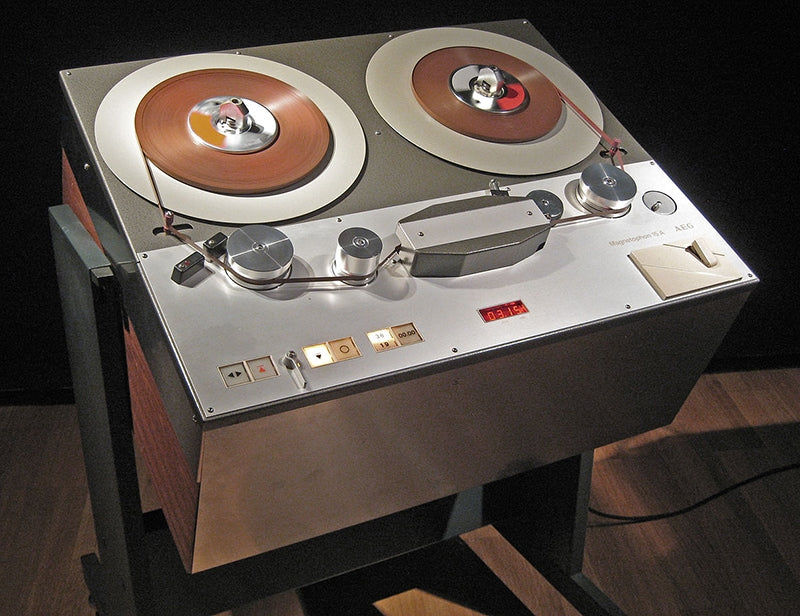
Telefunken M15A. From The Recorderman website. Telefunken M15A. From The Recorderman website.

What looks like a speed selector button is only an indicator lamp. The speed selector switch is hidden under the hinged splicing block (which in itself leaves a lot to be desired; I always use an external aluminum splicing block for critical editing work) along with the power switch and a local/remote switch, which locks out the remote control so that it cannot be used, I guess for that occasion when someone has had too much schnapps for their own good, and you need to make it to the end of the session without offending them by taking the remote control out of their hands and without any obvious hints on how it could be made to work again. (“Ah, don’t worry about it Fritz, it probably broke, we’ll fix it some other time.”) The meter for keeping track of hours is also under the splicing block, to ensure you will not forget the routine maintenance as soon as the number of hours for the required maintenance interval are clocked. Near the splicing block, on the top panel of the machine, there is also a round edit switch, and this is about all there is to it, together with the counter (displaying tape time in HH:MM:SS) and a counter reset button.

No bells and whistles, nothing other than the essentials for operating a tape machine. This is not to say that you couldn’t have bells and whistles on your Telefunken; just that they were not built into the basic model. Instead, the company offered a huge selection of extras, optional accessories that came as modules, to be installed in a variety of cabinets, all compatible with German industrial standards (DIN-specification racks, instead of the standard 19-inch racks used in studios and broadcasting facilities in the entire rest of the world). You could get a VU meter bridge, a remote control with separate Fast Forward and Rewind buttons, a fully featured autolocator with location memories, a varispeed module offering a +/- 50% variation in speed by means of a fader, various editing gadgets, an impressive selection of timecode-related modules which were popular in broadcasting, and even a little shelf to place your notes on.

Once you had selected a variety of these accessories along with one of the industrial-styled trolleys for the transport, you then had to run this by your structural engineer to ensure that the floor wouldn’t collapse under the weight. Just as an indication, the 32-track machine without any of the optional extras weighed a bit over 550 lbs. after the shipping pallet and rest of the packaging had been removed. Unsurprisingly, these machines were rugged and reliable workhorses, intended for 24/7 operation in professional environments. They needed very little maintenance; they did not drift out of adjustment even after prolonged heavy use, and they just lasted forever.

M15A with optional shelf. From an original Telefunken M15A product brochure.

The M15A is by far one of the best sounding tape machines of all time and at the same time, one of the most indestructible. As such, it is by far my all-time-favorite tape deck. I own two of them, modified to identical specs and currently wearing a set of special butterfly heads that far exceed the performance of the Telefunken originals. The heads were manufactured by Studer in Switzerland, back when they were still making heads, but they are not meant to fit any Studer machine. These were made specifically as high-performance aftermarket heads for the Telefunken M15A, with electrical specs to match the Telefunken electronics.

I use them both for recording straight to stereo and also for disk mastering from tape, entirely in the analog domain. Having had the pleasure of working with many of the world’s finest tape machines over the years, the M15A was love at first sight. I actually hadn’t even heard of it, several years into my career, as everyone was talking about the Studers, Ampex, MCI and other common brands. Telefunkens were never widely adopted by recording studios and are almost unheard of outside the German-speaking world. Up until one day – a friend found one in very poor condition and I had a chance to look at the very detailed documentation and sales literature. I was astonished by the design, minimalistic yet highly effective in achieving utmost performance without needing to be babied. Since then, I have been converted, and bought two of these as soon as I could find them (in international configuration of course).

While the Telefunken M15A was a standard item of equipment in German broadcasting stations and also encountered in German recording and mastering facilities, they were hugely unsuccessful in the international market. Even within Europe, both in recording/mastering studios and broadcasting, the M15A never really caught on.

In the USA these machines are extremely rare and even many experienced audio professionals have never seen or heard of them. Parts are scarce, and you can pretty much forget about Telefunken supporting them nowadays. The German-configuration machines are now cheap and plentiful in Germany as nobody really wants them, but for the same reason, they are usually incomplete, abused, or improperly stored, and would require quite a bit of work to get them going again. International-configuration machines in working condition usually sell for anywhere between USD $4,000 and $12,000, depending on configuration.

Once you get one to run well, it will most probably far outlive you with very minimal care, and reward you with a level of sound quality you would be hard-pressed to find elsewhere. There are no offerings on the market for vacuum tube electronics specifically intended to work with the M15A, but this is something I have been thinking about for a while now. As soon as time permits… However, if you would prefer not to mess with conversions and external electronics, the stock electronics are truly excellent.

In the next episode, we will look at a rare Telefunken M15A preview head machine in active professional service, located at one of the few disk mastering facilities left in the world that can cut records from the tape entirely in the analog domain.

Header image: from an original Telefunken M15A product brochure.

More from Issue 142

View All Articles in Issue 142

Search Copper Magazine

#225 Capital Audiofest 2025: Must-See Stereo, Part One by Frank Doris Dec 01, 2025 #225 Otis Taylor and the Electrics Delivers a Powerful Set of Hypnotic Modern Blues by Frank Doris Dec 01, 2025 #225 A Christmas Miracle by B. Jan Montana Dec 01, 2025 #225 T.H.E. Show New York 2025, Part Two: Plenty to See, Hear, and Enjoy by Frank Doris Dec 01, 2025 #225 Underappreciated Artists, Part One: Martin Briley by Rich Isaacs Dec 01, 2025 #225 Rock and Roll is Here to Stay by Wayne Robins Dec 01, 2025 #225 A Lifetime of Holiday Record (and CD) Listening by Rudy Radelic Dec 01, 2025 #225 Little Feat: Not Saying Goodbye, Not Yet by Ray Chelstowski Dec 01, 2025 #225 How to Play in a Rock Band, Part 18: Dealing With Burnout by Frank Doris Dec 01, 2025 #225 The People Who Make Audio Happen: CanJam SoCal 2025 by Harris Fogel Dec 01, 2025 #225 Chicago’s Sonic Sanctuaries: Four Hi‑Fi Listening Bars Channeling the Jazz‑Kissa Spirit by Olivier Meunier-Plante Dec 01, 2025 #225 From The Audiophile’s Guide: Controlling Bass Frequencies Through Membrane Absorbers (and How to Build Your Own) by Paul McGowan Dec 01, 2025 #225 Your Editor’s Tips for Attending Audio Shows by Frank Doris Dec 01, 2025 #225 PS Audio in the News by Frank Doris Dec 01, 2025 #225 Back to My Reel-to-Reel Roots, Part 24 by Ken Kessler Dec 01, 2025 #225 Holiday Music by Frank Doris Dec 01, 2025 #225 Puppy Prognostication by Peter Xeni Dec 01, 2025 #225 How to Post Comments on Copper by Frank Doris Dec 01, 2025 #225 Living Color by Rudy Radelic Dec 01, 2025 #224 T.H.E. Show New York 2025, Part One: A New Beginning by Frank Doris Nov 03, 2025 #224 Fool’s Leap of Faith is the Extraordinary Octave Records Debut from Singer/Songwriter Tyler Burba and Visit by Frank Doris Nov 03, 2025 #224 The Beatles’ “Aeolian Cadences.” What? by Wayne Robins Nov 03, 2025 #224 Persona Non Grata by B. Jan Montana Nov 03, 2025 #224 Talking With Recording Engineer Barry Diament of Soundkeeper Recordings, Part Two by Frank Doris Nov 03, 2025 #224 B Sides, B Movies, and Beware of Zombies by Rudy Radelic Nov 03, 2025 #224 The Burn-In Chronicles: 1,000 Hours to Sonic Salvation by Olivier Meunier-Plante Nov 03, 2025 #224 A Conversation With Mat Weisfeld of VPI Industries by Joe Caplan Nov 03, 2025 #224 Blues-Rocker Kenny Wayne Shepherd Celebrates 30 Years of Ledbetter Heights by Ray Chelstowski Nov 03, 2025 #224 Playing in a Rock Band, 17: When Good Gigs Go Bad, Part Two by Frank Doris Nov 03, 2025 #224 From The Audiophile’s Guide: Dealing with Odd-Shaped Rooms by Paul McGowan Nov 03, 2025 #224 TEAC’s TN-3B-SE Turntable Plays Bob Dylan by Howard Kneller Nov 03, 2025 #224 PS Audio in the News by Frank Doris Nov 03, 2025 #224 Lost in Translation by Peter Xeni Nov 03, 2025 #224 Reel-to-Reel Roots, Part 23: Better Than Rice Krispies by Ken Kessler Nov 03, 2025 #224 I Bring Joy! by Frank Doris Nov 03, 2025 #224 Screen Test by Rich Isaacs Nov 03, 2025 #224 How to Post Comments on Copper by Frank Doris Nov 03, 2025 #132 Dr. Patrick Gleeson: The Interview, Part Two by Rich Isaacs Oct 07, 2025 #223 World Fusion Meets Flamenco in Gratitude from Steve Mullins and Rim of the Well by Frank Doris Oct 06, 2025 #223 Judging Albums by Their Covers by Rich Isaacs Oct 06, 2025 #223 Recent Arrivals and 12-inch Royalty by Rudy Radelic Oct 06, 2025 #223 Summer of Creem, Part Two by Wayne Robins Oct 06, 2025 #223 Recording Engineer Barry Diament of Soundkeeper Recordings: Striving for Natural Sound by Frank Doris Oct 06, 2025 #223 Tea on the Terrace by B. Jan Montana Oct 06, 2025 #223 How Good Can Car Audio Get? by Joe Caplan Oct 06, 2025 #223 The Advantages of a Dedicated Listening Room by Paul McGowan Oct 06, 2025 #223 1! 2! 3! 4! Surrounded by the Ramones in Dolby Atmos! by Frank Doris Oct 06, 2025

The Giants of Tape, Part Nine: The Telefunken M15A, Part Three

The Giants of Tape, Part Nine: The Telefunken M15A, Part Three
Part One and Part Two of J.I. Agnew’s look at the Telefunken M15A tape machine ran in Issue 140 and Issue 141. The series continues here.

The Telefunken M15A could be purchased as a bare chassis with no cabinet or trolley. In this configuration, the 1/4-inch stereo machines, being the lightest-weight offerings, weighed around 150 lbs. I am still unsure if this was intended as some kind of joke, but the Telefunken brochures advertised a huge suitcase with a single carrying handle on top, in which the M15A chassis could be bolted, to make a “portable” tape recording deck. The suitcase was as heavily built as the M15A itself, and must have weighed at least 100 lbs. empty, so the combination would have been 250 lbs., to be carried by a single carrying handle. Not sure what kind of people worked in the broadcasting sector or as news reporters in Germany in the 1970s, but if this was really intended as a competitor to the Uher and Nagra portable tape recorders, it probably missed the target for weight and size by an astoundingly enormous margin. Even if people of the required build could be found among the elite ranks of the special forces of German Broadcasting who would be able to lift this thing, it certainly wouldn’t fit in their 1970s Volkswagen.

Not only was the M15A large and heavy even as a bare chassis, it also came with nothing but the absolute minimum of features and functions. It was minimalism at its finest, with a distinct Bauhaus aesthetic which almost begs for it to be used as a coffee table, or perhaps with a pillow on top as an ottoman. The basic machine comes with a Play, Stop and Wind button. Yes, a single wind button; no separate Fast Forward and Rewind buttons, but one button for both. There is a lever next to the button to control the winding direction and speed. It is rather unusual, but once you get used to this, it is extremely handy. In fact, it is a feature I miss every time I work on a different machine. You can set up a very slow wind in either direction and leave it there to slowly get to the end of a particularly fragile reel of tape, or you can put the lever in the middle to stop the tape while remaining in wind mode, which allows you to slowly jog the tape forwards and backwards, to locate a splice or any other feature of interest.

Telefunken M15A. From The Recorderman website. Telefunken M15A. From The Recorderman website.

What looks like a speed selector button is only an indicator lamp. The speed selector switch is hidden under the hinged splicing block (which in itself leaves a lot to be desired; I always use an external aluminum splicing block for critical editing work) along with the power switch and a local/remote switch, which locks out the remote control so that it cannot be used, I guess for that occasion when someone has had too much schnapps for their own good, and you need to make it to the end of the session without offending them by taking the remote control out of their hands and without any obvious hints on how it could be made to work again. (“Ah, don’t worry about it Fritz, it probably broke, we’ll fix it some other time.”) The meter for keeping track of hours is also under the splicing block, to ensure you will not forget the routine maintenance as soon as the number of hours for the required maintenance interval are clocked. Near the splicing block, on the top panel of the machine, there is also a round edit switch, and this is about all there is to it, together with the counter (displaying tape time in HH:MM:SS) and a counter reset button.

No bells and whistles, nothing other than the essentials for operating a tape machine. This is not to say that you couldn’t have bells and whistles on your Telefunken; just that they were not built into the basic model. Instead, the company offered a huge selection of extras, optional accessories that came as modules, to be installed in a variety of cabinets, all compatible with German industrial standards (DIN-specification racks, instead of the standard 19-inch racks used in studios and broadcasting facilities in the entire rest of the world). You could get a VU meter bridge, a remote control with separate Fast Forward and Rewind buttons, a fully featured autolocator with location memories, a varispeed module offering a +/- 50% variation in speed by means of a fader, various editing gadgets, an impressive selection of timecode-related modules which were popular in broadcasting, and even a little shelf to place your notes on.

Once you had selected a variety of these accessories along with one of the industrial-styled trolleys for the transport, you then had to run this by your structural engineer to ensure that the floor wouldn’t collapse under the weight. Just as an indication, the 32-track machine without any of the optional extras weighed a bit over 550 lbs. after the shipping pallet and rest of the packaging had been removed. Unsurprisingly, these machines were rugged and reliable workhorses, intended for 24/7 operation in professional environments. They needed very little maintenance; they did not drift out of adjustment even after prolonged heavy use, and they just lasted forever.

M15A with optional shelf. From an original Telefunken M15A product brochure.

The M15A is by far one of the best sounding tape machines of all time and at the same time, one of the most indestructible. As such, it is by far my all-time-favorite tape deck. I own two of them, modified to identical specs and currently wearing a set of special butterfly heads that far exceed the performance of the Telefunken originals. The heads were manufactured by Studer in Switzerland, back when they were still making heads, but they are not meant to fit any Studer machine. These were made specifically as high-performance aftermarket heads for the Telefunken M15A, with electrical specs to match the Telefunken electronics.

I use them both for recording straight to stereo and also for disk mastering from tape, entirely in the analog domain. Having had the pleasure of working with many of the world’s finest tape machines over the years, the M15A was love at first sight. I actually hadn’t even heard of it, several years into my career, as everyone was talking about the Studers, Ampex, MCI and other common brands. Telefunkens were never widely adopted by recording studios and are almost unheard of outside the German-speaking world. Up until one day – a friend found one in very poor condition and I had a chance to look at the very detailed documentation and sales literature. I was astonished by the design, minimalistic yet highly effective in achieving utmost performance without needing to be babied. Since then, I have been converted, and bought two of these as soon as I could find them (in international configuration of course).

While the Telefunken M15A was a standard item of equipment in German broadcasting stations and also encountered in German recording and mastering facilities, they were hugely unsuccessful in the international market. Even within Europe, both in recording/mastering studios and broadcasting, the M15A never really caught on.

In the USA these machines are extremely rare and even many experienced audio professionals have never seen or heard of them. Parts are scarce, and you can pretty much forget about Telefunken supporting them nowadays. The German-configuration machines are now cheap and plentiful in Germany as nobody really wants them, but for the same reason, they are usually incomplete, abused, or improperly stored, and would require quite a bit of work to get them going again. International-configuration machines in working condition usually sell for anywhere between USD $4,000 and $12,000, depending on configuration.

Once you get one to run well, it will most probably far outlive you with very minimal care, and reward you with a level of sound quality you would be hard-pressed to find elsewhere. There are no offerings on the market for vacuum tube electronics specifically intended to work with the M15A, but this is something I have been thinking about for a while now. As soon as time permits… However, if you would prefer not to mess with conversions and external electronics, the stock electronics are truly excellent.

In the next episode, we will look at a rare Telefunken M15A preview head machine in active professional service, located at one of the few disk mastering facilities left in the world that can cut records from the tape entirely in the analog domain.

Header image: from an original Telefunken M15A product brochure.

0 comments

Leave a comment

0 Comments

Your avatar

Loading comments...

🗑️ Delete Comment

Enter moderator password to delete this comment: