COPPER

A PS Audio Publication

Issue 155 • Free Online Magazine

Issue 155 Featured

The Blues Project: Projections

The Blues Project: Projections

It was my 13th birthday when my mother inquired if I had a preference for a birthday gift. I graciously asked for an album or two, as I was in the early throes of a lifelong addiction to music. I figured the Beatles and Stones would be in the mix, as both were charting regularly in the mid-1960s. My mother said she’d inquire at the local record shop for suggestions. It sounded like a good plan.

When she returned home with The Blues Project’s second album, Projections (1966), I was a bit miffed by her purchase. “I don’t know these guys,” I said, slightly hiding my disappointment. “The guy at Record World just raved about them,” mother replied.

It was an early life moment where, upon reflection, mom’s cool quotient was off the charts, and I was totally clueless. Nobody in my inner circle knew of the Blues Project, and I can honestly say I didn’t particularly care for their sound when the needle dropped on the LP. My adolescent and unsophisticated musical taste had a pop orientation, rather than the eclectic range of blues, rock, folk, R&B and jazz so well represented in the Projections LP. However, in the intervening years, with the benefit of age and wisdom, my appreciation for this album and this band has grown considerably.

So, who are The Blues Project? The lineup on Projections consisted of Danny Kalb (guitar, vocals), Steve Katz (guitar, vocals), Roy Blumenfeld (drums), Andy Kulberg (bass, flute) and Al Kooper (keyboards, vocals). A few of those guys may need an introduction, but certainly not Al Kooper, arguably the most underrated singer, songwriter, producer in modern-music history…and that’s no hyperbole!

The Blues Project were signed in 1965 to the Verve Folkways label, a subsidiary of MGM Records. Early artists signed to the label included such folk luminaries as Richie Havens, Janis Ian, Tim Hardin, Laura Nyro and Dave Van Ronk.
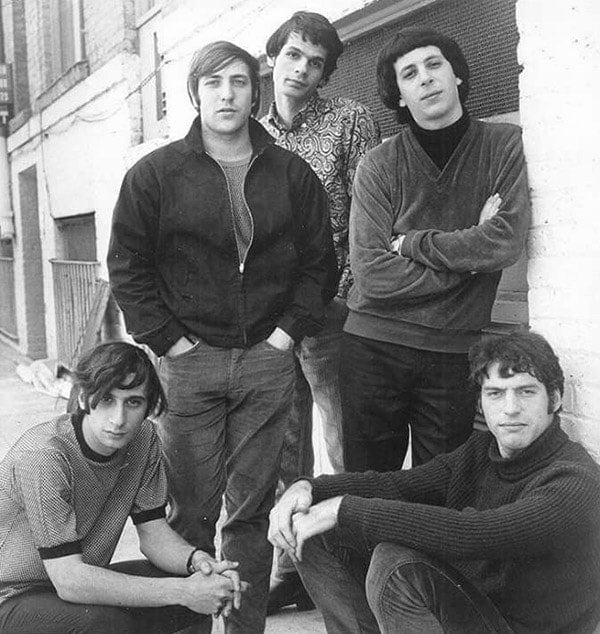
The Blues Project. The Blues Project.

The group were fixtures in the Greenwich Village music scene, and they had a particularly strong following on college campuses. Known for their live performances, the band’s first album release was a live recording captured at the famed New York City club Cafe Au Go Go, a venue the band played quite frequently.

A founding member and leading force of the band was Danny Kalb, a well-known session guitarist and protégé of Dave Van Ronk. Kalb had recorded with the likes of Pete Seeger, Judy Collins, Phil Ochs and Bob Dylan. In 1961 Kalb and Dylan performed a live concert broadcast on WBAI-FM, an NYC radio station that played a prominent role in the era’s counterculture movement.

Projections features a roughly 11-minute Kalb arrangement of Muddy Waters’ “Two Trains Running.” Kalb positively revered Waters, and the song was a staple of the band’s live performances. In 1965, Waters appeared on the same bill as The Blues Project at the Cafe Au Go Go. Kalb nervously asked Waters what he thought of their cover. Waters replied, “You really got to me.” Reflecting on that brief encounter, Kalb has said, somewhat in jest, “If I had dropped dead at that moment, my life would have been well spent.”

Projections also features the Chuck Berry track “You Can’t Catch Me.” Berry also had a big influence on Kalb and Kooper, as he did with so many artists of that era. The Blues Project once again had the good fortune of performing live with one its heroes at NYC’s Town Hall. Chuck Berry rarely traveled with his own band, so it often fell to a local promoter to assemble musicians to back up his set. For the Town Hall concert, that honor fell to The Blues Project. Said Kooper, “It was one of our first big gigs. We opened for him (Berry) and then we backed him. It was nerve-wracking because he was very difficult to work with. Fortunately I knew all of his songs so he didn’t give me any sh*t. He was very, very tough, the rehearsal was pretty scary.”

“Wake Me Shake Me “ is a gospel song originally recorded by The Golden Chords. Kooper, an admirer of gospel music, had heard the group perform the song live and loved it, but realized a Blues Project rendition would require a significantly different arrangement. “The song worked out very well because the band really got into it,” said Kooper. “It gave us a lot of room to improvise live. So it became our closer.”

“I Can’t Keep From Crying” is another gospel track originally recorded by Blind Willie Johnson in 1928. The song is perhaps best known by both the live and studio versions recorded by Alvin Lee and Ten Years After.

“Flute Thing” is a jazz-influenced instrumental featuring flautist Andy Kulberg, while “Steve’s Song” has folk roots and features Steve Katz on vocals. The song was intended to be called “September Fifth,” but for a bit of miscommunication between the band’s record label and management. “We were on the road a lot,” reminisced Katz, “and there were no cell phones in those days. Our record label (Verve Folkways) called our manager, who is like a total idiot, and said, ‘we have the artwork and the master tapes, but we’re missing the name of the second song on the first side.’ So our manager says, ‘Second song, first side? Second song, first side? Oh, that’s Steve’s song.’ We get off the road a week later and I’m reviewing (album cover) proofs and I cry out, what the hell is ‘Steve’s Song”?


Reflecting further on the song’s recording, Katz added, “I tried to do my vocal over again, and producer Tom Wilson said there wasn’t enough time because Eric Burdon (the Animals) was coming in. We were restricted by three-hour sessions, and that was pretty much it.” As a new and relatively unproven artist, the band wasn’t afforded a lot of leeway or consideration in production.

The liner notes to Projections were penned by the late promoter Sid Bernstein (the Beatles, the Rolling Stones, Herman’s Hermits). At the time, Bernstein had two artists under personal management contracts, The Young Rascals and The Blues Project. Under Bernstein’s tutelage, the band had hoped to achieve greater commercial success. In the Dec 17, 1966 issue of Billboard magazine, Bernstein outlined a development plan for The Blues Project that included “taking voice lessons to improve their technique – because 90 percent of their dates are college performances – and their staging.”

A prerequisite for a band’s success in the 1960s was a hit single (or 45), and the Projections LP sorely lacked one. The label released “I Can’t Keep From Crying” as a 45 but it didn’t receive very much airplay. The band’s only charting single was a trippy, psychedelic track called “No Time Like The Right Time” released in 1967. The song, written by Kooper, entered the Billboard Hot 100 chart and quickly petered out at 96. A few other Blues Project single releases also performed poorly. They just weren’t a singles band. Their style of music was better suited to live performance and AOR (album oriented rock) radio, which was just gaining traction as a radio format.


The band’s relationship with their record label (Verve Folkways) was never particularly healthy, nor did the label seemingly know how to market or promote the band. How bad was it? Well, the group didn’t hear the final mix or see the final cover art on Projections until the album was literally in the stores.

Their record label also excluded the names of individual band members from the album jacket, while album producer Tom Wilson’s credit is prominently displayed in exceedingly large type. The late Wilson was a highly accomplished producer (Bob Dylan, the Velvet Underground, Simon and Garfunkel), but hardly a household name with the listening public. The rather over the top liner credit was likely to assuage Wilson, an important producer for the Verve Folkways label.

The Band’s third album, The Blues Project Live At Town Hall (1967) inexplicably included only one song recorded live at Town Hall. Most of the songs were live recordings from other venues, or studio outtakes with overdubbed applause to give the appearance of a live recording. It’s not exactly in the Milli Vanilli scandal zone, but a head-scratcher nonetheless.

Al Kooper and Steve Katz went on to form Blood, Sweat & Tears. Kooper left BS&T after six months, but not before leaving a large imprint with the band’s debut LP, Child Is A Father To The Man (1968). Two Kooper-penned tracks from the album are the classics: “I Love You More Than You’ll Ever Know” and “I Can’t Quit Her.”

Over an astoundingly rich career, Kooper has recorded with Jimi Hendrix, B.B. King, The Who, Cream, Alice Cooper, George Harrison, and the Rolling Stones. Most ardent music fans are aware that Kooper serendipitously created one of the most memorable organ riffs ever heard on a Hammond B3 on Dylan’s “Like A Rolling Stone.” Many fans, however, are likely unaware that the French horn intro to the Stones’ “You Can’t Always Get What You Want” is also Kooper.  Mick and Keith had invited Kooper to London to play on the Let It Bleed sessions.

While in London, Kooper suggested the Stones add a French horn intro to the song. Mick and Keith said they’d think about it. It didn’t take very long for the boys to relent, and Kooper subsequently recorded the French horn intro in a New York City studio.

Other highly regarded Kooper projects include the classic Al Kooper, Mike Bloomfield, Stephen Stills Super Session LP (1968), and his first solo album, I Stand Alone (1969). Kooper is also credited with discovering Lynyrd Skynyrd and producing the band’s first three albums, including the hit songs “Sweet Home Alabama,” “Saturday Night Special” and “Free Bird.” For a truly great read with fabulous stories, check out Kooper’s arguably best-ever-titled memoir, Backstage Passes & Backstabbing Bastards: Memoirs of a Rock ‘n’ Roll Survivor.”

Guitarist Steve Katz remained with BS&T’s for five years, including during the band’s heyday with lead vocalist David Clayton-Thomas. Katz went on to produce two Lou Reed albums, Sally Can’t Dance (1974) and Rock ‘n’ Roll Animal (1974). He later would form the band American Flyer, and then subsequently became an executive with Mercury Records.

The Blues Project’s Andy Kulberg and Roy Blumenfeld went on to form Seatrain, another great band, perhaps best known for their George Martin-produced LP The Marblehead Messenger (1971).


One of The Blues Project’s last performances in the 1960s was at the legendary Monterey International Pop Festival, which featured Otis Redding, Jimi Hendrix and The Byrds, among others. In 1973, The Blues Project briefly reunited and performed at the Schaefer Music Festival in NYC’s Central Park. That performance culminated with a live double album release, The Original Blues Project, Reunion In Central Park (1973). The band sporadically performed in the 1980s and 1990s with various members, and as recently as 2021 original members Katz and Blumenfeld did a few club dates.

The Blues Project never received the acclaim some members believe they deserved. Reflecting on the band’s legacy, Danny Kalb has said, “I think that the way the band has been either forgotten or dissed is disgraceful. We were one of the most exciting bands in the period. We really took big chances, both spiritually and musically.”

The Blues Project were like a fine wine uncorked without proper aging. The band’s live performances were so highly regarded – with almost cult-like appeal for many – perhaps with time and better management the band could have become a notable jam band, in the spirit of the Grateful Dead, the Allman Brothers, or Phish.

Yep, successful musical outcomes are often the result of bands having strong skills, good timing, and a heck of a lot of luck.

More from Issue 155

View All Articles in Issue 155

Search Copper Magazine

#234 A Life in High-End Audio: The Roy Hall Interview, Part One by Frank Doris Sep 07, 2026 #234 Jason Greenlaw Offers His Personal Perspective on Jazz Guitar in Vantage Point by Frank Doris Sep 07, 2026 #234 Transcendent Phoenix: Lucina Yue Brings the Ancient Konghou Into Modern Times by Frank Doris Sep 07, 2026 #234 We Must All Follow Our Bliss by B. Jan Montana Sep 07, 2026 #234 How to Play in a Rock Band, 27: Leveling Up by Frank Doris Sep 07, 2026 #234 Ross Valory: Traveling Into New Musical Territory With All of the Above by Ray Chelstowski Sep 07, 2026 #234 Singer/Songwriter John David Schrader: On the Need to Create by Joe Caplan Sep 07, 2026 #234 The People Who Make Audio Happen: More From T.H.E. Show SoCal 2026 by Harris Fogel Sep 07, 2026 #234 The Vinyl Beat Digs Into the Gadget Box by Rudy Radelic Sep 07, 2026 #234 The Rolling Stones: Foreign Tongues Spoken Loud by Wayne Robins Sep 07, 2026 #234 Musical Moments by Rich Isaacs Sep 07, 2026 #234 Rags for Solo Piano and a Dog: David Chesky's Ragtime Music for the Modern Age by Frankly Speaking Sep 07, 2026 #234 HIGH END 2026, Vienna: Here to Stay by Carsten Barnbeck Sep 07, 2026 #234 From The Audiophile’s Guide: The Two Main Types of Loudpeakers – Box and Panel by Paul McGowan Sep 07, 2026 #234 Letting it Slide by Frank Doris Sep 07, 2026 #234 PS Audio in the News by PS Audio Staff Sep 07, 2026 #234 Long Playing by Peter Xeni Sep 07, 2026 #234 La Mer by B. Jan Montana Sep 07, 2026 #233 A Report From The Total Hi-Fi Experience Show SoCal 2026 by B. Jan Montana Aug 03, 2026 #233 Bluegrass Meets Country, Folk, Jazz and More in All That We Carried by The Squid City Slingers by Frank Doris Aug 03, 2026 #233 Corey Glover and One Tribe Nation: A Variegated Musical Collective by Ray Chelstowski Aug 03, 2026 #233 Excursions with Clive: The Late Clive Davis, A Personal History by Wayne Robins Aug 03, 2026 #233 AI, Art, and Music: A Conversation With Synthography Art by Joe Caplan Aug 03, 2026 #233 New American Symphonies: A Rediscovered Gem and a Vital Contemporary Work by Frank Doris Aug 03, 2026 #233 The Vinyl Beat: Genesis, the Dave Clark Five, Antonio Carlos Jobim and More by Rudy Radelic Aug 03, 2026 #233 How to Play in a Rock Band, 26: When It's Time to Record Your Music by Frank Doris Aug 03, 2026 #233 More From T.H.E. Show 2026, and the People Who Made it Happen by Harris Fogel Aug 03, 2026 #233 Underappreciated Artists, Part Three: Icehouse by Rich Isaacs Aug 03, 2026 #233 The Surprisingly Rich and Varied Music of Somalia by Steve Kindig Aug 03, 2026 #233 A Remarkable Discographic Legacy: The LP Recordings of the Basel Symphony Orchestra by Stephan Haberthür Aug 03, 2026 #233 From The Audiophile’s Guide: The Importance of Loudspeakers by Paul McGowan Aug 03, 2026 #233 From Swimming Pool to New Listening Room: A Conversation with Norman Varney of AV RoomService by Gilles Laferrière Aug 03, 2026 #233 PS Audio in the News by PS Audio Staff Aug 03, 2026 #233 Audio Jewelry by Peter Xeni Aug 03, 2026 #233 Enrich Your Life by Frank Doris Aug 03, 2026 #233 The Searcher by James Schrimpf Aug 03, 2026 #232 What came first: Art or Music? A Conversation With Artist Jose Acosta by Joe Caplan Jul 06, 2026 #232 Blow By Blow: The Jeff Beck Story: An Insightful Book About a Guitar Icon by Ray Chelstowski Jul 06, 2026 #232 Creed Over Camaraderie? by B. Jan Montana Jul 06, 2026 #232 Chronicles of a Sound Pilgrim at the 2026 Montreal Audiofest by Hugues Morin Jul 06, 2026 #232 The Vinyl Beat: Summer Grooves by Rudy Radelic Jul 06, 2026 #232 Hibbing Hillbilly Dylan's Acoustic Rock by Wayne Robins Jul 06, 2026 #232 Quad Quads and Plasmatronics Tweeters: An Extraordinary System Comes to Life by Frank Doris Jul 06, 2026 #232 In Praise of Live Music, Once Again by Ted Shafran Jul 06, 2026 #232 Allnic Audio’s L-9000 Preamplifier: Design and Engineering Innovation by Howard Kneller Jul 06, 2026 #232 “Best Of” Lists and Rage Bait: Enough Already by Frank Doris Jul 06, 2026 #232 Quick Takes: Bud Shank, Paulo Almeida, Jakob Dreyer, Tim Eriksen and Peter Irvine by Frank Doris Jul 06, 2026

The Blues Project: Projections

The Blues Project: Projections

It was my 13th birthday when my mother inquired if I had a preference for a birthday gift. I graciously asked for an album or two, as I was in the early throes of a lifelong addiction to music. I figured the Beatles and Stones would be in the mix, as both were charting regularly in the mid-1960s. My mother said she’d inquire at the local record shop for suggestions. It sounded like a good plan.

When she returned home with The Blues Project’s second album, Projections (1966), I was a bit miffed by her purchase. “I don’t know these guys,” I said, slightly hiding my disappointment. “The guy at Record World just raved about them,” mother replied.

It was an early life moment where, upon reflection, mom’s cool quotient was off the charts, and I was totally clueless. Nobody in my inner circle knew of the Blues Project, and I can honestly say I didn’t particularly care for their sound when the needle dropped on the LP. My adolescent and unsophisticated musical taste had a pop orientation, rather than the eclectic range of blues, rock, folk, R&B and jazz so well represented in the Projections LP. However, in the intervening years, with the benefit of age and wisdom, my appreciation for this album and this band has grown considerably.

So, who are The Blues Project? The lineup on Projections consisted of Danny Kalb (guitar, vocals), Steve Katz (guitar, vocals), Roy Blumenfeld (drums), Andy Kulberg (bass, flute) and Al Kooper (keyboards, vocals). A few of those guys may need an introduction, but certainly not Al Kooper, arguably the most underrated singer, songwriter, producer in modern-music history…and that’s no hyperbole!

The Blues Project were signed in 1965 to the Verve Folkways label, a subsidiary of MGM Records. Early artists signed to the label included such folk luminaries as Richie Havens, Janis Ian, Tim Hardin, Laura Nyro and Dave Van Ronk.

The Blues Project. The Blues Project.

The group were fixtures in the Greenwich Village music scene, and they had a particularly strong following on college campuses. Known for their live performances, the band’s first album release was a live recording captured at the famed New York City club Cafe Au Go Go, a venue the band played quite frequently.

A founding member and leading force of the band was Danny Kalb, a well-known session guitarist and protégé of Dave Van Ronk. Kalb had recorded with the likes of Pete Seeger, Judy Collins, Phil Ochs and Bob Dylan. In 1961 Kalb and Dylan performed a live concert broadcast on WBAI-FM, an NYC radio station that played a prominent role in the era’s counterculture movement.

Projections features a roughly 11-minute Kalb arrangement of Muddy Waters’ “Two Trains Running.” Kalb positively revered Waters, and the song was a staple of the band’s live performances. In 1965, Waters appeared on the same bill as The Blues Project at the Cafe Au Go Go. Kalb nervously asked Waters what he thought of their cover. Waters replied, “You really got to me.” Reflecting on that brief encounter, Kalb has said, somewhat in jest, “If I had dropped dead at that moment, my life would have been well spent.”

Projections also features the Chuck Berry track “You Can’t Catch Me.” Berry also had a big influence on Kalb and Kooper, as he did with so many artists of that era. The Blues Project once again had the good fortune of performing live with one its heroes at NYC’s Town Hall. Chuck Berry rarely traveled with his own band, so it often fell to a local promoter to assemble musicians to back up his set. For the Town Hall concert, that honor fell to The Blues Project. Said Kooper, “It was one of our first big gigs. We opened for him (Berry) and then we backed him. It was nerve-wracking because he was very difficult to work with. Fortunately I knew all of his songs so he didn’t give me any sh*t. He was very, very tough, the rehearsal was pretty scary.”

“Wake Me Shake Me “ is a gospel song originally recorded by The Golden Chords. Kooper, an admirer of gospel music, had heard the group perform the song live and loved it, but realized a Blues Project rendition would require a significantly different arrangement. “The song worked out very well because the band really got into it,” said Kooper. “It gave us a lot of room to improvise live. So it became our closer.”

“I Can’t Keep From Crying” is another gospel track originally recorded by Blind Willie Johnson in 1928. The song is perhaps best known by both the live and studio versions recorded by Alvin Lee and Ten Years After.

“Flute Thing” is a jazz-influenced instrumental featuring flautist Andy Kulberg, while “Steve’s Song” has folk roots and features Steve Katz on vocals. The song was intended to be called “September Fifth,” but for a bit of miscommunication between the band’s record label and management. “We were on the road a lot,” reminisced Katz, “and there were no cell phones in those days. Our record label (Verve Folkways) called our manager, who is like a total idiot, and said, ‘we have the artwork and the master tapes, but we’re missing the name of the second song on the first side.’ So our manager says, ‘Second song, first side? Second song, first side? Oh, that’s Steve’s song.’ We get off the road a week later and I’m reviewing (album cover) proofs and I cry out, what the hell is ‘Steve’s Song”?


Reflecting further on the song’s recording, Katz added, “I tried to do my vocal over again, and producer Tom Wilson said there wasn’t enough time because Eric Burdon (the Animals) was coming in. We were restricted by three-hour sessions, and that was pretty much it.” As a new and relatively unproven artist, the band wasn’t afforded a lot of leeway or consideration in production.

The liner notes to Projections were penned by the late promoter Sid Bernstein (the Beatles, the Rolling Stones, Herman’s Hermits). At the time, Bernstein had two artists under personal management contracts, The Young Rascals and The Blues Project. Under Bernstein’s tutelage, the band had hoped to achieve greater commercial success. In the Dec 17, 1966 issue of Billboard magazine, Bernstein outlined a development plan for The Blues Project that included “taking voice lessons to improve their technique – because 90 percent of their dates are college performances – and their staging.”

A prerequisite for a band’s success in the 1960s was a hit single (or 45), and the Projections LP sorely lacked one. The label released “I Can’t Keep From Crying” as a 45 but it didn’t receive very much airplay. The band’s only charting single was a trippy, psychedelic track called “No Time Like The Right Time” released in 1967. The song, written by Kooper, entered the Billboard Hot 100 chart and quickly petered out at 96. A few other Blues Project single releases also performed poorly. They just weren’t a singles band. Their style of music was better suited to live performance and AOR (album oriented rock) radio, which was just gaining traction as a radio format.


The band’s relationship with their record label (Verve Folkways) was never particularly healthy, nor did the label seemingly know how to market or promote the band. How bad was it? Well, the group didn’t hear the final mix or see the final cover art on Projections until the album was literally in the stores.

Their record label also excluded the names of individual band members from the album jacket, while album producer Tom Wilson’s credit is prominently displayed in exceedingly large type. The late Wilson was a highly accomplished producer (Bob Dylan, the Velvet Underground, Simon and Garfunkel), but hardly a household name with the listening public. The rather over the top liner credit was likely to assuage Wilson, an important producer for the Verve Folkways label.

The Band’s third album, The Blues Project Live At Town Hall (1967) inexplicably included only one song recorded live at Town Hall. Most of the songs were live recordings from other venues, or studio outtakes with overdubbed applause to give the appearance of a live recording. It’s not exactly in the Milli Vanilli scandal zone, but a head-scratcher nonetheless.

Al Kooper and Steve Katz went on to form Blood, Sweat & Tears. Kooper left BS&T after six months, but not before leaving a large imprint with the band’s debut LP, Child Is A Father To The Man (1968). Two Kooper-penned tracks from the album are the classics: “I Love You More Than You’ll Ever Know” and “I Can’t Quit Her.”

Over an astoundingly rich career, Kooper has recorded with Jimi Hendrix, B.B. King, The Who, Cream, Alice Cooper, George Harrison, and the Rolling Stones. Most ardent music fans are aware that Kooper serendipitously created one of the most memorable organ riffs ever heard on a Hammond B3 on Dylan’s “Like A Rolling Stone.” Many fans, however, are likely unaware that the French horn intro to the Stones’ “You Can’t Always Get What You Want” is also Kooper.  Mick and Keith had invited Kooper to London to play on the Let It Bleed sessions.

While in London, Kooper suggested the Stones add a French horn intro to the song. Mick and Keith said they’d think about it. It didn’t take very long for the boys to relent, and Kooper subsequently recorded the French horn intro in a New York City studio.

Other highly regarded Kooper projects include the classic Al Kooper, Mike Bloomfield, Stephen Stills Super Session LP (1968), and his first solo album, I Stand Alone (1969). Kooper is also credited with discovering Lynyrd Skynyrd and producing the band’s first three albums, including the hit songs “Sweet Home Alabama,” “Saturday Night Special” and “Free Bird.” For a truly great read with fabulous stories, check out Kooper’s arguably best-ever-titled memoir, Backstage Passes & Backstabbing Bastards: Memoirs of a Rock ‘n’ Roll Survivor.”

Guitarist Steve Katz remained with BS&T’s for five years, including during the band’s heyday with lead vocalist David Clayton-Thomas. Katz went on to produce two Lou Reed albums, Sally Can’t Dance (1974) and Rock ‘n’ Roll Animal (1974). He later would form the band American Flyer, and then subsequently became an executive with Mercury Records.

The Blues Project’s Andy Kulberg and Roy Blumenfeld went on to form Seatrain, another great band, perhaps best known for their George Martin-produced LP The Marblehead Messenger (1971).


One of The Blues Project’s last performances in the 1960s was at the legendary Monterey International Pop Festival, which featured Otis Redding, Jimi Hendrix and The Byrds, among others. In 1973, The Blues Project briefly reunited and performed at the Schaefer Music Festival in NYC’s Central Park. That performance culminated with a live double album release, The Original Blues Project, Reunion In Central Park (1973). The band sporadically performed in the 1980s and 1990s with various members, and as recently as 2021 original members Katz and Blumenfeld did a few club dates.

The Blues Project never received the acclaim some members believe they deserved. Reflecting on the band’s legacy, Danny Kalb has said, “I think that the way the band has been either forgotten or dissed is disgraceful. We were one of the most exciting bands in the period. We really took big chances, both spiritually and musically.”

The Blues Project were like a fine wine uncorked without proper aging. The band’s live performances were so highly regarded – with almost cult-like appeal for many – perhaps with time and better management the band could have become a notable jam band, in the spirit of the Grateful Dead, the Allman Brothers, or Phish.

Yep, successful musical outcomes are often the result of bands having strong skills, good timing, and a heck of a lot of luck.

0 comments

Leave a comment

0 Comments

Your avatar

Loading comments...

🗑️ Delete Comment

Enter moderator password to delete this comment:

✏️ Edit Comment

Enter your email to verify ownership: