Copper Magazine · Issue 145 · A free PS Audio publication
Issue 145 FEATURED

Self-Help Before YouTube: More Records to Improve Your Life

Self-Help Before YouTube: More Records to Improve Your Life

Have you ever wondered how we learned to do things (repair/install/build/develop skills, etc.) before smartphones and YouTube came along?  Well, back in ancient times, before “there’s an app for that,” there were records for that (and I mean LPs).

I worked in record stores for nearly 30 years, and after a while I owned most of the music that I wanted, so I began to collect non-music albums – the weirder, the better. The thought was (in part) that I could cull some interesting snippets to throw in for fun between songs on mix tapes. I ended up with hundreds of LPs filed under headings such as “Lectures,” “Children’s Stories,” “Historical,” “Old Radio Shows,” “Literature” (readings from classic books), and “Instructional.”

Here’s a look at some of the entries in that latter category, a few of which are actually on YouTube.

How to CB album cover.

How to CB – 500 CB Terms for Quick on the Road Reference

Hey, good buddy, aren’t we glad that fad didn’t last? The Citizen’s Band craze in the 1970s spawned movies (Smokey and the Bandit and others) and even hit singles (“Convoy,” by country singer/songwriter C.W. McCall). For the most part, the CB world was the domain of truckers and other “good ol’ boys,” as evidenced by some of the blatantly sexist lingo included in the glossary on the back. You got yer “beaver,” for female, and “seat cover” as code for an attractive female passenger. At least they used “mercy” as a substitute for those bad words you couldn’t legally say on the air. The enclosed booklet lists all 500 terms, colorful names for 64 cities and towns (e.g. Corpus Christi, Texas, is “Taco Town”), and four square feet of insanely fine print with the complete text of FCC Rules and Regulations Part 95 – Citizens Radio Service. There are lots of videos on YouTube covering the jargon, along with ones demonstrating the installation and maintenance of CB radios.

If the Bomb Falls album cover. If the Bomb Falls, back album cover.

If the Bomb Falls – A Recorded Guide to Survival

The early 1960s was a time of nuclear paranoia. The possibility of atomic weaponry being used was ever-present, what with the antagonistic relationship between the USA and the Soviet Union. People were building bomb shelters and stocking them with non-perishable food and other survival supplies. Children in schools practiced getting under their desks to “duck and cover,” (as if that might protect one from an H-bomb). This short (23-minute) album was intended to prepare you for a possible nuclear explosion in your vicinity. The narration is measured and sobering, and the list of survival supplies is exhaustive (and exhausting).


How to Get Appointments by Telephone album cover. How to Get Appointments by Telephone, back cover.

How to Get Appointments by Telephone by Mona Ling

False advertising! Mona Ling is not heard on this record. Ms. Ling did write the script, and she autographed this particular copy, but the narration sounds as if it was done by the same guy who voiced all those deadly dull educational films we watched in school. This one comes from the Success Motivation Institute of Waco, Texas. The album demonstrates all the sales techniques you’d expect: using the client’s name, promising benefits, attempting to overcome objections, etc. These are all things that turn me off when I know the salesperson is using them. The accompanying booklet has the complete transcript of the record, so you don’t really have to listen to it, if, like me, it makes your skin crawl. The booklet includes bonus material such as voice exercises, self-evaluation quizzes, and the “Ten Commandments in Telephone Selling,” with gems like Number Five: You shall not show off your technical vocabulary.

Jimmy Nelson's Instant Ventriloquism album cover. Jimmy Nelson's Instant Ventriloquism, back cover.

Jimmy Nelson’s Instant Ventriloquism

Jimmy Nelson was one of the most famous ventriloquists during what The New York Times referred to (in his 2019 obituary) as “the golden age of ventriloquism.” He and his characters, Danny O’Day and Farfel (a dog), were beloved staples of the variety show and nightclub world. The first track on side two is Review and the Ventriloquial Voice. I didn’t know there was such a word as ventriloquial, and I dare you to say it five times fast. A complete script booklet came with the record to help with learning. The tracks on this YouTube link are in a different order, and it looks like they jazzed up the album cover for subsequent issues.


Contract Bridge: The Stayman System album cover.

Contract Bridge: The Stayman System

My folks used to play bridge with friends, and I tried to learn it when I was in elementary school, but understanding it was way beyond me, then and now. I’ve always thought that some comedian could make a routine about learning a foreign language by reading the bridge column in the newspaper. I once saw a reference to “finessing a player out of their honor,” which sounds like they’re talking about seduction and not a card game. Well, if you want to try playing bridge, there are plenty of videos out there, but this album isn’t on YouTube.

The Basic Principles of Kreskin's ESP album cover.

The Basic Principles of Kreskin’s ESP

“You are about to enter an uncanny world of your mind.” Sounds exciting, doesn’t it? Not when the narration is bone-dry. You’d think as an entertainer, mentalist and magician George Joseph Kresge, better known as Kreskin, would put a little more life into it. He was a frequent guest on The Tonight Show in the 1970s. To his credit, he didn’t present himself as a psychic with paranormal powers, but he was known for making predictions about the future.


Learn Morse Code the Easy Way album cover. Learn Morse Code the Easy Way, back cover.

Learn Code the Easy Way

Don’t get excited – they aren’t talking about computer code. After all, this article is about “old-school” learning. Most of us don’t have a practical use for Morse code anymore, but it shows up every once in a while. The front and back album covers for the Roger Waters LP Radio Kaos consisted entirely of coded information, with short vertical lines separating the letters and longer lines separating the words. With the help of this record (actually just the chart on the back cover), I could decipher it all. Although I couldn’t find Learn Code the Easy Way on YouTube, I was amazed at the numbers of Morse code instructional videos there. This album was released on the Archer label, which some will remember as the “house brand” of Radio Shack.

Radio Kaos back cover.

Roger Waters, Radio Kaos front and back album covers.

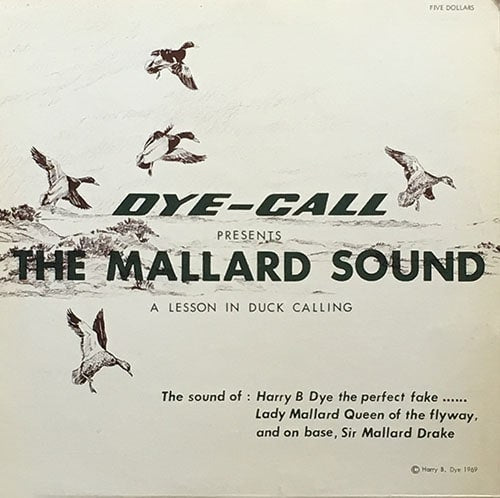
Dye-Call Presents The Mallard Sound, album cover.

Dye-Call Presents The Mallard Sound – A Lesson in Duck Calling

What manner of quackery be this? Why, it’s Harry B. Dye, the eponymous founder of Dye-Call, showing you how to attract waterfowl. As a bonus, he’s included a typewritten order form with retail prices for 1974. You might notice on the back cover showing four types of calls that the sound of three of them are described as “quacks,” but the feeding call is described as “kitty, kitty, kitty.” The greeting or comeback call has the cadence of human laughter, and the feeding call has rapid staccato quacks with a lot of vibrato. This is definitely an amateur production, done on the custom Century label, which was known for recording high school bands and other non-professional performances. Again, it isn’t on YouTube, but there’s no shortage of other duck-calling videos.

Make Your Bird a Star album cover. Make Your Bird a Star, back cover.

Make Your Bird a Star

If you value your sanity, you’ll leave the house when you put this one on – it consists entirely of passable impersonations of famous celebrities doing their catch phrases repeated ad nauseum so your pet talking bird can learn to sound like a Hollywood star of the past. The producers went to great (?) lengths to avoid lawsuits by attributing the lines to names like “W.C. Birdfields,” “Greta Garbird,” “John Wainbird,” or “Clark Gaybird.” (We may never know if that last one was an intentional reference.) Only two of the sixteen utterances are from female movie stars, and one impressionist handles all the male voices.

 Everything You Always Wanted to Know About Home Computers, album cover.

Everything You Always Wanted to Know About Home Computers

This one’s a head-scratcher. I mean, to whom else would you turn to learn about computers other than Steve Allen and Jayne Meadows? Don’t answer that. This was done in 1983, which, in technology terms, might as well be the Stone Age, but I have to admit that some of their predictions about future computer use were uncanny in their accuracy. You can hear the unintentionally campy album in full with the link below.


I had fun with these albums, although I may never listen to them again!

More from Issue 145

View All Articles in Issue 145

Search Copper Magazine

Favorites From T.H.E. Show SoCal 2026 by Cam Martin Oct 05, 2026 #235 Singer/Songwriter John David Schrader: On the Need to Create, Part Two by Joe Caplan Oct 05, 2026 #235 A Life in High-End Audio: The Roy Hall Interview, Part Two by Frank Doris Oct 05, 2026 #235 Grammy-Winning Producer, Songwriter, and Guitarist John Leventhal Goes Instrumental With National Drift by Ray Chelstowski Oct 05, 2026 #235 From Swimming Pool to New Listening Room—to Founding an Accidental Audio Company by Gilles Laferrière Oct 05, 2026 #235 The Vinyl Beat’s Size Matters Edition by Rudy Radelic Oct 05, 2026 #235 The Sublime Complexities of Nature by B. Jan Montana Oct 05, 2026 #235 How to Play In a Rock Band, 28: Growing Older and Dealing With It by Frank Doris Oct 05, 2026 #235 Young Rascals: From Bar Band to Stardom by Wayne Robins Oct 05, 2026 #235 Duncan Sheik: In Memoriam by Ray Chelstowski Oct 05, 2026 #235 From The Listening Chair: The Meze Audio 105 Silva Headphones by Howard Kneller Oct 05, 2026 #235 Checking Out Some NOLA Loudspeakers – and Some Thoughts About Audio Writing by Frank Doris Oct 05, 2026 #235 The Kanazawa Phonograph Museum: Music from a Time Capsule by Sebastian Polcyn Oct 05, 2026 #235 PS Audio in the News by PS Audio Staff Oct 05, 2026 #235 From The Audiophile’s Guide: Making the Most Critical Choice by Paul McGowan Oct 05, 2026 #235 Evolutionary Growth by Frank Doris Oct 05, 2026 #235 Speed Racer by Peter Xeni Oct 05, 2026 #235 Happy Halloween! by James Schrimpf Oct 05, 2026 #234 A Life in High-End Audio: The Roy Hall Interview, Part One by Frank Doris Sep 07, 2026 #234 Jason Greenlaw Offers His Personal Perspective on Jazz Guitar in Vantage Point by Frank Doris Sep 07, 2026 #234 Transcendent Phoenix: Lucina Yue Brings the Ancient Konghou Into Modern Times by Frank Doris Sep 07, 2026 #234 We Must All Follow Our Bliss by B. Jan Montana Sep 07, 2026 #234 How to Play in a Rock Band, 27: Leveling Up by Frank Doris Sep 07, 2026 #234 Ross Valory: Traveling Into New Musical Territory With All of the Above by Ray Chelstowski Sep 07, 2026 #234 Singer/Songwriter John David Schrader: On the Need to Create by Joe Caplan Sep 07, 2026 #234 The People Who Make Audio Happen: More From T.H.E. Show SoCal 2026 by Harris Fogel Sep 07, 2026 #234 The Vinyl Beat Digs Into the Gadget Box by Rudy Radelic Sep 07, 2026 #234 The Rolling Stones: Foreign Tongues Spoken Loud by Wayne Robins Sep 07, 2026 #234 Musical Moments by Rich Isaacs Sep 07, 2026 #234 Rags for Solo Piano and a Dog: David Chesky's Ragtime Music for the Modern Age by Frankly Speaking Sep 07, 2026 #234 HIGH END 2026, Vienna: Here to Stay by Carsten Barnbeck Sep 07, 2026 #234 From The Audiophile’s Guide: The Two Main Types of Loudpeakers – Box and Panel by Paul McGowan Sep 07, 2026 #234 Letting it Slide by Frank Doris Sep 07, 2026 #234 PS Audio in the News by PS Audio Staff Sep 07, 2026 #234 Long Playing by Peter Xeni Sep 07, 2026 #234 La Mer by B. Jan Montana Sep 07, 2026 #233 A Report From The Total Hi-Fi Experience Show SoCal 2026 by B. Jan Montana Aug 03, 2026 #233 Bluegrass Meets Country, Folk, Jazz and More in All That We Carried by The Squid City Slingers by Frank Doris Aug 03, 2026 #233 Corey Glover and One Tribe Nation: A Variegated Musical Collective by Ray Chelstowski Aug 03, 2026 #233 Excursions with Clive: The Late Clive Davis, A Personal History by Wayne Robins Aug 03, 2026 #233 AI, Art, and Music: A Conversation With Synthography Art by Joe Caplan Aug 03, 2026 #233 New American Symphonies: A Rediscovered Gem and a Vital Contemporary Work by Frank Doris Aug 03, 2026 #233 The Vinyl Beat: Genesis, the Dave Clark Five, Antonio Carlos Jobim and More by Rudy Radelic Aug 03, 2026 #233 How to Play in a Rock Band, 26: When It's Time to Record Your Music by Frank Doris Aug 03, 2026 #233 More From T.H.E. Show 2026, and the People Who Made it Happen by Harris Fogel Aug 03, 2026 #233 Underappreciated Artists, Part Three: Icehouse by Rich Isaacs Aug 03, 2026 #233 The Surprisingly Rich and Varied Music of Somalia by Steve Kindig Aug 03, 2026

Self-Help Before YouTube: More Records to Improve Your Life

Self-Help Before YouTube: More Records to Improve Your Life

Have you ever wondered how we learned to do things (repair/install/build/develop skills, etc.) before smartphones and YouTube came along?  Well, back in ancient times, before “there’s an app for that,” there were records for that (and I mean LPs).

I worked in record stores for nearly 30 years, and after a while I owned most of the music that I wanted, so I began to collect non-music albums – the weirder, the better. The thought was (in part) that I could cull some interesting snippets to throw in for fun between songs on mix tapes. I ended up with hundreds of LPs filed under headings such as “Lectures,” “Children’s Stories,” “Historical,” “Old Radio Shows,” “Literature” (readings from classic books), and “Instructional.”

Here’s a look at some of the entries in that latter category, a few of which are actually on YouTube.

How to CB album cover.

How to CB – 500 CB Terms for Quick on the Road Reference

Hey, good buddy, aren’t we glad that fad didn’t last? The Citizen’s Band craze in the 1970s spawned movies (Smokey and the Bandit and others) and even hit singles (“Convoy,” by country singer/songwriter C.W. McCall). For the most part, the CB world was the domain of truckers and other “good ol’ boys,” as evidenced by some of the blatantly sexist lingo included in the glossary on the back. You got yer “beaver,” for female, and “seat cover” as code for an attractive female passenger. At least they used “mercy” as a substitute for those bad words you couldn’t legally say on the air. The enclosed booklet lists all 500 terms, colorful names for 64 cities and towns (e.g. Corpus Christi, Texas, is “Taco Town”), and four square feet of insanely fine print with the complete text of FCC Rules and Regulations Part 95 – Citizens Radio Service. There are lots of videos on YouTube covering the jargon, along with ones demonstrating the installation and maintenance of CB radios.

If the Bomb Falls album cover. If the Bomb Falls, back album cover.

If the Bomb Falls – A Recorded Guide to Survival

The early 1960s was a time of nuclear paranoia. The possibility of atomic weaponry being used was ever-present, what with the antagonistic relationship between the USA and the Soviet Union. People were building bomb shelters and stocking them with non-perishable food and other survival supplies. Children in schools practiced getting under their desks to “duck and cover,” (as if that might protect one from an H-bomb). This short (23-minute) album was intended to prepare you for a possible nuclear explosion in your vicinity. The narration is measured and sobering, and the list of survival supplies is exhaustive (and exhausting).


How to Get Appointments by Telephone album cover. How to Get Appointments by Telephone, back cover.

How to Get Appointments by Telephone by Mona Ling

False advertising! Mona Ling is not heard on this record. Ms. Ling did write the script, and she autographed this particular copy, but the narration sounds as if it was done by the same guy who voiced all those deadly dull educational films we watched in school. This one comes from the Success Motivation Institute of Waco, Texas. The album demonstrates all the sales techniques you’d expect: using the client’s name, promising benefits, attempting to overcome objections, etc. These are all things that turn me off when I know the salesperson is using them. The accompanying booklet has the complete transcript of the record, so you don’t really have to listen to it, if, like me, it makes your skin crawl. The booklet includes bonus material such as voice exercises, self-evaluation quizzes, and the “Ten Commandments in Telephone Selling,” with gems like Number Five: You shall not show off your technical vocabulary.

Jimmy Nelson's Instant Ventriloquism album cover. Jimmy Nelson's Instant Ventriloquism, back cover.

Jimmy Nelson’s Instant Ventriloquism

Jimmy Nelson was one of the most famous ventriloquists during what The New York Times referred to (in his 2019 obituary) as “the golden age of ventriloquism.” He and his characters, Danny O’Day and Farfel (a dog), were beloved staples of the variety show and nightclub world. The first track on side two is Review and the Ventriloquial Voice. I didn’t know there was such a word as ventriloquial, and I dare you to say it five times fast. A complete script booklet came with the record to help with learning. The tracks on this YouTube link are in a different order, and it looks like they jazzed up the album cover for subsequent issues.


Contract Bridge: The Stayman System album cover.

Contract Bridge: The Stayman System

My folks used to play bridge with friends, and I tried to learn it when I was in elementary school, but understanding it was way beyond me, then and now. I’ve always thought that some comedian could make a routine about learning a foreign language by reading the bridge column in the newspaper. I once saw a reference to “finessing a player out of their honor,” which sounds like they’re talking about seduction and not a card game. Well, if you want to try playing bridge, there are plenty of videos out there, but this album isn’t on YouTube.

The Basic Principles of Kreskin's ESP album cover.

The Basic Principles of Kreskin’s ESP

“You are about to enter an uncanny world of your mind.” Sounds exciting, doesn’t it? Not when the narration is bone-dry. You’d think as an entertainer, mentalist and magician George Joseph Kresge, better known as Kreskin, would put a little more life into it. He was a frequent guest on The Tonight Show in the 1970s. To his credit, he didn’t present himself as a psychic with paranormal powers, but he was known for making predictions about the future.


Learn Morse Code the Easy Way album cover. Learn Morse Code the Easy Way, back cover.

Learn Code the Easy Way

Don’t get excited – they aren’t talking about computer code. After all, this article is about “old-school” learning. Most of us don’t have a practical use for Morse code anymore, but it shows up every once in a while. The front and back album covers for the Roger Waters LP Radio Kaos consisted entirely of coded information, with short vertical lines separating the letters and longer lines separating the words. With the help of this record (actually just the chart on the back cover), I could decipher it all. Although I couldn’t find Learn Code the Easy Way on YouTube, I was amazed at the numbers of Morse code instructional videos there. This album was released on the Archer label, which some will remember as the “house brand” of Radio Shack.
Radio Kaos back cover.

Roger Waters, Radio Kaos front and back album covers.

Dye-Call Presents The Mallard Sound, album cover.

Dye-Call Presents The Mallard Sound – A Lesson in Duck Calling

What manner of quackery be this? Why, it’s Harry B. Dye, the eponymous founder of Dye-Call, showing you how to attract waterfowl. As a bonus, he’s included a typewritten order form with retail prices for 1974. You might notice on the back cover showing four types of calls that the sound of three of them are described as “quacks,” but the feeding call is described as “kitty, kitty, kitty.” The greeting or comeback call has the cadence of human laughter, and the feeding call has rapid staccato quacks with a lot of vibrato. This is definitely an amateur production, done on the custom Century label, which was known for recording high school bands and other non-professional performances. Again, it isn’t on YouTube, but there’s no shortage of other duck-calling videos.

Make Your Bird a Star album cover. Make Your Bird a Star, back cover.

Make Your Bird a Star

If you value your sanity, you’ll leave the house when you put this one on – it consists entirely of passable impersonations of famous celebrities doing their catch phrases repeated ad nauseum so your pet talking bird can learn to sound like a Hollywood star of the past. The producers went to great (?) lengths to avoid lawsuits by attributing the lines to names like “W.C. Birdfields,” “Greta Garbird,” “John Wainbird,” or “Clark Gaybird.” (We may never know if that last one was an intentional reference.) Only two of the sixteen utterances are from female movie stars, and one impressionist handles all the male voices.

 Everything You Always Wanted to Know About Home Computers, album cover.

Everything You Always Wanted to Know About Home Computers

This one’s a head-scratcher. I mean, to whom else would you turn to learn about computers other than Steve Allen and Jayne Meadows? Don’t answer that. This was done in 1983, which, in technology terms, might as well be the Stone Age, but I have to admit that some of their predictions about future computer use were uncanny in their accuracy. You can hear the unintentionally campy album in full with the link below.


I had fun with these albums, although I may never listen to them again!

0 comments

Leave a comment

0 Comments

Your avatar

Loading comments...

🗑️ Delete Comment

Enter moderator password to delete this comment:

✏️ Edit Comment

Enter your email to verify ownership: