COPPER

A PS Audio Publication

Issue 150 • Free Online Magazine

Issue 150 Speaker Stories

One Size Fits All? Part One

One Size Fits All? Part One

Many of us use 2.1-channel or multichannel speaker setups that include subwoofers. In this article, we examine some of the relative merits of setting up your speakers using either the “large” or “small” setting in your preamp, processor or A/V receiver.

Probably one of the most confusing aspects is whether to set the speakers to “large” or “small in the setup menu. On first glance it looks quite straightforward: if you have small speakers, then put the setting to “small.” If you have floorstanding or large speakers, then surely logic would dictate that you set the setting to “large.” Nothing could be simpler, right?

In fact, “large” or “small” designates the setting of the crossover point between your main speakers and subwoofer(s). It has very little to do with the speaker sizes themselves! When you think about it, this makes sense. How could any A/V receiver, preamp or processor accommodate every possible speaker size on the market with just two categories, “large” and “small?”

The nomenclature is a complete misnomer. Many years ago, with the advent of multichannel home theater systems using subwoofers, Anthony Grimani (of Dolby and THX), introduced bass management to optimize the performance of such systems. A big part of bass management is, literally, managing where the low frequencies are directed, whether to the main speakers or the subwoofers. If the A/V receiver or preamp/processor’s speaker setting is set to “small,” the bass, typically below 80 Hz, is sent to the subwoofer and the rest of the frequency range is fed to the main speakers. If set to “large,” the main speakers will receive the full frequency range.
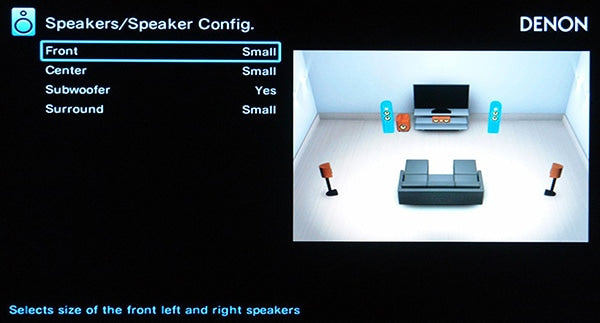
A Denon A/V receiver setup menu with speakers set to "small" and the subwoofer output enabled. A Denon A/V receiver setup menu with speakers set to "small" and the subwoofer output enabled.

Now it is true that a larger speaker will usually handle more bass than a smaller one, and that a floorstanding speaker will move more volume of air and produce a fuller bass response. But, even so, the “large” or “small” setting has greater significance for how you should set up your system, particularly if you want a more even bass response throughout the room.

In reality, with nearly all domestic stereo speakers and home theater systems that include a subwoofer, you should set the speaker settings to “small.” Although this may be counterintuitive if you own large floorstanders, it benefits your overall sound and not just the bass response. When set to “small,” the receiver or preamp/processor will now recognize that you have a preselected crossover point for your sub to handle all of the frequencies from that point and below. Not only does this allow you the freedom to choose your crossover point based on what sounds best for your speakers and room, it contributes to the evenness of bass response and the tonality of your bass, and it allows the lower midrange and midrange frequencies of your main speakers to come through with more clarity because they are no longer handling the low frequencies as they would be if run full-range. The main speakers also now have to handle less power, which gives them more headroom.

I tend to think of good frequency assignment and crossover settings as a bit like having your musical meal in three separate courses, each nicely prepared for their bespoke flavors and combinations of ingredients. In a similar way, each speaker handles its designated frequency range of bass, midrange and treble (as managed by the speaker’s own internal crossover network*). Each course is also served at the correct time, in the same way that a well-designed speaker is correctly time-aligned, so that you hear each sound at the appropriate time.

A starter course, which could be likened to the treble, often defines a strong characteristic or personality of a speaker and may be the first thing you are drawn to, followed by a main course of the body of the music, or the vocals, which could be akin to the midrange. Finally, a dessert, the bass, rounds out the whole meal, leaving you satisfied with what you’ve partaken of. Wouldn’t you prefer a meal that was served to you this way, in separate courses, rather than having all three courses brought out to you at once, where they then grow cold and less appetizing?

Or worse still, all three courses of food are served together on the same plate and mixed together, which is probably more analogous to having one speaker serve you all the frequencies without time alignment.

If you are running bookshelf speakers and a subwoofer, using the “small” setting is a great way to go, not least of all because the smaller speakers will not typically have the bass extension, or the power-handling capacity to drive serious bass, of a floorstander. They might even be doing very well if they reach as low as, say, 45 or 40 Hz (about the lowest note of an acoustic or four-string electric bass), but won’t reproduce true deep bass. A good approach may be to set the subwoofer crossover frequency at least 20 Hz higher than the lowest stated nominal frequency the main speakers go down to. This is a useful rule of thumb for creating a good blend between the main speakers and the sub and serves as a good starting point for smooth integration.

SVS Prime satellite/subwoofer system. SVS Prime satellite/subwoofer system.

“But I want to run my speakers full-range!” I hear you cry. Or, “They just sound better this way and besides, my user manual says that woofers up to 8 inches in diameter are considered “small” and I have 10-inch woofers, so I should set my receiver’s bass management setting to large.” In fact, you may be entirely right for your personal situation.

I run my main front stereo pair and surrounds full-range with a subwoofer, which is then fine-tuned for placement, phase, frequency setting, volume and EQ. I know it contests the conventional wisdom of not having overlapping bass frequencies from the mains and the subs, (and possibly incurring problems like phase cancellation), but the point is, it’s worth measuring what your room is actually doing to your sound. Sometimes “wrong” may sound “right.” This is particularly the case when you consider the known practical benefits of multiple bass sources pressurizing the room, thereby eradicating more nulls (areas of bass cancellation) within the listening room itself, and providing general reinforcement of bass frequencies, which also allow for effective EQing. After all, it’s worth remembering that floorstanding speakers have been designed by the manufacturer to be run at full range in the first place. Adding more sources of bass and managing them by effective integration can provide better seat-to-seat consistency of bass, and better evenness in bass response which is less localized.

The intention of this article is not to dictate what sounds good to you, but rather to make you aware of how you can take the best control of your sound by either choosing to use a crossover to your subwoofer, or not.

Remember that bass support and enhancement of the low-end frequencies below 45 Hz (down to perhaps 20 or even 15Hz) is the goal of using a subwoofer, and in doing so, to better reproduce those low frequencies with more accuracy, speed, attack and grip. A dedicated sub may also provide a cleaner signal path, in bypassing a more complex crossover as found in the main stereo speakers. Regardless of its driver size, cabinet configuration or whether it employs passive radiators, a subwoofer has been built from the ground up to handle bass.

In our next article we will consider some additional reasons why using stereo speakers full-range on the “large setting” may actually be the right thing for your situation.

Header image: B&W 600 Series loudspeakers and subwoofer.

More from Issue 150

View All Articles in Issue 150

Search Copper Magazine

#234 A Life in High-End Audio: The Roy Hall Interview, Part One by Frank Doris Sep 07, 2026 #234 Jason Greenlaw Offers His Personal Perspective on Jazz Guitar in Vantage Point by Frank Doris Sep 07, 2026 #234 Transcendent Phoenix: Lucina Yue Brings the Ancient Konghou Into Modern Times by Frank Doris Sep 07, 2026 #234 We Must All Follow Our Bliss by B. Jan Montana Sep 07, 2026 #234 How to Play in a Rock Band, 27: Leveling Up by Frank Doris Sep 07, 2026 #234 Ross Valory: Traveling Into New Musical Territory With All of the Above by Ray Chelstowski Sep 07, 2026 #234 Singer/Songwriter John David Schrader: On the Need to Create by Joe Caplan Sep 07, 2026 #234 The People Who Make Audio Happen: More From T.H.E. Show SoCal 2026 by Harris Fogel Sep 07, 2026 #234 The Vinyl Beat Digs Into the Gadget Box by Rudy Radelic Sep 07, 2026 #234 The Rolling Stones: Foreign Tongues Spoken Loud by Wayne Robins Sep 07, 2026 #234 Musical Moments by Rich Isaacs Sep 07, 2026 #234 Rags for Solo Piano and a Dog: David Chesky's Ragtime Music for the Modern Age by Frankly Speaking Sep 07, 2026 #234 HIGH END 2026, Vienna: Here to Stay by Carsten Barnbeck Sep 07, 2026 #234 From The Audiophile’s Guide: The Two Main Types of Loudpeakers – Box and Panel by Paul McGowan Sep 07, 2026 #234 Letting it Slide by Frank Doris Sep 07, 2026 #234 PS Audio in the News by PS Audio Staff Sep 07, 2026 #234 Long Playing by Peter Xeni Sep 07, 2026 #234 La Mer by B. Jan Montana Sep 07, 2026 #233 A Report From The Total Hi-Fi Experience Show SoCal 2026 by B. Jan Montana Aug 03, 2026 #233 Bluegrass Meets Country, Folk, Jazz and More in All That We Carried by The Squid City Slingers by Frank Doris Aug 03, 2026 #233 Corey Glover and One Tribe Nation: A Variegated Musical Collective by Ray Chelstowski Aug 03, 2026 #233 Excursions with Clive: The Late Clive Davis, A Personal History by Wayne Robins Aug 03, 2026 #233 AI, Art, and Music: A Conversation With Synthography Art by Joe Caplan Aug 03, 2026 #233 New American Symphonies: A Rediscovered Gem and a Vital Contemporary Work by Frank Doris Aug 03, 2026 #233 The Vinyl Beat: Genesis, the Dave Clark Five, Antonio Carlos Jobim and More by Rudy Radelic Aug 03, 2026 #233 How to Play in a Rock Band, 26: When It's Time to Record Your Music by Frank Doris Aug 03, 2026 #233 More From T.H.E. Show 2026, and the People Who Made it Happen by Harris Fogel Aug 03, 2026 #233 Underappreciated Artists, Part Three: Icehouse by Rich Isaacs Aug 03, 2026 #233 The Surprisingly Rich and Varied Music of Somalia by Steve Kindig Aug 03, 2026 #233 A Remarkable Discographic Legacy: The LP Recordings of the Basel Symphony Orchestra by Stephan Haberthür Aug 03, 2026 #233 From The Audiophile’s Guide: The Importance of Loudspeakers by Paul McGowan Aug 03, 2026 #233 From Swimming Pool to New Listening Room: A Conversation with Norman Varney of AV RoomService by Gilles Laferrière Aug 03, 2026 #233 PS Audio in the News by PS Audio Staff Aug 03, 2026 #233 Audio Jewelry by Peter Xeni Aug 03, 2026 #233 Enrich Your Life by Frank Doris Aug 03, 2026 #233 The Searcher by James Schrimpf Aug 03, 2026 #232 What came first: Art or Music? A Conversation With Artist Jose Acosta by Joe Caplan Jul 06, 2026 #232 Blow By Blow: The Jeff Beck Story: An Insightful Book About a Guitar Icon by Ray Chelstowski Jul 06, 2026 #232 Creed Over Camaraderie? by B. Jan Montana Jul 06, 2026 #232 Chronicles of a Sound Pilgrim at the 2026 Montreal Audiofest by Hugues Morin Jul 06, 2026 #232 The Vinyl Beat: Summer Grooves by Rudy Radelic Jul 06, 2026 #232 Hibbing Hillbilly Dylan's Acoustic Rock by Wayne Robins Jul 06, 2026 #232 Quad Quads and Plasmatronics Tweeters: An Extraordinary System Comes to Life by Frank Doris Jul 06, 2026 #232 In Praise of Live Music, Once Again by Ted Shafran Jul 06, 2026 #232 Allnic Audio’s L-9000 Preamplifier: Design and Engineering Innovation by Howard Kneller Jul 06, 2026 #232 “Best Of” Lists and Rage Bait: Enough Already by Frank Doris Jul 06, 2026 #232 Quick Takes: Bud Shank, Paulo Almeida, Jakob Dreyer, Tim Eriksen and Peter Irvine by Frank Doris Jul 06, 2026

One Size Fits All? Part One

One Size Fits All? Part One

Many of us use 2.1-channel or multichannel speaker setups that include subwoofers. In this article, we examine some of the relative merits of setting up your speakers using either the “large” or “small” setting in your preamp, processor or A/V receiver.

Probably one of the most confusing aspects is whether to set the speakers to “large” or “small in the setup menu. On first glance it looks quite straightforward: if you have small speakers, then put the setting to “small.” If you have floorstanding or large speakers, then surely logic would dictate that you set the setting to “large.” Nothing could be simpler, right?

In fact, “large” or “small” designates the setting of the crossover point between your main speakers and subwoofer(s). It has very little to do with the speaker sizes themselves! When you think about it, this makes sense. How could any A/V receiver, preamp or processor accommodate every possible speaker size on the market with just two categories, “large” and “small?”

The nomenclature is a complete misnomer. Many years ago, with the advent of multichannel home theater systems using subwoofers, Anthony Grimani (of Dolby and THX), introduced bass management to optimize the performance of such systems. A big part of bass management is, literally, managing where the low frequencies are directed, whether to the main speakers or the subwoofers. If the A/V receiver or preamp/processor’s speaker setting is set to “small,” the bass, typically below 80 Hz, is sent to the subwoofer and the rest of the frequency range is fed to the main speakers. If set to “large,” the main speakers will receive the full frequency range.

A Denon A/V receiver setup menu with speakers set to "small" and the subwoofer output enabled. A Denon A/V receiver setup menu with speakers set to "small" and the subwoofer output enabled.

Now it is true that a larger speaker will usually handle more bass than a smaller one, and that a floorstanding speaker will move more volume of air and produce a fuller bass response. But, even so, the “large” or “small” setting has greater significance for how you should set up your system, particularly if you want a more even bass response throughout the room.

In reality, with nearly all domestic stereo speakers and home theater systems that include a subwoofer, you should set the speaker settings to “small.” Although this may be counterintuitive if you own large floorstanders, it benefits your overall sound and not just the bass response. When set to “small,” the receiver or preamp/processor will now recognize that you have a preselected crossover point for your sub to handle all of the frequencies from that point and below. Not only does this allow you the freedom to choose your crossover point based on what sounds best for your speakers and room, it contributes to the evenness of bass response and the tonality of your bass, and it allows the lower midrange and midrange frequencies of your main speakers to come through with more clarity because they are no longer handling the low frequencies as they would be if run full-range. The main speakers also now have to handle less power, which gives them more headroom.

I tend to think of good frequency assignment and crossover settings as a bit like having your musical meal in three separate courses, each nicely prepared for their bespoke flavors and combinations of ingredients. In a similar way, each speaker handles its designated frequency range of bass, midrange and treble (as managed by the speaker’s own internal crossover network*). Each course is also served at the correct time, in the same way that a well-designed speaker is correctly time-aligned, so that you hear each sound at the appropriate time.

A starter course, which could be likened to the treble, often defines a strong characteristic or personality of a speaker and may be the first thing you are drawn to, followed by a main course of the body of the music, or the vocals, which could be akin to the midrange. Finally, a dessert, the bass, rounds out the whole meal, leaving you satisfied with what you’ve partaken of. Wouldn’t you prefer a meal that was served to you this way, in separate courses, rather than having all three courses brought out to you at once, where they then grow cold and less appetizing?

Or worse still, all three courses of food are served together on the same plate and mixed together, which is probably more analogous to having one speaker serve you all the frequencies without time alignment.

If you are running bookshelf speakers and a subwoofer, using the “small” setting is a great way to go, not least of all because the smaller speakers will not typically have the bass extension, or the power-handling capacity to drive serious bass, of a floorstander. They might even be doing very well if they reach as low as, say, 45 or 40 Hz (about the lowest note of an acoustic or four-string electric bass), but won’t reproduce true deep bass. A good approach may be to set the subwoofer crossover frequency at least 20 Hz higher than the lowest stated nominal frequency the main speakers go down to. This is a useful rule of thumb for creating a good blend between the main speakers and the sub and serves as a good starting point for smooth integration.

SVS Prime satellite/subwoofer system. SVS Prime satellite/subwoofer system.

“But I want to run my speakers full-range!” I hear you cry. Or, “They just sound better this way and besides, my user manual says that woofers up to 8 inches in diameter are considered “small” and I have 10-inch woofers, so I should set my receiver’s bass management setting to large.” In fact, you may be entirely right for your personal situation.

I run my main front stereo pair and surrounds full-range with a subwoofer, which is then fine-tuned for placement, phase, frequency setting, volume and EQ. I know it contests the conventional wisdom of not having overlapping bass frequencies from the mains and the subs, (and possibly incurring problems like phase cancellation), but the point is, it’s worth measuring what your room is actually doing to your sound. Sometimes “wrong” may sound “right.” This is particularly the case when you consider the known practical benefits of multiple bass sources pressurizing the room, thereby eradicating more nulls (areas of bass cancellation) within the listening room itself, and providing general reinforcement of bass frequencies, which also allow for effective EQing. After all, it’s worth remembering that floorstanding speakers have been designed by the manufacturer to be run at full range in the first place. Adding more sources of bass and managing them by effective integration can provide better seat-to-seat consistency of bass, and better evenness in bass response which is less localized.

The intention of this article is not to dictate what sounds good to you, but rather to make you aware of how you can take the best control of your sound by either choosing to use a crossover to your subwoofer, or not.

Remember that bass support and enhancement of the low-end frequencies below 45 Hz (down to perhaps 20 or even 15Hz) is the goal of using a subwoofer, and in doing so, to better reproduce those low frequencies with more accuracy, speed, attack and grip. A dedicated sub may also provide a cleaner signal path, in bypassing a more complex crossover as found in the main stereo speakers. Regardless of its driver size, cabinet configuration or whether it employs passive radiators, a subwoofer has been built from the ground up to handle bass.

In our next article we will consider some additional reasons why using stereo speakers full-range on the “large setting” may actually be the right thing for your situation.

Header image: B&W 600 Series loudspeakers and subwoofer.

0 comments

Leave a comment

0 Comments

Your avatar

Loading comments...

🗑️ Delete Comment

Enter moderator password to delete this comment:

✏️ Edit Comment

Enter your email to verify ownership: