COPPER

A PS Audio Publication

Issue 149 • Free Online Magazine

Issue 149 EUREKA MOMENTS

Building My First System

Building My First System

In the 1950s, TV sets had lousy pictures – but some of them had rather good sound. Our 16-inch RCA TV (“that big screen in a 12 x 12-foot room?” said the neighbors; “you’ll go blind!”) showed images only in black and white, of course, with a 525-line vertical resolution (up to 486 of those lines visible) and about 440 pixels horizontally – about one-tenth the resolution of a 1080p digital TV. But the RCA had a wood, floor-standing cabinet, with an 8-inch speaker baffled on all sides except the back. Since all else we had were two Emerson AM radios, it had the best sound in the house.

And our TV had an audio input jack on the rear panel – RCA’s way of encouraging sales of the Victrola Attachment 45 rpm record changer, the company’s answer to the LP system Columbia Records had introduced a year or two before.

RCA Victor 16-inch TV.

Aged 11, I’d been listening to our AM radios, largely to classical music from distant New York City. But with one of those little changers and some records, I could hear music of my choice whenever I wanted to. And, at $12.95 (including six records!) I could afford it from banked birthday money my parents hadn’t let me spend. I got Dad to break $25 loose from my savings account, and scampered down to Conn’s Record Shop on Church Street.

And what a haul! The RCA player, of course, plus Mario Lanza’s Great Caruso album (I wanted to sing like that tenor back then, though still a soprano at the time), a single by Caruso himself, one Spike Jones single, three Phil Harris discs, and another record or two that I’ve forgotten.

I wasn’t an audiophile yet, but I had two audiophile traits – a love of music and the urge to make improvements. The first one, at my urging but on Dad’s nickel, was to replace the 45-only changer with a Webcor 3-speed model, so we could play LPs, too. The second, once I’d been introduced to hi-fi by my high school chem teacher, was to replace the TV’s 8-inch driver with a $10 Lafayette SK-98 whose cone had a hardened center section for better highs. (I’ve heard since that it was made by Pioneer.) Rated response was “40 – 16,000 cycles per second,” numbers that meant nothing to me at the time.

That sufficed until I went off to Yale, and had to leave our TV console home. I bought a small, $15 ported enclosure from Lafayette, and a used Realistic 10- or 12-watt amplifier (built by Grommes) for $10 from my girlfriend’s father. I progressed from there to a used 25-watt Heathkit W5M amp and model WA-P2 preamp that took its power from an octal socket on the amp. The preamp’s main feature was selectable turnover and rolloff frequencies, to deal with the many company-specific record-equalization curves then prevalent; the RIAA curve was already in use, but there were still a lot of older discs out there. (Unfortunately, I couldn’t use that selectable EQ, because the Webcor had a ceramic cartridge that didn’t require equalization.) I also moved the Lafayette speaker to an RJ enclosure that I got cheap because the foam surround of the RJ’s original Wharfedale driver had rotted out.


Heathkit WA-P2 preamplifier.

Heathkit WA-P2 preamplifier.

Sophomore year, I roomed with guys who wanted something fancier, and in new-fangled stereo. Rather than pool our money for a jointly-owned system we’d have to sell off when we went our separate ways, we each bought one system component. I don’t recall what speakers we wound up with (AR-1s?), but I know we had a sleek-looking Fairchild arm, cartridge, and belt-drive turntable, plus an H.H. Scott stereo preamp and H.H. Scott 330 “binaural” tuner. The 330 had independent AM and FM tuner sections and dials, to take advantage of “simulcast” stereo with one channel on AM and one on FM. (Alas, the only station doing that near us was WQXR, in New York; since that was 80 miles away, we could only get the AM part.) To round out the system, we had two Dynaco Mk. III 60-watt amps.


Dynaco MK III amplifier schematic diagram.

Getting the amps was my job. Having very little money, I researched the hell out of my selection, to make sure I got maximum value. I’d hoped to find a book that would explain it all to me, but couldn’t, and resolved someday to write that book myself (which eventually led to my career in audio).

I took the next year off, living and working in New York. While there, I bought and built my first kit, an Eico HFT-90 FM tuner; its dial pointer glowed green in a pattern like an exclamation point that narrowed when you hit a station frequency. My dealer for that, Audio Workshop, not only sold kits but provided tools, bench space, supervision, and technical assistance, plus lockers where you could keep partly finished kits between sessions. Their technical assistance came in handy when I turned the Eico on and got smoke; I’d been supposed to wire pin 1 of one tube to pin 2 and pin 2 to pin 3; but then I went on to wire pin 3 to pin 4, too.

I noticed the Webcor had a two-position tracking force selector, a spring that could be moved from one hole to another. Having heard about the virtues of low tracking force, I moved it to its lower setting, then bought a stylus-force gauge to check the results. The gauge read up to 20 grams, but when I put the Webcor’s tone arm on it, it bottomed with a “clunk!” So, I replaced the Webcor: I got a Dynaco/B&O Stereodyne arm/cartridge that tracked at a then-remarkable 2 grams, and mounted it to a Weathers kit turntable.

Component turntables of the day had massive platters whose flywheel effect added speed stability. (The Fairchild, though, was available with an electronic speed control system.) Many, such as the popular Rek-O-Kut, had idler drives that interposed a rubber wheel between the motor shaft and the platter’s rim to gear the motor’s speed down. To provide the torque those heavy platters needed, the idler had to be heavy and stiff, and unless it was moved away from the motor shaft and platter when the turntable was off, the idler would develop flat spots, leading to thumps and speed irregularities in playback.
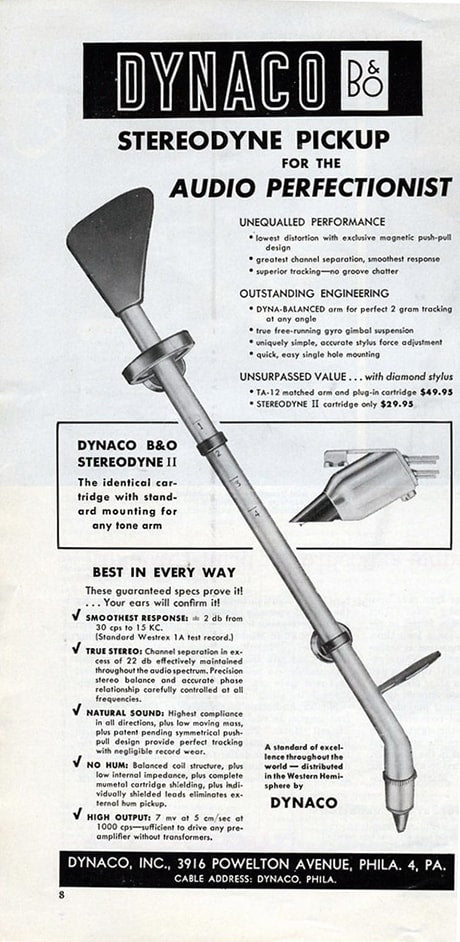
Dynaco/B&O pickup arm. Dynaco/B&O pickup arm.

The Weathers did it differently. Its speed was regulated by a motor much like an electric clock’s. Since such motors had little torque, the platter had to be a light aluminum stamping. And since the torque involved was so small, the idler wheel could be of rubber too soft to develop flat spots – so there was no need for mechanisms to move it out of the way when the turntable was off. Simple. And therefore very, very cheap – just $50, as I recall.

Switching from the Webcor’s ceramic cartridge to the Dyna/B&O magnetic one called for a preamp. I could have used my Heathkit, since my Dyna amps also had sockets that could power it, but I was so close to having stereo I switched to a Dynakit stereo preamp. Click here to view the Dynaco PAS-2 assembly and owners manual.

Then, since I already had those two Dyna amps, all I needed was a second speaker. Another Audio Workshop customer sold me a working RJ Wharfedale, which I temporarily paired with my RJ-housed Lafayette speaker until I could get a matching Wharfedale driver. Now my first real stereo system was a-a-l-most complete. A few months later, I swapped the Eico tuner for a Magnecord PT-6 mono tape recorder whose transport had been taken apart. With the aid of a Sams Photofact service manual, one of my former roommates put it back together for me.
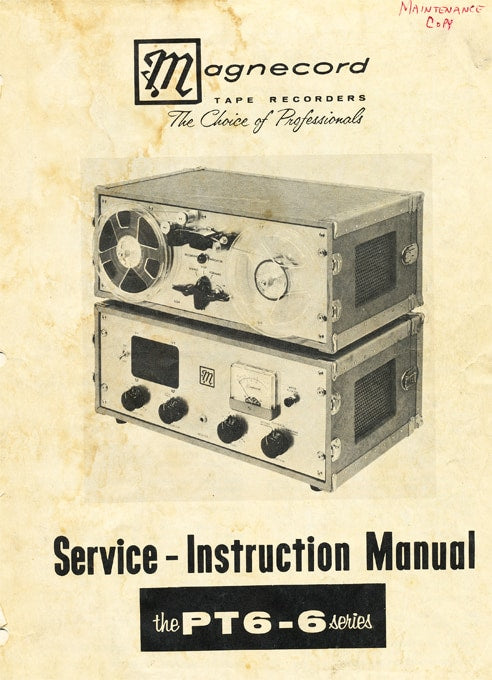
Magnecord PT-6 service and instruction manual. Magnecord PT-6 service and instruction manual.

And that was that.

For a year or so, anyway…

Header image: Eico HFT-90 FM tuner, courtesy of Wikimedia Commons/Joe Haupt.


More from Issue 149

View All Articles in Issue 149

Search Copper Magazine

#227 Seth Lewis Gets in the Groove With Take a Look Around: a Tribute to the Meters by Frank Doris Feb 02, 2026 #227 Passport to Sound: May Anwar’s Audio Learning Experience for Young People by Frank Doris Feb 02, 2026 #227 Conjectures on Cosmic Consciousness by B. Jan Montana Feb 02, 2026 #227 The Big Takeover Turns 45 by Wayne Robins Feb 02, 2026 #227 Music and Chocolate: On the Sensory Connection by Joe Caplan Feb 02, 2026 #227 Singer/Songwriter Chris Berardo: Getting Wilder All the Time by Ray Chelstowski Feb 02, 2026 #227 The Earliest Stars of Country Music, Part One by Jeff Weiner Feb 02, 2026 #227 The Vinyl Beat Goes Down to Tijuana (By Way of Los Angeles), Part Two by Rudy Radelic Feb 02, 2026 #227 How to Play in a Rock Band, 20: On the Road With Blood, Sweat & Tears’ Guitarist Gabe Cummins by Frank Doris Feb 02, 2026 #227 From The Audiophile’s Guide: Audio Specs and Measuring by Paul McGowan Feb 02, 2026 #227 Our Brain is Always Listening by Peter Trübner Feb 02, 2026 #227 PS Audio in the News by PS Audio Staff Feb 02, 2026 #227 The Listening Chair: Sleek Style and Sound From the Luxman L3 by Howard Kneller Feb 02, 2026 #227 The Los Angeles and Orange County Audio Society Celebrates Its 32nd Anniversary, Honoring David and Sheryl Lee Wilson and Bernie Grundman by Harris Fogel Feb 02, 2026 #227 Back to My Reel-to-Reel Roots, Part 26: Half Full – Not Half Empty, Redux by Ken Kessler Feb 02, 2026 #227 That's What Puzzles Us... by Frank Doris Feb 02, 2026 #227 Record-Breaking by Peter Xeni Feb 02, 2026 #227 The Long and Winding Road by B. Jan Montana Feb 02, 2026 #226 JJ Murphy’s Sleep Paralysis is a Genre-Bending Musical Journey Through Jazz, Fusion and More by Frank Doris Jan 05, 2026 #226 Stewardship by Consent by B. Jan Montana Jan 05, 2026 #226 Food, Music, and Sensory Experience: An Interview With Professor Jonathan Zearfoss of the Culinary Institute of America by Joe Caplan Jan 05, 2026 #226 Studio Confidential: A Who’s Who of Recording Engineers Tell Their Stories by Frank Doris Jan 05, 2026 #226 Pilot Radio is Reborn, 50 Years Later: Talking With CEO Barak Epstein by Frank Doris Jan 05, 2026 #226 The Vinyl Beat Goes Down to Tijuana (By Way of Los Angeles), Part One by Rudy Radelic Jan 05, 2026 #226 Capital Audiofest 2025: Must-See Stereo, Part Two by Frank Doris Jan 05, 2026 #226 My Morning Jacket’s Carl Broemel and Tyler Ramsey Collaborate on Their Acoustic Guitar Album, Celestun by Ray Chelstowski Jan 05, 2026 #226 The People Who Make Audio Happen: CanJam SoCal 2025, Part Two by Harris Fogel Jan 05, 2026 #226 How to Play in a Rock Band, 19: Touring Can Make You Crazy, Part One by Frank Doris Jan 05, 2026 #226 Linda Ronstadt Goes Bigger by Wayne Robins Jan 05, 2026 #226 From The Audiophile’s Guide: Active Room Correction and Digital Signal Processing by Paul McGowan Jan 05, 2026 #226 PS Audio in the News by Frank Doris Jan 05, 2026 #226 Back to My Reel-to-Reel Roots, Part 25: Half-Full, Not Empty by Ken Kessler Jan 05, 2026 #226 Happy New Year! by Frank Doris Jan 05, 2026 #226 Turn It Down! by Peter Xeni Jan 05, 2026 #226 Ghost Riders by James Schrimpf Jan 05, 2026 #226 A Factory Tour of Audio Manufacturer German Physiks by Markus "Marsu" Manthey Jan 04, 2026 #225 Capital Audiofest 2025: Must-See Stereo, Part One by Frank Doris Dec 01, 2025 #225 Otis Taylor and the Electrics Delivers a Powerful Set of Hypnotic Modern Blues by Frank Doris Dec 01, 2025 #225 A Christmas Miracle by B. Jan Montana Dec 01, 2025 #225 T.H.E. Show New York 2025, Part Two: Plenty to See, Hear, and Enjoy by Frank Doris Dec 01, 2025 #225 Underappreciated Artists, Part One: Martin Briley by Rich Isaacs Dec 01, 2025 #225 Rock and Roll is Here to Stay by Wayne Robins Dec 01, 2025 #225 A Lifetime of Holiday Record (and CD) Listening by Rudy Radelic Dec 01, 2025 #225 Little Feat: Not Saying Goodbye, Not Yet by Ray Chelstowski Dec 01, 2025 #225 How to Play in a Rock Band, Part 18: Dealing With Burnout by Frank Doris Dec 01, 2025 #225 The People Who Make Audio Happen: CanJam SoCal 2025 by Harris Fogel Dec 01, 2025 #225 Chicago’s Sonic Sanctuaries: Four Hi‑Fi Listening Bars Channeling the Jazz‑Kissa Spirit by Olivier Meunier-Plante Dec 01, 2025

Building My First System

Building My First System

In the 1950s, TV sets had lousy pictures – but some of them had rather good sound. Our 16-inch RCA TV (“that big screen in a 12 x 12-foot room?” said the neighbors; “you’ll go blind!”) showed images only in black and white, of course, with a 525-line vertical resolution (up to 486 of those lines visible) and about 440 pixels horizontally – about one-tenth the resolution of a 1080p digital TV. But the RCA had a wood, floor-standing cabinet, with an 8-inch speaker baffled on all sides except the back. Since all else we had were two Emerson AM radios, it had the best sound in the house.

And our TV had an audio input jack on the rear panel – RCA’s way of encouraging sales of the Victrola Attachment 45 rpm record changer, the company’s answer to the LP system Columbia Records had introduced a year or two before.

RCA Victor 16-inch TV.

Aged 11, I’d been listening to our AM radios, largely to classical music from distant New York City. But with one of those little changers and some records, I could hear music of my choice whenever I wanted to. And, at $12.95 (including six records!) I could afford it from banked birthday money my parents hadn’t let me spend. I got Dad to break $25 loose from my savings account, and scampered down to Conn’s Record Shop on Church Street.

And what a haul! The RCA player, of course, plus Mario Lanza’s Great Caruso album (I wanted to sing like that tenor back then, though still a soprano at the time), a single by Caruso himself, one Spike Jones single, three Phil Harris discs, and another record or two that I’ve forgotten.

I wasn’t an audiophile yet, but I had two audiophile traits – a love of music and the urge to make improvements. The first one, at my urging but on Dad’s nickel, was to replace the 45-only changer with a Webcor 3-speed model, so we could play LPs, too. The second, once I’d been introduced to hi-fi by my high school chem teacher, was to replace the TV’s 8-inch driver with a $10 Lafayette SK-98 whose cone had a hardened center section for better highs. (I’ve heard since that it was made by Pioneer.) Rated response was “40 – 16,000 cycles per second,” numbers that meant nothing to me at the time.

That sufficed until I went off to Yale, and had to leave our TV console home. I bought a small, $15 ported enclosure from Lafayette, and a used Realistic 10- or 12-watt amplifier (built by Grommes) for $10 from my girlfriend’s father. I progressed from there to a used 25-watt Heathkit W5M amp and model WA-P2 preamp that took its power from an octal socket on the amp. The preamp’s main feature was selectable turnover and rolloff frequencies, to deal with the many company-specific record-equalization curves then prevalent; the RIAA curve was already in use, but there were still a lot of older discs out there. (Unfortunately, I couldn’t use that selectable EQ, because the Webcor had a ceramic cartridge that didn’t require equalization.) I also moved the Lafayette speaker to an RJ enclosure that I got cheap because the foam surround of the RJ’s original Wharfedale driver had rotted out.


Heathkit WA-P2 preamplifier.

Heathkit WA-P2 preamplifier.

Sophomore year, I roomed with guys who wanted something fancier, and in new-fangled stereo. Rather than pool our money for a jointly-owned system we’d have to sell off when we went our separate ways, we each bought one system component. I don’t recall what speakers we wound up with (AR-1s?), but I know we had a sleek-looking Fairchild arm, cartridge, and belt-drive turntable, plus an H.H. Scott stereo preamp and H.H. Scott 330 “binaural” tuner. The 330 had independent AM and FM tuner sections and dials, to take advantage of “simulcast” stereo with one channel on AM and one on FM. (Alas, the only station doing that near us was WQXR, in New York; since that was 80 miles away, we could only get the AM part.) To round out the system, we had two Dynaco Mk. III 60-watt amps.


Dynaco MK III amplifier schematic diagram.

Getting the amps was my job. Having very little money, I researched the hell out of my selection, to make sure I got maximum value. I’d hoped to find a book that would explain it all to me, but couldn’t, and resolved someday to write that book myself (which eventually led to my career in audio).

I took the next year off, living and working in New York. While there, I bought and built my first kit, an Eico HFT-90 FM tuner; its dial pointer glowed green in a pattern like an exclamation point that narrowed when you hit a station frequency. My dealer for that, Audio Workshop, not only sold kits but provided tools, bench space, supervision, and technical assistance, plus lockers where you could keep partly finished kits between sessions. Their technical assistance came in handy when I turned the Eico on and got smoke; I’d been supposed to wire pin 1 of one tube to pin 2 and pin 2 to pin 3; but then I went on to wire pin 3 to pin 4, too.

I noticed the Webcor had a two-position tracking force selector, a spring that could be moved from one hole to another. Having heard about the virtues of low tracking force, I moved it to its lower setting, then bought a stylus-force gauge to check the results. The gauge read up to 20 grams, but when I put the Webcor’s tone arm on it, it bottomed with a “clunk!” So, I replaced the Webcor: I got a Dynaco/B&O Stereodyne arm/cartridge that tracked at a then-remarkable 2 grams, and mounted it to a Weathers kit turntable.

Component turntables of the day had massive platters whose flywheel effect added speed stability. (The Fairchild, though, was available with an electronic speed control system.) Many, such as the popular Rek-O-Kut, had idler drives that interposed a rubber wheel between the motor shaft and the platter’s rim to gear the motor’s speed down. To provide the torque those heavy platters needed, the idler had to be heavy and stiff, and unless it was moved away from the motor shaft and platter when the turntable was off, the idler would develop flat spots, leading to thumps and speed irregularities in playback.

Dynaco/B&O pickup arm. Dynaco/B&O pickup arm.

The Weathers did it differently. Its speed was regulated by a motor much like an electric clock’s. Since such motors had little torque, the platter had to be a light aluminum stamping. And since the torque involved was so small, the idler wheel could be of rubber too soft to develop flat spots – so there was no need for mechanisms to move it out of the way when the turntable was off. Simple. And therefore very, very cheap – just $50, as I recall.

Switching from the Webcor’s ceramic cartridge to the Dyna/B&O magnetic one called for a preamp. I could have used my Heathkit, since my Dyna amps also had sockets that could power it, but I was so close to having stereo I switched to a Dynakit stereo preamp. Click here to view the Dynaco PAS-2 assembly and owners manual.

Then, since I already had those two Dyna amps, all I needed was a second speaker. Another Audio Workshop customer sold me a working RJ Wharfedale, which I temporarily paired with my RJ-housed Lafayette speaker until I could get a matching Wharfedale driver. Now my first real stereo system was a-a-l-most complete. A few months later, I swapped the Eico tuner for a Magnecord PT-6 mono tape recorder whose transport had been taken apart. With the aid of a Sams Photofact service manual, one of my former roommates put it back together for me.

Magnecord PT-6 service and instruction manual. Magnecord PT-6 service and instruction manual.

And that was that.

For a year or so, anyway…

Header image: Eico HFT-90 FM tuner, courtesy of Wikimedia Commons/Joe Haupt.


0 comments

Leave a comment

0 Comments

Your avatar

Loading comments...

🗑️ Delete Comment

Enter moderator password to delete this comment:

✏️ Edit Comment

Enter your email to verify ownership: