COPPER

A PS Audio Publication

Issue 149 • Free Online Magazine

Issue 149 NATURAL BORN KESSLER

Back to My Reel-to-Reel Roots, Part Three

Back to My Reel-to-Reel Roots, Part Three

Just so there are no misunderstandings, I have to explain to you how focused is my interest in reel-to-reel tape. I absolutely don’t want to be challenged or trolled by studio denizens about why did I forget about such-and-such, 30 ips is better, yadayadayada. My interest is, firstly, ONLY about playback and, secondly, about domestic machines because I only care about pre-recorded open-reel tapes.

Thus, you will not read in my jottings anything to do with professional machines, the current availability of fresh blank tape, mixing desks, how to ensure correct record levels, microphones, ad infinitum. That’s because not only am I concerned exclusively with pre-recorded tape, my interest is also restricted to what we might call The Original Open Reel Era. For clarity, the tapes you can buy today from the Tape Project, Fonè, STS, et al, comprise what I will call The Open Reel Revivalists.

Simply put, I have no intention of recording anything live or off-air, though I will, at a later point, touch on the cult interest in transferring CDs or even LPs to tape, by those who find it improves the sound. Moreover, I am fully aware that there are countless audiophiles using professional machines, especially the much-coveted Studer 800 Series decks in 1/2-track form, in their sound systems. Mazel tov to them. But pro decks, in the main, relate to my field of interest as howitzers do to water pistols.

Finishing off with the hardware element for the time being, as I understand it, the production of open-reel machines (pro or domestic) from major makers ended around 2010 with the last of the Otaris. The end of quantity- or series-production tape decks for studios is not something I have researched, so I am going on what I was told by professionals. Since then, what you have are virtually bespoke, limited production items from specialists like Ballfinger, or resuscitated decks from the various restorers and resellers of Technics, TEAC, ReVox, and other rescued units.

For purely domestic open-reel tape recorders, from Akai, Sony, Pioneer and so on, I would have imagined that they ceased production in the early-to-mid 1990s. That certainly applies to one of the most important and popular manufacturers, which – according to authors Luca Maria Olgiati and Paolo Bologna, in their definitive history – show that ReVox’s last open-reel machine, the PR99 Mk III, was made in 1993.

[For the full saga, get a copy of their superb book, ReVox Reel to Reel Tape Recorders 1949-1993 (ReVoxMania, ISBN 978-1-36-659060-2). I found mine on Amazon.]

Finishing off with the hardware, the puzzler in my arsenal is the Otari MX5050 because I always thought of that brand as pro-only, yet here is a machine which, like the Technics RS-1500, plays three speeds and two formats. And who ever used 1/4-track in studios? Even if I lost all my other machines, between the Otari and the Technics there isn’t a commercial pre-recorded tape, whether Original Open Reel Era or current 15 ips stuff, which cannot be played.


This is KK's go-to machine for playing every format: the Otari MX5050, which accommodates three speeds, half- and quarter-track, and both CCIR and NAB equalization. The Technics RS-1500 or RS-1700 can do the same, minus CCIR EQ.

Now back to pre-recorded tape. Roughly speaking, commercially-available pre-recorded tapes date from the early 1950s to the mid-1980s. I have not found any open-reel tapes from any of the major labels after 1984 or so. From that point onward, as exemplified by early, pioneering open-reel specialists like Chad Kassem’s Acoustic Sounds, the aforementioned Tape Project and Foné, and the others which emerged in their wake, nearly all post-1980s pre-recorded tapes are 15 ips, two-track recordings on 10-inch spools, with prices that, frankly, are forbidding, even though they simply reflect the costs of making pre-recorded tapes today.

Let’s deal with the Revivalists at this point. I have nothing but the utmost respect for them, and understand why they have to charge anywhere from $200 to $800 for their tapes. This is not the place for a lesson in economics or commerce – if you don’t believe in profit margins, flights will soon resume to Cuba, Belarus or North Korea – but these guys have to add a markup. When the best price for a 10-inch spool of raw tape is anywhere from $70 – $100 (and as the majority of the labels seem to be in Europe, so you must add shipping and duty to US-sourced blanks), you’re already into three figures.

Then we come to the available recordings on the revivalist labels. These are divided between reissues of material from known artists, such as the Tape Project’s titles by Linda Ronstadt and Creedence Clearwater Revival, to what I can only describe without being mean or cynical as “audiophile repertoire.”

For those of you old enough to remember the heyday of audiophile vinyl, when any Japanese pressing was considered gold dust and direct-to-disc was the height of sonic excellence, the cliché was “great sound – a shame about the music.” Part of the problem, according to the musicians, was that direct-to-disc recordings did not enable multiple takes and editing was categorically out of the question, so performances were cautious or even stilted. Despite the involvement of wizards like Doug Sax, Lincoln Mayorga, Keith O. Johnson, and others of that caliber, the audiophile genre never threatened the appeal nor sonic supremacy of recordings from the best years of Mercury, RCA, Capitol, Columbia or Decca/London.

While there were some stunning and desirable titles on audiophile labels, from artists including Taj Mahal, Thelma Houston, Earl “Fatha” Hines, Ry Cooder and others, for the most part what you ended up with were LPs you played once, put away, and only retrieved when friends came over to hear your new preamp or cartridge. One suspects they were only played repeatedly by retailers, or exhibitors at hi-fi shows. Huh? You actually listened voluntarily to the Sheffield Lab Drum Record for pleasure? Don’t tell me: you also pour a brandy and groove on Shure test disc LPs. Hmmm…the only audiophile LPs I still play are reissues via Mobile Fidelity, Nautilus and others, of known titles.


Each of these five boxes holds 19 tapes – and this is just half of KK's soundtracks collection. Each of these five boxes holds 19 tapes – and this is just half of KK's soundtracks collection.

It’s the same problem with contemporary open-reel tapes. For those re-issuing familiar works, in addition to the cost of the blank tapes, the high cost of maintaining machines for duplicating, and the need to make copies in real time, comes the swingeing cost of royalties. One label with which I discussed the idea of releasing even big-ticket, ultra-limited runs of open-reel editions of their titles simply stated that, when compared to LPs and SACDs, the costs of labor, materials, but especially royalties based on a percentage of the retail price, it is simply not worth the effort for sales which might be as low as a few dozen, if even a few hundred.

So, what does that leave? If you’re not able to reissue known works under license, then you are forced to record new repertoire. Paying the performers, booking a concert hall, funding an orchestra – it isn’t cheap unless you think you can get away with some unplugged troubadour recorded in your living room.

Every once in a while, however, something amazing will slip through, like Eleanor McEvoy’s Forgotten Dreams on Chasing the Dragon. In addition to being an intimate, live set from a much-loved vocalist, the label even eased the pain of acquiring a copy by offering it not just on direct-cut vinyl, CD, and its premium 15 ips, 10-inch, 2-track tape, they also made it available on 7-1/2 ips/7-inch for a massive savings (£350 for 15 ips vs £215 for 7-1/2 ips).

But that’s the exception. The bulk of current pre-recorded open-reel tapes involve artists you probably never heard of, playing music which is best described as “special interest.” If – and I am totally not expecting this to happen – pre-recorded open-reel tapes are going to transcend the few hundred enthusiasts wealthy enough to indulge in them, then we’re gonna need reel-to-reel copies of Dylan or Adele or Marvin Gaye or Queen or ZZ Top or Taylor Swift or Elton John or even Ed Sheeran, and for under $200 apiece. And I base that latter figure on how Mobile Fidelity sells out of every one of its Ultradisc One-Step LPs at $125 a pop, in runs now typically hitting 7,500 copies.

Which is where I came in, finding original pre-recorded tapes no newer than 35 years old, probably stored in a garage or attic, covered in mouse droppings, poorly spooled, with split boxes and smelling like a corpse. Next time, we’ll discuss the trials, tribulations, and credit card flexing required to build up a library of tapes worth playing. And yes, I’m in love with one containing folk tunes from Peru.

Header image: Just one of KK’s latest finds on eBay – not bad for under $100 including shipping to the UK and criminal import charges.
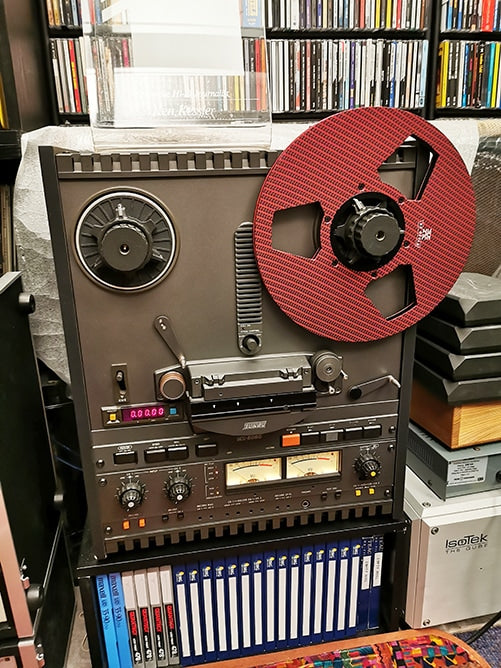
This is KK's go-to machine for playing every format: the Otari MX5050, which accommodates three speeds, half- and quarter-track, and both CCIR and NAB equalization. The Technics RS-1500 or RS-1700 can do the same, minus CCIR EQ.

Now back to pre-recorded tape. Roughly speaking, commercially-available pre-recorded tapes date from the early 1950s to the mid-1980s. I have not found any open-reel tapes from any of the major labels after 1984 or so. From that point onward, as exemplified by early, pioneering open-reel specialists like Chad Kassem’s Acoustic Sounds, the aforementioned Tape Project and Foné, and the others which emerged in their wake, nearly all post-1980s pre-recorded tapes are 15 ips, two-track recordings on 10-inch spools, with prices that, frankly, are forbidding, even though they simply reflect the costs of making pre-recorded tapes today.

Let’s deal with the Revivalists at this point. I have nothing but the utmost respect for them, and understand why they have to charge anywhere from $200 to $800 for their tapes. This is not the place for a lesson in economics or commerce – if you don’t believe in profit margins, flights will soon resume to Cuba, Belarus or North Korea – but these guys have to add a markup. When the best price for a 10-inch spool of raw tape is anywhere from $70 – $100 (and as the majority of the labels seem to be in Europe, so you must add shipping and duty to US-sourced blanks), you’re already into three figures.

Then we come to the available recordings on the revivalist labels. These are divided between reissues of material from known artists, such as the Tape Project’s titles by Linda Ronstadt and Creedence Clearwater Revival, to what I can only describe without being mean or cynical as “audiophile repertoire.”

For those of you old enough to remember the heyday of audiophile vinyl, when any Japanese pressing was considered gold dust and direct-to-disc was the height of sonic excellence, the cliché was “great sound – a shame about the music.” Part of the problem, according to the musicians, was that direct-to-disc recordings did not enable multiple takes and editing was categorically out of the question, so performances were cautious or even stilted. Despite the involvement of wizards like Doug Sax, Lincoln Mayorga, Keith O. Johnson, and others of that caliber, the audiophile genre never threatened the appeal nor sonic supremacy of recordings from the best years of Mercury, RCA, Capitol, Columbia or Decca/London.

While there were some stunning and desirable titles on audiophile labels, from artists including Taj Mahal, Thelma Houston, Earl “Fatha” Hines, Ry Cooder and others, for the most part what you ended up with were LPs you played once, put away, and only retrieved when friends came over to hear your new preamp or cartridge. One suspects they were only played repeatedly by retailers, or exhibitors at hi-fi shows. Huh? You actually listened voluntarily to the Sheffield Lab Drum Record for pleasure? Don’t tell me: you also pour a brandy and groove on Shure test disc LPs. Hmmm…the only audiophile LPs I still play are reissues via Mobile Fidelity, Nautilus and others, of known titles.


Each of these five boxes holds 19 tapes – and this is just half of KK's soundtracks collection. Each of these five boxes holds 19 tapes – and this is just half of KK's soundtracks collection.

It’s the same problem with contemporary open-reel tapes. For those re-issuing familiar works, in addition to the cost of the blank tapes, the high cost of maintaining machines for duplicating, and the need to make copies in real time, comes the swingeing cost of royalties. One label with which I discussed the idea of releasing even big-ticket, ultra-limited runs of open-reel editions of their titles simply stated that, when compared to LPs and SACDs, the costs of labor, materials, but especially royalties based on a percentage of the retail price, it is simply not worth the effort for sales which might be as low as a few dozen, if even a few hundred.

So, what does that leave? If you’re not able to reissue known works under license, then you are forced to record new repertoire. Paying the performers, booking a concert hall, funding an orchestra – it isn’t cheap unless you think you can get away with some unplugged troubadour recorded in your living room.

Every once in a while, however, something amazing will slip through, like Eleanor McEvoy’s Forgotten Dreams on Chasing the Dragon. In addition to being an intimate, live set from a much-loved vocalist, the label even eased the pain of acquiring a copy by offering it not just on direct-cut vinyl, CD, and its premium 15 ips, 10-inch, 2-track tape, they also made it available on 7-1/2 ips/7-inch for a massive savings (£350 for 15 ips vs £215 for 7-1/2 ips).

But that’s the exception. The bulk of current pre-recorded open-reel tapes involve artists you probably never heard of, playing music which is best described as “special interest.” If – and I am totally not expecting this to happen – pre-recorded open-reel tapes are going to transcend the few hundred enthusiasts wealthy enough to indulge in them, then we’re gonna need reel-to-reel copies of Dylan or Adele or Marvin Gaye or Queen or ZZ Top or Taylor Swift or Elton John or even Ed Sheeran, and for under $200 apiece. And I base that latter figure on how Mobile Fidelity sells out of every one of its Ultradisc One-Step LPs at $125 a pop, in runs now typically hitting 7,500 copies.

Which is where I came in, finding original pre-recorded tapes no newer than 35 years old, probably stored in a garage or attic, covered in mouse droppings, poorly spooled, with split boxes and smelling like a corpse. Next time, we’ll discuss the trials, tribulations, and credit card flexing required to build up a library of tapes worth playing. And yes, I’m in love with one containing folk tunes from Peru.

Header image: Just one of KK’s latest finds on eBay – not bad for under $100 including shipping to the UK and criminal import charges.


More from Issue 149

View All Articles in Issue 149

Search Copper Magazine

#227 Seth Lewis Gets in the Groove With Take a Look Around: a Tribute to the Meters by Frank Doris Feb 02, 2026 #227 Passport to Sound: May Anwar’s Audio Learning Experience for Young People by Frank Doris Feb 02, 2026 #227 Conjectures on Cosmic Consciousness by B. Jan Montana Feb 02, 2026 #227 The Big Takeover Turns 45 by Wayne Robins Feb 02, 2026 #227 Music and Chocolate: On the Sensory Connection by Joe Caplan Feb 02, 2026 #227 Singer/Songwriter Chris Berardo: Getting Wilder All the Time by Ray Chelstowski Feb 02, 2026 #227 The Earliest Stars of Country Music, Part One by Jeff Weiner Feb 02, 2026 #227 The Vinyl Beat Goes Down to Tijuana (By Way of Los Angeles), Part Two by Rudy Radelic Feb 02, 2026 #227 How to Play in a Rock Band, 20: On the Road With Blood, Sweat & Tears’ Guitarist Gabe Cummins by Frank Doris Feb 02, 2026 #227 From The Audiophile’s Guide: Audio Specs and Measuring by Paul McGowan Feb 02, 2026 #227 Our Brain is Always Listening by Peter Trübner Feb 02, 2026 #227 PS Audio in the News by PS Audio Staff Feb 02, 2026 #227 The Listening Chair: Sleek Style and Sound From the Luxman L3 by Howard Kneller Feb 02, 2026 #227 The Los Angeles and Orange County Audio Society Celebrates Its 32nd Anniversary, Honoring David and Sheryl Lee Wilson and Bernie Grundman by Harris Fogel Feb 02, 2026 #227 Back to My Reel-to-Reel Roots, Part 26: Half Full – Not Half Empty, Redux by Ken Kessler Feb 02, 2026 #227 That's What Puzzles Us... by Frank Doris Feb 02, 2026 #227 Record-Breaking by Peter Xeni Feb 02, 2026 #227 The Long and Winding Road by B. Jan Montana Feb 02, 2026 #226 JJ Murphy’s Sleep Paralysis is a Genre-Bending Musical Journey Through Jazz, Fusion and More by Frank Doris Jan 05, 2026 #226 Stewardship by Consent by B. Jan Montana Jan 05, 2026 #226 Food, Music, and Sensory Experience: An Interview With Professor Jonathan Zearfoss of the Culinary Institute of America by Joe Caplan Jan 05, 2026 #226 Studio Confidential: A Who’s Who of Recording Engineers Tell Their Stories by Frank Doris Jan 05, 2026 #226 Pilot Radio is Reborn, 50 Years Later: Talking With CEO Barak Epstein by Frank Doris Jan 05, 2026 #226 The Vinyl Beat Goes Down to Tijuana (By Way of Los Angeles), Part One by Rudy Radelic Jan 05, 2026 #226 Capital Audiofest 2025: Must-See Stereo, Part Two by Frank Doris Jan 05, 2026 #226 My Morning Jacket’s Carl Broemel and Tyler Ramsey Collaborate on Their Acoustic Guitar Album, Celestun by Ray Chelstowski Jan 05, 2026 #226 The People Who Make Audio Happen: CanJam SoCal 2025, Part Two by Harris Fogel Jan 05, 2026 #226 How to Play in a Rock Band, 19: Touring Can Make You Crazy, Part One by Frank Doris Jan 05, 2026 #226 Linda Ronstadt Goes Bigger by Wayne Robins Jan 05, 2026 #226 From The Audiophile’s Guide: Active Room Correction and Digital Signal Processing by Paul McGowan Jan 05, 2026 #226 PS Audio in the News by Frank Doris Jan 05, 2026 #226 Back to My Reel-to-Reel Roots, Part 25: Half-Full, Not Empty by Ken Kessler Jan 05, 2026 #226 Happy New Year! by Frank Doris Jan 05, 2026 #226 Turn It Down! by Peter Xeni Jan 05, 2026 #226 Ghost Riders by James Schrimpf Jan 05, 2026 #226 A Factory Tour of Audio Manufacturer German Physiks by Markus "Marsu" Manthey Jan 04, 2026 #225 Capital Audiofest 2025: Must-See Stereo, Part One by Frank Doris Dec 01, 2025 #225 Otis Taylor and the Electrics Delivers a Powerful Set of Hypnotic Modern Blues by Frank Doris Dec 01, 2025 #225 A Christmas Miracle by B. Jan Montana Dec 01, 2025 #225 T.H.E. Show New York 2025, Part Two: Plenty to See, Hear, and Enjoy by Frank Doris Dec 01, 2025 #225 Underappreciated Artists, Part One: Martin Briley by Rich Isaacs Dec 01, 2025 #225 Rock and Roll is Here to Stay by Wayne Robins Dec 01, 2025 #225 A Lifetime of Holiday Record (and CD) Listening by Rudy Radelic Dec 01, 2025 #225 Little Feat: Not Saying Goodbye, Not Yet by Ray Chelstowski Dec 01, 2025 #225 How to Play in a Rock Band, Part 18: Dealing With Burnout by Frank Doris Dec 01, 2025 #225 The People Who Make Audio Happen: CanJam SoCal 2025 by Harris Fogel Dec 01, 2025 #225 Chicago’s Sonic Sanctuaries: Four Hi‑Fi Listening Bars Channeling the Jazz‑Kissa Spirit by Olivier Meunier-Plante Dec 01, 2025

Back to My Reel-to-Reel Roots, Part Three

Back to My Reel-to-Reel Roots, Part Three

Just so there are no misunderstandings, I have to explain to you how focused is my interest in reel-to-reel tape. I absolutely don’t want to be challenged or trolled by studio denizens about why did I forget about such-and-such, 30 ips is better, yadayadayada. My interest is, firstly, ONLY about playback and, secondly, about domestic machines because I only care about pre-recorded open-reel tapes.

Thus, you will not read in my jottings anything to do with professional machines, the current availability of fresh blank tape, mixing desks, how to ensure correct record levels, microphones, ad infinitum. That’s because not only am I concerned exclusively with pre-recorded tape, my interest is also restricted to what we might call The Original Open Reel Era. For clarity, the tapes you can buy today from the Tape Project, Fonè, STS, et al, comprise what I will call The Open Reel Revivalists.

Simply put, I have no intention of recording anything live or off-air, though I will, at a later point, touch on the cult interest in transferring CDs or even LPs to tape, by those who find it improves the sound. Moreover, I am fully aware that there are countless audiophiles using professional machines, especially the much-coveted Studer 800 Series decks in 1/2-track form, in their sound systems. Mazel tov to them. But pro decks, in the main, relate to my field of interest as howitzers do to water pistols.

Finishing off with the hardware element for the time being, as I understand it, the production of open-reel machines (pro or domestic) from major makers ended around 2010 with the last of the Otaris. The end of quantity- or series-production tape decks for studios is not something I have researched, so I am going on what I was told by professionals. Since then, what you have are virtually bespoke, limited production items from specialists like Ballfinger, or resuscitated decks from the various restorers and resellers of Technics, TEAC, ReVox, and other rescued units.

For purely domestic open-reel tape recorders, from Akai, Sony, Pioneer and so on, I would have imagined that they ceased production in the early-to-mid 1990s. That certainly applies to one of the most important and popular manufacturers, which – according to authors Luca Maria Olgiati and Paolo Bologna, in their definitive history – show that ReVox’s last open-reel machine, the PR99 Mk III, was made in 1993.

[For the full saga, get a copy of their superb book, ReVox Reel to Reel Tape Recorders 1949-1993 (ReVoxMania, ISBN 978-1-36-659060-2). I found mine on Amazon.]

Finishing off with the hardware, the puzzler in my arsenal is the Otari MX5050 because I always thought of that brand as pro-only, yet here is a machine which, like the Technics RS-1500, plays three speeds and two formats. And who ever used 1/4-track in studios? Even if I lost all my other machines, between the Otari and the Technics there isn’t a commercial pre-recorded tape, whether Original Open Reel Era or current 15 ips stuff, which cannot be played.


This is KK's go-to machine for playing every format: the Otari MX5050, which accommodates three speeds, half- and quarter-track, and both CCIR and NAB equalization. The Technics RS-1500 or RS-1700 can do the same, minus CCIR EQ.

Now back to pre-recorded tape. Roughly speaking, commercially-available pre-recorded tapes date from the early 1950s to the mid-1980s. I have not found any open-reel tapes from any of the major labels after 1984 or so. From that point onward, as exemplified by early, pioneering open-reel specialists like Chad Kassem’s Acoustic Sounds, the aforementioned Tape Project and Foné, and the others which emerged in their wake, nearly all post-1980s pre-recorded tapes are 15 ips, two-track recordings on 10-inch spools, with prices that, frankly, are forbidding, even though they simply reflect the costs of making pre-recorded tapes today.

Let’s deal with the Revivalists at this point. I have nothing but the utmost respect for them, and understand why they have to charge anywhere from $200 to $800 for their tapes. This is not the place for a lesson in economics or commerce – if you don’t believe in profit margins, flights will soon resume to Cuba, Belarus or North Korea – but these guys have to add a markup. When the best price for a 10-inch spool of raw tape is anywhere from $70 – $100 (and as the majority of the labels seem to be in Europe, so you must add shipping and duty to US-sourced blanks), you’re already into three figures.

Then we come to the available recordings on the revivalist labels. These are divided between reissues of material from known artists, such as the Tape Project’s titles by Linda Ronstadt and Creedence Clearwater Revival, to what I can only describe without being mean or cynical as “audiophile repertoire.”

For those of you old enough to remember the heyday of audiophile vinyl, when any Japanese pressing was considered gold dust and direct-to-disc was the height of sonic excellence, the cliché was “great sound – a shame about the music.” Part of the problem, according to the musicians, was that direct-to-disc recordings did not enable multiple takes and editing was categorically out of the question, so performances were cautious or even stilted. Despite the involvement of wizards like Doug Sax, Lincoln Mayorga, Keith O. Johnson, and others of that caliber, the audiophile genre never threatened the appeal nor sonic supremacy of recordings from the best years of Mercury, RCA, Capitol, Columbia or Decca/London.

While there were some stunning and desirable titles on audiophile labels, from artists including Taj Mahal, Thelma Houston, Earl “Fatha” Hines, Ry Cooder and others, for the most part what you ended up with were LPs you played once, put away, and only retrieved when friends came over to hear your new preamp or cartridge. One suspects they were only played repeatedly by retailers, or exhibitors at hi-fi shows. Huh? You actually listened voluntarily to the Sheffield Lab Drum Record for pleasure? Don’t tell me: you also pour a brandy and groove on Shure test disc LPs. Hmmm…the only audiophile LPs I still play are reissues via Mobile Fidelity, Nautilus and others, of known titles.


Each of these five boxes holds 19 tapes – and this is just half of KK's soundtracks collection. Each of these five boxes holds 19 tapes – and this is just half of KK's soundtracks collection.

It’s the same problem with contemporary open-reel tapes. For those re-issuing familiar works, in addition to the cost of the blank tapes, the high cost of maintaining machines for duplicating, and the need to make copies in real time, comes the swingeing cost of royalties. One label with which I discussed the idea of releasing even big-ticket, ultra-limited runs of open-reel editions of their titles simply stated that, when compared to LPs and SACDs, the costs of labor, materials, but especially royalties based on a percentage of the retail price, it is simply not worth the effort for sales which might be as low as a few dozen, if even a few hundred.

So, what does that leave? If you’re not able to reissue known works under license, then you are forced to record new repertoire. Paying the performers, booking a concert hall, funding an orchestra – it isn’t cheap unless you think you can get away with some unplugged troubadour recorded in your living room.

Every once in a while, however, something amazing will slip through, like Eleanor McEvoy’s Forgotten Dreams on Chasing the Dragon. In addition to being an intimate, live set from a much-loved vocalist, the label even eased the pain of acquiring a copy by offering it not just on direct-cut vinyl, CD, and its premium 15 ips, 10-inch, 2-track tape, they also made it available on 7-1/2 ips/7-inch for a massive savings (£350 for 15 ips vs £215 for 7-1/2 ips).

But that’s the exception. The bulk of current pre-recorded open-reel tapes involve artists you probably never heard of, playing music which is best described as “special interest.” If – and I am totally not expecting this to happen – pre-recorded open-reel tapes are going to transcend the few hundred enthusiasts wealthy enough to indulge in them, then we’re gonna need reel-to-reel copies of Dylan or Adele or Marvin Gaye or Queen or ZZ Top or Taylor Swift or Elton John or even Ed Sheeran, and for under $200 apiece. And I base that latter figure on how Mobile Fidelity sells out of every one of its Ultradisc One-Step LPs at $125 a pop, in runs now typically hitting 7,500 copies.

Which is where I came in, finding original pre-recorded tapes no newer than 35 years old, probably stored in a garage or attic, covered in mouse droppings, poorly spooled, with split boxes and smelling like a corpse. Next time, we’ll discuss the trials, tribulations, and credit card flexing required to build up a library of tapes worth playing. And yes, I’m in love with one containing folk tunes from Peru.

Header image: Just one of KK’s latest finds on eBay – not bad for under $100 including shipping to the UK and criminal import charges.

This is KK's go-to machine for playing every format: the Otari MX5050, which accommodates three speeds, half- and quarter-track, and both CCIR and NAB equalization. The Technics RS-1500 or RS-1700 can do the same, minus CCIR EQ.

Now back to pre-recorded tape. Roughly speaking, commercially-available pre-recorded tapes date from the early 1950s to the mid-1980s. I have not found any open-reel tapes from any of the major labels after 1984 or so. From that point onward, as exemplified by early, pioneering open-reel specialists like Chad Kassem’s Acoustic Sounds, the aforementioned Tape Project and Foné, and the others which emerged in their wake, nearly all post-1980s pre-recorded tapes are 15 ips, two-track recordings on 10-inch spools, with prices that, frankly, are forbidding, even though they simply reflect the costs of making pre-recorded tapes today.

Let’s deal with the Revivalists at this point. I have nothing but the utmost respect for them, and understand why they have to charge anywhere from $200 to $800 for their tapes. This is not the place for a lesson in economics or commerce – if you don’t believe in profit margins, flights will soon resume to Cuba, Belarus or North Korea – but these guys have to add a markup. When the best price for a 10-inch spool of raw tape is anywhere from $70 – $100 (and as the majority of the labels seem to be in Europe, so you must add shipping and duty to US-sourced blanks), you’re already into three figures.

Then we come to the available recordings on the revivalist labels. These are divided between reissues of material from known artists, such as the Tape Project’s titles by Linda Ronstadt and Creedence Clearwater Revival, to what I can only describe without being mean or cynical as “audiophile repertoire.”

For those of you old enough to remember the heyday of audiophile vinyl, when any Japanese pressing was considered gold dust and direct-to-disc was the height of sonic excellence, the cliché was “great sound – a shame about the music.” Part of the problem, according to the musicians, was that direct-to-disc recordings did not enable multiple takes and editing was categorically out of the question, so performances were cautious or even stilted. Despite the involvement of wizards like Doug Sax, Lincoln Mayorga, Keith O. Johnson, and others of that caliber, the audiophile genre never threatened the appeal nor sonic supremacy of recordings from the best years of Mercury, RCA, Capitol, Columbia or Decca/London.

While there were some stunning and desirable titles on audiophile labels, from artists including Taj Mahal, Thelma Houston, Earl “Fatha” Hines, Ry Cooder and others, for the most part what you ended up with were LPs you played once, put away, and only retrieved when friends came over to hear your new preamp or cartridge. One suspects they were only played repeatedly by retailers, or exhibitors at hi-fi shows. Huh? You actually listened voluntarily to the Sheffield Lab Drum Record for pleasure? Don’t tell me: you also pour a brandy and groove on Shure test disc LPs. Hmmm…the only audiophile LPs I still play are reissues via Mobile Fidelity, Nautilus and others, of known titles.


Each of these five boxes holds 19 tapes – and this is just half of KK's soundtracks collection. Each of these five boxes holds 19 tapes – and this is just half of KK's soundtracks collection.

It’s the same problem with contemporary open-reel tapes. For those re-issuing familiar works, in addition to the cost of the blank tapes, the high cost of maintaining machines for duplicating, and the need to make copies in real time, comes the swingeing cost of royalties. One label with which I discussed the idea of releasing even big-ticket, ultra-limited runs of open-reel editions of their titles simply stated that, when compared to LPs and SACDs, the costs of labor, materials, but especially royalties based on a percentage of the retail price, it is simply not worth the effort for sales which might be as low as a few dozen, if even a few hundred.

So, what does that leave? If you’re not able to reissue known works under license, then you are forced to record new repertoire. Paying the performers, booking a concert hall, funding an orchestra – it isn’t cheap unless you think you can get away with some unplugged troubadour recorded in your living room.

Every once in a while, however, something amazing will slip through, like Eleanor McEvoy’s Forgotten Dreams on Chasing the Dragon. In addition to being an intimate, live set from a much-loved vocalist, the label even eased the pain of acquiring a copy by offering it not just on direct-cut vinyl, CD, and its premium 15 ips, 10-inch, 2-track tape, they also made it available on 7-1/2 ips/7-inch for a massive savings (£350 for 15 ips vs £215 for 7-1/2 ips).

But that’s the exception. The bulk of current pre-recorded open-reel tapes involve artists you probably never heard of, playing music which is best described as “special interest.” If – and I am totally not expecting this to happen – pre-recorded open-reel tapes are going to transcend the few hundred enthusiasts wealthy enough to indulge in them, then we’re gonna need reel-to-reel copies of Dylan or Adele or Marvin Gaye or Queen or ZZ Top or Taylor Swift or Elton John or even Ed Sheeran, and for under $200 apiece. And I base that latter figure on how Mobile Fidelity sells out of every one of its Ultradisc One-Step LPs at $125 a pop, in runs now typically hitting 7,500 copies.

Which is where I came in, finding original pre-recorded tapes no newer than 35 years old, probably stored in a garage or attic, covered in mouse droppings, poorly spooled, with split boxes and smelling like a corpse. Next time, we’ll discuss the trials, tribulations, and credit card flexing required to build up a library of tapes worth playing. And yes, I’m in love with one containing folk tunes from Peru.

Header image: Just one of KK’s latest finds on eBay – not bad for under $100 including shipping to the UK and criminal import charges.


0 comments

Leave a comment

0 Comments

Your avatar

Loading comments...

🗑️ Delete Comment

Enter moderator password to delete this comment:

✏️ Edit Comment

Enter your email to verify ownership: