COPPER

A PS Audio Publication

Issue 120 • Free Online Magazine

Issue 120 REVOLUTIONS PER MINUTE

Acoustic Design Consultant Philip Newell, Part Two

Acoustic Design Consultant Philip Newell, Part Two
In Part One (Issue 119), acoustical design consultant Philip Newell talked about his early years in the 1960s and 1970s, his experiences with Virgin Records and entrepreneur Richard Branson, the reason he got a pilot’s license and other topics. The interview continues here.
Philip Newell back in the day.

J.I. Agnew:

During the 1973 oil crisis, you fitted several huge fuel tanks to the Manor Mobile recording truck, to give it a range “from Oxford to the South of France and back without refuelling.” Then, in 1978, you were planning on constructing a studio for Virgin Records on Necker island, a deserted island where no infrastructure whatsoever existed, which you expected to fly to with a seaplane. Was there a certain pattern of “going further” in these endeavors?

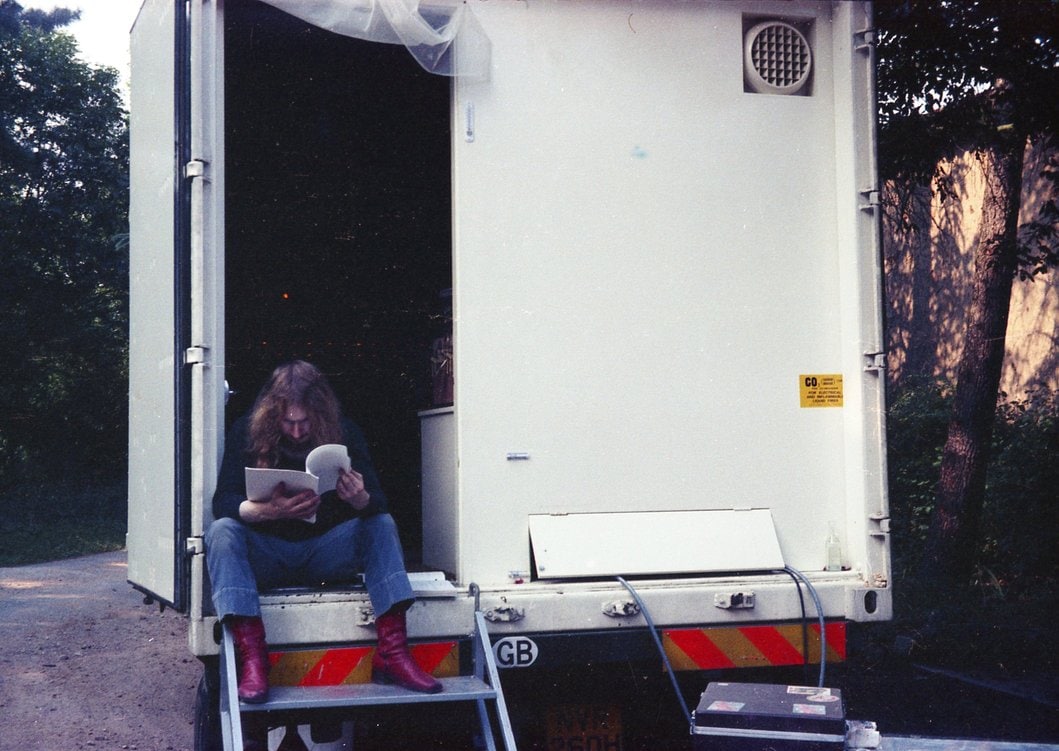
The Manor Mobile recording truck, retrofitted with extra fuel tanks underneath.

Philip Newell: There was an enormous spirit of optimism in the Virgin organisation, which seemed to match Richard [Branson’s] adventurous spirit. I think he really enjoyed it when any of us took on challenges and did things that were unusual. He granted us all a great degree of autonomy, and backed a lot of our ideas. I think most of the 1970s Virgin team still have a lot of affection for him.

JIA: What was so special about Virgin during that time, compared to other labels/studios in the UK? What was driving Virgin in the often-unconventional directions it took?

PN: Initially, I suppose it had to be said that it largely all coagulated around Richard and his personality. To me, he certainly seemed like an odd guy, and in many ways, it seemed like he didn’t have much of a clue about anything – and especially not about music – yet it seemed that he could make things happen. It didn’t take long before there was a very creative group of people around him, all individuals, and all full of ideas and enthusiasm, yet all cooperating. It reached a sort of critical mass, after which it disintegrated, but it had sowed the seeds of many ideas with a lot of energy and a very positive spirit.


One of the control rooms inside a Manor Mobile recording truck, 1970s.

At the time, many things in the industry were very set in their ways, but Richard liked to hear about how things could be done better, and the “think tank” surrounding him had the knowledge about how to do them better. Looking back, I am sure that Richard’s prime motivation was building his empire, and he probably saw all of these alternative ways as means of establishing footholds for his upwards climb. However, in doing this, he became an “enabler.” He enabled many people to do these “disruptive” things, and it led to a culture of inspired ideas, and different concepts of record labels and studios, amongst many other things.

JIA: Would it be possible to do such things nowadays?

PN: I don’t think that we could work in the same way today because, certainly in the UK, it is a much more controlled world that we live in. There is so much more regulation and control over so much daily life. Freedom in the UK has definitely gone backwards. I also don’t think that there is the same general spirit of optimism around. In the year before Virgin began, men had just landed on the Moon, and the first Concorde had just flown. Everything seemed to be possible, and things were also not strangled by “health and safety” laws . You could actually go up a ladder, at work, without having attended a training course about ladders. There was much more individual responsibility and much less “nanny state.” I am sure that this helped to allow Virgin to be less conventional, which enabled the creativity to thrive.

JIA: How did you acquire your diverse set of skills, which enabled you to do so many different things on a professional level successfully?

PN: All of those seemingly diverse things are actually linked. I can show you a link between any two of them. Essentially, one thing led to another, sometimes through a chain of events, and sometimes through branching out, like a tree, but they are all linked. [My live sound work at] the Orchid ballroom led to the London studios, which led to The Manor Studio. An engineer at The Manor was learning to fly, which sparked my curiosity. Then I, also, learned to fly, so when Richard bought Necker Island, I converted to [flying] seaplanes, which I became fascinated by. This led me to visit Southampton University, where I was unexpectedly introduced to the Institute of Sound and Vibration Research, which led me back to studio design. I could never have planned it all like that, but it was all fascinating. And the fact that things were linked meant that I never had to break contact with any of my past, so I didn’t lose my old friends.
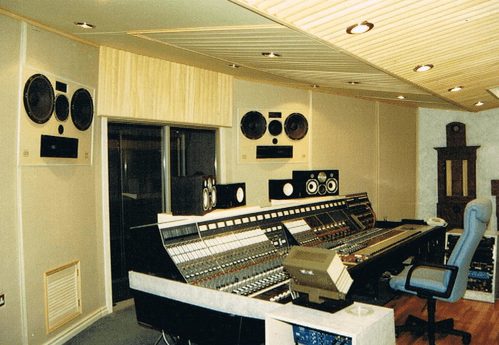

The control room of the Pink Museum (now the Motor Museum) in Liverpool, England in 1988.

I suppose that the fundamental thing is that I was interested in all of these things. I actually wanted to do them, almost as though they were my hobbies. I was enthusiastic about them. So, I would say that it was not about working hard at something so that I could be successful; it was about doing things that I was so enthusiastic about that it barely seemed like work. I think the success came from the commitment (although I am not sure it was as great for my family life).

JIA: What kind of educational path would you recommend to young people nowadays, wishing to build up a similarly diverse skillset?

PN: What I would recommend is to find careers that are based on things that you enjoy doing, so that even the bad times are part of something good. Success will probably follow if people are enthusiastic about doing something that they not only have an aptitude for, but also something that they like doing. However, you have to be realistic. At 62 kilograms [137 pounds], it was no use me wanting to be a professional rugby player or a renowned Sumo wrestler, as I just wasn’t big enough. And, with my dismal lack of interest in gourmet food, I was never going to be a master chef either. Also, hovering around world-class musicians at the age of 18, I soon knew that I was no budding virtuoso, and I didn’t have the necessary dedication to any instrument. Nevertheless, I did have skills which could help the musicians make great recordings, and I began to enjoy it. You have to find where you fit into the team. Being part of a good team can be very rewarding – in many ways.

JIA: Which of the many different phases of your career would you say has been the most fulfilling and enjoyable for you?

PN: In general, what has been special has been sharing a lot of time with so many amazingly creative, enthusiastic and skilful people: whether artistic or academic. Their attributes are infectious. However, my time with Virgin, from 1971 to 1981, was like a rocket ride (albeit sometimes with a seemingly unreliable guidance system). The first ten years of Virgin were something really special. The whole organisation involved a very special team of people. It was the springboard to everything I did later.

JIA: In many of your writings, you have stated the importance of accurate monitoring in studios. How important do you think it is to have accurate loudspeakers and controlled acoustics in domestic listening rooms?

PN: I think the whole concept of high-fidelity music in the home is now disappearing. The culture is changing, and music is becoming just part of the multi-stimulus packages that are wanted more for their convenience than for their fidelity. I remember writing an article in the 1990s called “Hi-Fi or Surround?” You may wish for both, but in reality, once you try to set up music systems with more than two loudspeakers in the home – at least in any way that will accommodate domestic convenience – the performance soon becomes idiosyncratic, with little chance of things sounding the same as in anyone else’s home. In fact, it may sound “great” in many of these homes, but it probably has no fidelity to any reference, and they can’t all be true to any original if they are all different.

So, with the change in the reality and the change in the culture of listening, I really can’t imagine the return of very high-quality sound-systems in people’s homes in the near future. Perhaps that culture is now lost. I come across very few young people, nowadays, who just want to sit down and listen to music on good loudspeakers without simultaneously multi-tasking – or turning off the phone! Also, the convenience of listening now seems to have trumped sound quality. Perhaps we now have to judge things in terms of the quality of the overall experience of all that they are doing at the same time, as opposed to just the sound quality of the music. True hi-fi sound is a relatively rare experience in homes, these days.

JIA: To what extent do consumer listening trends affect how studios are being designed?

PN: I don’t think that they are affecting things much. I think that maybe 10 or 15 years ago there were attempts by some studios to follow end-product fashion, such as by trying to use monitor loudspeakers which gave the best  compatibility with listening on ear buds. However, it proved to be not only impractical, but also to be very short-lived as the listening fashions changed.


Another view of the Pink Museum (now the Motor Museum).


Anyhow, it has been shown in various very large international studies that the average of all domestic listening experiences in all formats is virtually flat [J.I. will elaborate on this in the next issue – Ed.], so the best way to be fair to all of them is to follow the best long-established professional practices. This means working in monitoring conditions with high fidelity and flat responses, which also actually makes things much easier for the musicians and the recording personnel. Any required compromises can then be judged at the mastering stage, and adjusted if necessary, but the basic recording will always have long-term compatibility. So, essentially, nothing has changed in the last 50 years about the concept of what constitutes good studio monitoring. It is just that we can actually do it better now, because we understand more about it.

JIA: If there would be one thing you could change about how the music industry works nowadays, what would it be?

PN: I have no idea, because how the industry works is inextricably linked to changes in the culture, so it is no use changing something if the prevailing culture doesn’t value the change. I think there is a widening generation gap, so it is difficult for me to judge what would now be seen as any “improvement.” Would how I might want [things] to change have any meaning to the majority of other people? Probably not!

The music industry has always been a reflection of its time. It is unlikely that the 1980s electronic new wave music would have had any success whatsoever in a 1960s market, even if those instruments had been invented then. It had no resonance with 1960s general culture. What is more, the industry has also been radically affected by the changes in technology. New synthesisers drove much of the new music in the 1980s, but could many 1980s record companies have flourished once streaming and downloading began? Could any small company have resisted the bullying tactics of the modern multinationals? In so many ways, nowadays, what is happening in music is being led by the technology giants. They have largely taken over the whole show.


Header image: the control room in one of the Manor Mobile remote recording trucks during the 1970s.

More from Issue 120

View All Articles in Issue 120

Search Copper Magazine

#227 Seth Lewis Gets in the Groove With Take a Look Around: a Tribute to the Meters by Frank Doris Feb 02, 2026 #227 Passport to Sound: May Anwar’s Audio Learning Experience for Young People by Frank Doris Feb 02, 2026 #227 Conjectures on Cosmic Consciousness by B. Jan Montana Feb 02, 2026 #227 The Big Takeover Turns 45 by Wayne Robins Feb 02, 2026 #227 Music and Chocolate: On the Sensory Connection by Joe Caplan Feb 02, 2026 #227 Singer/Songwriter Chris Berardo: Getting Wilder All the Time by Ray Chelstowski Feb 02, 2026 #227 The Earliest Stars of Country Music, Part One by Jeff Weiner Feb 02, 2026 #227 The Vinyl Beat Goes Down to Tijuana (By Way of Los Angeles), Part Two by Rudy Radelic Feb 02, 2026 #227 How to Play in a Rock Band, 20: On the Road With Blood, Sweat & Tears’ Guitarist Gabe Cummins by Frank Doris Feb 02, 2026 #227 From The Audiophile’s Guide: Audio Specs and Measuring by Paul McGowan Feb 02, 2026 #227 Our Brain is Always Listening by Peter Trübner Feb 02, 2026 #227 PS Audio in the News by PS Audio Staff Feb 02, 2026 #227 The Listening Chair: Sleek Style and Sound From the Luxman L3 by Howard Kneller Feb 02, 2026 #227 The Los Angeles and Orange County Audio Society Celebrates Its 32nd Anniversary, Honoring David and Sheryl Lee Wilson and Bernie Grundman by Harris Fogel Feb 02, 2026 #227 Back to My Reel-to-Reel Roots, Part 26: Half Full – Not Half Empty, Redux by Ken Kessler Feb 02, 2026 #227 That's What Puzzles Us... by Frank Doris Feb 02, 2026 #227 Record-Breaking by Peter Xeni Feb 02, 2026 #227 The Long and Winding Road by B. Jan Montana Feb 02, 2026 #226 JJ Murphy’s Sleep Paralysis is a Genre-Bending Musical Journey Through Jazz, Fusion and More by Frank Doris Jan 05, 2026 #226 Stewardship by Consent by B. Jan Montana Jan 05, 2026 #226 Food, Music, and Sensory Experience: An Interview With Professor Jonathan Zearfoss of the Culinary Institute of America by Joe Caplan Jan 05, 2026 #226 Studio Confidential: A Who’s Who of Recording Engineers Tell Their Stories by Frank Doris Jan 05, 2026 #226 Pilot Radio is Reborn, 50 Years Later: Talking With CEO Barak Epstein by Frank Doris Jan 05, 2026 #226 The Vinyl Beat Goes Down to Tijuana (By Way of Los Angeles), Part One by Rudy Radelic Jan 05, 2026 #226 Capital Audiofest 2025: Must-See Stereo, Part Two by Frank Doris Jan 05, 2026 #226 My Morning Jacket’s Carl Broemel and Tyler Ramsey Collaborate on Their Acoustic Guitar Album, Celestun by Ray Chelstowski Jan 05, 2026 #226 The People Who Make Audio Happen: CanJam SoCal 2025, Part Two by Harris Fogel Jan 05, 2026 #226 How to Play in a Rock Band, 19: Touring Can Make You Crazy, Part One by Frank Doris Jan 05, 2026 #226 Linda Ronstadt Goes Bigger by Wayne Robins Jan 05, 2026 #226 From The Audiophile’s Guide: Active Room Correction and Digital Signal Processing by Paul McGowan Jan 05, 2026 #226 PS Audio in the News by Frank Doris Jan 05, 2026 #226 Back to My Reel-to-Reel Roots, Part 25: Half-Full, Not Empty by Ken Kessler Jan 05, 2026 #226 Happy New Year! by Frank Doris Jan 05, 2026 #226 Turn It Down! by Peter Xeni Jan 05, 2026 #226 Ghost Riders by James Schrimpf Jan 05, 2026 #226 A Factory Tour of Audio Manufacturer German Physiks by Markus "Marsu" Manthey Jan 04, 2026 #225 Capital Audiofest 2025: Must-See Stereo, Part One by Frank Doris Dec 01, 2025 #225 Otis Taylor and the Electrics Delivers a Powerful Set of Hypnotic Modern Blues by Frank Doris Dec 01, 2025 #225 A Christmas Miracle by B. Jan Montana Dec 01, 2025 #225 T.H.E. Show New York 2025, Part Two: Plenty to See, Hear, and Enjoy by Frank Doris Dec 01, 2025 #225 Underappreciated Artists, Part One: Martin Briley by Rich Isaacs Dec 01, 2025 #225 Rock and Roll is Here to Stay by Wayne Robins Dec 01, 2025 #225 A Lifetime of Holiday Record (and CD) Listening by Rudy Radelic Dec 01, 2025 #225 Little Feat: Not Saying Goodbye, Not Yet by Ray Chelstowski Dec 01, 2025 #225 How to Play in a Rock Band, Part 18: Dealing With Burnout by Frank Doris Dec 01, 2025 #225 The People Who Make Audio Happen: CanJam SoCal 2025 by Harris Fogel Dec 01, 2025 #225 Chicago’s Sonic Sanctuaries: Four Hi‑Fi Listening Bars Channeling the Jazz‑Kissa Spirit by Olivier Meunier-Plante Dec 01, 2025

Acoustic Design Consultant Philip Newell, Part Two

Acoustic Design Consultant Philip Newell, Part Two
In Part One (Issue 119), acoustical design consultant Philip Newell talked about his early years in the 1960s and 1970s, his experiences with Virgin Records and entrepreneur Richard Branson, the reason he got a pilot’s license and other topics. The interview continues here.
Philip Newell back in the day.

J.I. Agnew:

During the 1973 oil crisis, you fitted several huge fuel tanks to the Manor Mobile recording truck, to give it a range “from Oxford to the South of France and back without refuelling.” Then, in 1978, you were planning on constructing a studio for Virgin Records on Necker island, a deserted island where no infrastructure whatsoever existed, which you expected to fly to with a seaplane. Was there a certain pattern of “going further” in these endeavors?

The Manor Mobile recording truck, retrofitted with extra fuel tanks underneath.

Philip Newell: There was an enormous spirit of optimism in the Virgin organisation, which seemed to match Richard [Branson’s] adventurous spirit. I think he really enjoyed it when any of us took on challenges and did things that were unusual. He granted us all a great degree of autonomy, and backed a lot of our ideas. I think most of the 1970s Virgin team still have a lot of affection for him.

JIA: What was so special about Virgin during that time, compared to other labels/studios in the UK? What was driving Virgin in the often-unconventional directions it took?

PN: Initially, I suppose it had to be said that it largely all coagulated around Richard and his personality. To me, he certainly seemed like an odd guy, and in many ways, it seemed like he didn’t have much of a clue about anything – and especially not about music – yet it seemed that he could make things happen. It didn’t take long before there was a very creative group of people around him, all individuals, and all full of ideas and enthusiasm, yet all cooperating. It reached a sort of critical mass, after which it disintegrated, but it had sowed the seeds of many ideas with a lot of energy and a very positive spirit.


One of the control rooms inside a Manor Mobile recording truck, 1970s.

At the time, many things in the industry were very set in their ways, but Richard liked to hear about how things could be done better, and the “think tank” surrounding him had the knowledge about how to do them better. Looking back, I am sure that Richard’s prime motivation was building his empire, and he probably saw all of these alternative ways as means of establishing footholds for his upwards climb. However, in doing this, he became an “enabler.” He enabled many people to do these “disruptive” things, and it led to a culture of inspired ideas, and different concepts of record labels and studios, amongst many other things.

JIA: Would it be possible to do such things nowadays?

PN: I don’t think that we could work in the same way today because, certainly in the UK, it is a much more controlled world that we live in. There is so much more regulation and control over so much daily life. Freedom in the UK has definitely gone backwards. I also don’t think that there is the same general spirit of optimism around. In the year before Virgin began, men had just landed on the Moon, and the first Concorde had just flown. Everything seemed to be possible, and things were also not strangled by “health and safety” laws . You could actually go up a ladder, at work, without having attended a training course about ladders. There was much more individual responsibility and much less “nanny state.” I am sure that this helped to allow Virgin to be less conventional, which enabled the creativity to thrive.

JIA: How did you acquire your diverse set of skills, which enabled you to do so many different things on a professional level successfully?

PN: All of those seemingly diverse things are actually linked. I can show you a link between any two of them. Essentially, one thing led to another, sometimes through a chain of events, and sometimes through branching out, like a tree, but they are all linked. [My live sound work at] the Orchid ballroom led to the London studios, which led to The Manor Studio. An engineer at The Manor was learning to fly, which sparked my curiosity. Then I, also, learned to fly, so when Richard bought Necker Island, I converted to [flying] seaplanes, which I became fascinated by. This led me to visit Southampton University, where I was unexpectedly introduced to the Institute of Sound and Vibration Research, which led me back to studio design. I could never have planned it all like that, but it was all fascinating. And the fact that things were linked meant that I never had to break contact with any of my past, so I didn’t lose my old friends.


The control room of the Pink Museum (now the Motor Museum) in Liverpool, England in 1988.

I suppose that the fundamental thing is that I was interested in all of these things. I actually wanted to do them, almost as though they were my hobbies. I was enthusiastic about them. So, I would say that it was not about working hard at something so that I could be successful; it was about doing things that I was so enthusiastic about that it barely seemed like work. I think the success came from the commitment (although I am not sure it was as great for my family life).

JIA: What kind of educational path would you recommend to young people nowadays, wishing to build up a similarly diverse skillset?

PN: What I would recommend is to find careers that are based on things that you enjoy doing, so that even the bad times are part of something good. Success will probably follow if people are enthusiastic about doing something that they not only have an aptitude for, but also something that they like doing. However, you have to be realistic. At 62 kilograms [137 pounds], it was no use me wanting to be a professional rugby player or a renowned Sumo wrestler, as I just wasn’t big enough. And, with my dismal lack of interest in gourmet food, I was never going to be a master chef either. Also, hovering around world-class musicians at the age of 18, I soon knew that I was no budding virtuoso, and I didn’t have the necessary dedication to any instrument. Nevertheless, I did have skills which could help the musicians make great recordings, and I began to enjoy it. You have to find where you fit into the team. Being part of a good team can be very rewarding – in many ways.

JIA: Which of the many different phases of your career would you say has been the most fulfilling and enjoyable for you?

PN: In general, what has been special has been sharing a lot of time with so many amazingly creative, enthusiastic and skilful people: whether artistic or academic. Their attributes are infectious. However, my time with Virgin, from 1971 to 1981, was like a rocket ride (albeit sometimes with a seemingly unreliable guidance system). The first ten years of Virgin were something really special. The whole organisation involved a very special team of people. It was the springboard to everything I did later.

JIA: In many of your writings, you have stated the importance of accurate monitoring in studios. How important do you think it is to have accurate loudspeakers and controlled acoustics in domestic listening rooms?

PN: I think the whole concept of high-fidelity music in the home is now disappearing. The culture is changing, and music is becoming just part of the multi-stimulus packages that are wanted more for their convenience than for their fidelity. I remember writing an article in the 1990s called “Hi-Fi or Surround?” You may wish for both, but in reality, once you try to set up music systems with more than two loudspeakers in the home – at least in any way that will accommodate domestic convenience – the performance soon becomes idiosyncratic, with little chance of things sounding the same as in anyone else’s home. In fact, it may sound “great” in many of these homes, but it probably has no fidelity to any reference, and they can’t all be true to any original if they are all different.

So, with the change in the reality and the change in the culture of listening, I really can’t imagine the return of very high-quality sound-systems in people’s homes in the near future. Perhaps that culture is now lost. I come across very few young people, nowadays, who just want to sit down and listen to music on good loudspeakers without simultaneously multi-tasking – or turning off the phone! Also, the convenience of listening now seems to have trumped sound quality. Perhaps we now have to judge things in terms of the quality of the overall experience of all that they are doing at the same time, as opposed to just the sound quality of the music. True hi-fi sound is a relatively rare experience in homes, these days.

JIA: To what extent do consumer listening trends affect how studios are being designed?

PN: I don’t think that they are affecting things much. I think that maybe 10 or 15 years ago there were attempts by some studios to follow end-product fashion, such as by trying to use monitor loudspeakers which gave the best  compatibility with listening on ear buds. However, it proved to be not only impractical, but also to be very short-lived as the listening fashions changed.


Another view of the Pink Museum (now the Motor Museum).


Anyhow, it has been shown in various very large international studies that the average of all domestic listening experiences in all formats is virtually flat [J.I. will elaborate on this in the next issue – Ed.], so the best way to be fair to all of them is to follow the best long-established professional practices. This means working in monitoring conditions with high fidelity and flat responses, which also actually makes things much easier for the musicians and the recording personnel. Any required compromises can then be judged at the mastering stage, and adjusted if necessary, but the basic recording will always have long-term compatibility. So, essentially, nothing has changed in the last 50 years about the concept of what constitutes good studio monitoring. It is just that we can actually do it better now, because we understand more about it.

JIA: If there would be one thing you could change about how the music industry works nowadays, what would it be?

PN: I have no idea, because how the industry works is inextricably linked to changes in the culture, so it is no use changing something if the prevailing culture doesn’t value the change. I think there is a widening generation gap, so it is difficult for me to judge what would now be seen as any “improvement.” Would how I might want [things] to change have any meaning to the majority of other people? Probably not!

The music industry has always been a reflection of its time. It is unlikely that the 1980s electronic new wave music would have had any success whatsoever in a 1960s market, even if those instruments had been invented then. It had no resonance with 1960s general culture. What is more, the industry has also been radically affected by the changes in technology. New synthesisers drove much of the new music in the 1980s, but could many 1980s record companies have flourished once streaming and downloading began? Could any small company have resisted the bullying tactics of the modern multinationals? In so many ways, nowadays, what is happening in music is being led by the technology giants. They have largely taken over the whole show.


Header image: the control room in one of the Manor Mobile remote recording trucks during the 1970s.

0 comments

Leave a comment

0 Comments

Your avatar

Loading comments...

🗑️ Delete Comment

Enter moderator password to delete this comment:

✏️ Edit Comment

Enter your email to verify ownership: