Copper Magazine · Issue 33 · A free PS Audio publication
Issue 33 IN MY ROOM

Zen and the Art of Speaker Building

Zen and the Art of Speaker Building

Most of us squander far too much of our time engaged in “self-talk”. Our minds are continually preoccupied with “what if” scenarios and how to resolve them, even though these scenarios seldom materialize. From an evolutionary perspective, predetermined responses to potential threats is an effective survival strategy, but it also keeps our minds trapped in the temporal plane of existence.

A “koan” is a Zen Buddhist tool designed to help the devotee transcend the temporal plane. It usually takes the form of a question. For example, “What is the sound of one hand clapping?” The mind doggedly seeks an answer, but there is none. That’s the point, to tie the logical mind into such a knot that it short-circuits the endless flow of self-talk. Once the mind is in a state of “non-thinking”, it is free to experience bliss.

Pondering the sound of one hand clapping has never led me to bliss. Neither has contemplating whether or not a tree falling in the forest makes a sound if there is no one around to hear it. Koans frustrate me like child-proof containers.

Music is my koan. It wipes out self-talk like a tsunami washes away beach huts. It can carry me from the mundane to a state of transcendental bliss faster than Owsley’s elixir. Twenty minutes in that state is as refreshing as a good night’s sleep.

But it’s not sleeping, as my wife once assumed. She would see me motionless in my recliner for most of a symphony and believe I was dozing. One day, she decided to walk across the listening room. As soon as she blocked the sound of one speaker, I addressed her, eyes still closed, “Hi Sweetie.” She was startled. I was meditating, not comatose.

If music is my koan, then my music system is my guru. I want to hear it as clearly and unambiguously as possible. Finding the right guru has been a long search.

Like most audiophiles, my first few systems consisted of “off-the-shelf” components that did some things well, and other things not so well. Over the years, I traded up to more expensive equipment that did other things well, but then I would miss some of the things at which my old systems excelled.

So I started scrutinizing components. It didn’t take long to determine that electronic components which offered a neutral response, and distortion and noise below audible levels, sounded similar. By definition, they should. (The only qualifier is that amplifiers must have sufficient power to drive the load.)

That wasn’t the case with loudspeakers. At the dozen or so Consumer Electronics Shows I attended in Las Vegas, I found that most loudspeakers sounded radically different from one another — even if their manufacturers professed similar design objectives.

Surprisingly, the most expensive speakers were seldom my favorites. As they rarely won the “Best Sound of Show” award, many others must have felt the same way. Audiophiles choose what elements of reproduced sound are most important to them, and prefer a system which caters to those preferences. The choice of best loudspeaker, like best restaurant or movie, is dependent on the sensibilities of the beholder. Different strokes for different folks.

My sensibilities must be idiosyncratic. I never found a speaker system at the CES that did everything I sought. Like the systems I’d owned in the past, they usually did some things really well, and other things not so well, regardless of their price. In the next room, those strengths and weaknesses might be reversed.

When I realized this, a light went off. Why not build a custom speaker system catering to my sensibilities?

I attended the next CES with a single minded purpose, to discover my personal preferences. As I auditioned various systems, I wrote pages of notes. When I reviewed them in the evening, these patterns emerged:
– 3 way/3 driver systems sounded cleaner to me than systems using more (or fewer) drivers.
– high efficiency systems seemed:
– more resolving at low volumes.
– better at holding a note’s decay to its conclusion — especially noticeable on piano.
– more dynamic than those that needed big power.
– wide cabinets also appeared to offer superior midrange dynamics.
– the smoothest high frequencies emanated from ribbon tweeters.
– big bass-reflex bins utilizing large, low-excursion woofers best reproduced effortless, natural-sounding bass.
– most highly resolving midrange drivers soon became fatiguing — except those with paper cones.
The loveliest midrange frequencies emanated from a system that had no midrange driver at all. No, it wasn’t a two way system. It came from a single, full range paper driver designed to cover the entire frequency spectrum. This driver turned coarse at high frequencies (where it broke up) and produced no real bass, but the midrange resolution and imaging were enchanting. I was able to buy a matched pair from the exhibitor.

The most effortless deep bass I heard filled the room of a European exhibitor. His system employed 15″ Italian woofers in large, bass reflex cabinets. He was kind enough to provide the information I needed to source a pair.

One speaker, showing crossover and auxiliary damping animals.

The smoothest high frequencies came from the ribbon tweeters of an Asian system. The exhibitor didn’t even know the name of the manufacturer…….or wasn’t willing to reveal it. After a considerable amount of time and research back home, I was able pinpoint the manufacturer. I had to buy a dozen and import them myself.

Once I had the drivers, it was time to acquire the cabinets. I’d planned to construct them myself, but with a stroke of luck, came across a pair of 7 cu. ft. bass bins originating from a recording studio. They weigh over 200 lbs. each and are much better built than my limited carpentry skills and equipment would allow. All I had to do was tailor the ports and internal damping to my Italian drivers.

The ports were easy, there are formulas for that.

The internal damping took several months. Too much and the sound was lifeless. Too little and the bass sounded like it was coming from a bathroom. I tried foam, shredded cotton, wool felt, and various types of fiberglass damping material. The most natural bass resulted from sparcely applied sheets of 1″ O/C 705 high-density fiberglass. This is the yellow stuff often found behind ovens and fridges (nasty to work with, wear gloves and a respirator).

The midrange boxes are re-purposed EPI 100 loudspeaker cabinets. I removed the drivers, covered the baffle with MDF, and laid them on their sides. Then I cut a hole in what was the top to accommodate my 8″ midrange driver. There is a similar hole in the other end (backside). The cabinets are stuffed with increasing-density damping material, like a transmission line. That way, the backwaves have no opportunity to reflect back into the lightweight cone to cause distortion.

The heavy ribbon tweeter is simply set on top of the midrange driver and braced. Being a line source, it has controlled vertical dispersion. This design keeps high frequencies from bouncing off the ceiling and floor.

Diffraction causes sound waves to re-radiate from cabinet edges and splash off nearby surfaces. It makes drivers sound muddy. The custom-cut acoustic foam in the photo extends the baffle size thereby reducing diffraction. It also directs the sound waves away from the walls and to the listener for superior dynamics.

Once the drivers and cabinets were sorted out, the next challenge was the crossover. I studied passive crossovers for a couple of years and built several, but was never satisfied with the results. This could have been due to my lack of expertise and experience, or, as an EE friend suggested, the inherent limitations of passive-crossover design.

At his urging, I purchased an active digital crossover. It splits each stereo channel into 3 signals: bass, midrange and highs. These signals are then fed into six amplifiers, one for each driver. This way, there is nothing between the amps and the drivers except the speaker cables. It allows the amps to do their best work. Complicated passive crossovers can suck the life out of amplifiers and dull the sound.

Because active crossovers are capable of steep slopes, there is little intermodulation distortion between the drivers, and they can be crossed-over closer to the edge of their bandwidths without hitting their break-up or resonance modes.

Another benefit of a digital crossover is how easily crossover frequencies and slopes can be manipulated. I set mine “by the book” initially, then tweaked until I got the sound that most pleased me.
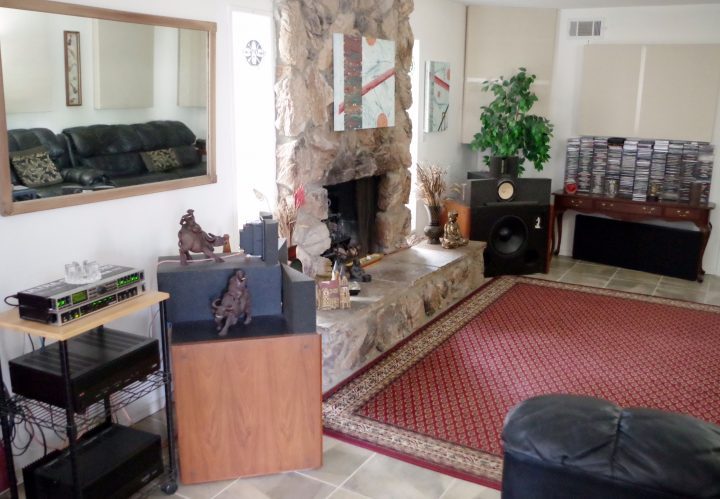
The big picture.

My crossover unit includes digital equalization (EQ). I use it to compensate for room modes. Without such equalization, the most accurate speakers in the world will sound colored in most domestic rooms. For example, in a recent issue of an audio mag, the in-room frequency response of a well-reviewed pair of $100,000+ loudspeakers showed a 15 db variation in bass response. Making accurate listener assessments of any audio product with such a handicap is like testing a sports car in a hockey rink.

EQ can also compensate for poor recordings. Some of my favorite recordings from the ’60s were mastered with too much bass, a midrange peak for ‘presence’, and treble frequencies accompanied by lots of distortion. On a highly resolving system, they are unlistenable. Applying some EQ can make those “oldies” enjoyable again.

My goal was to recreate (in-home) a sound that most closely approximates the experience of live orchestral music in a concert hall. I failed miserably. No-one will ever mistake the sound in my little room for the glorious sound of symphony hall. The laws of physics preclude it. But I got closer than any other system I’ve heard in an equivalently sized space.

Some audiophiles who don’t attend symphony concerts seem to prefer a disparate sound. I don’t know what standard they use to measure audio quality — perhaps the memory of their own equipment. Different strokes for different folks.

However, a few well-known audio engineers have also auditioned my system. These were their responses:

“I was impressed with Jan’s system when I visited his home. It was very-well balanced, clean, and had excellent imaging. He played a choral piece that was particularly impressive. He did a great job on his system!”

“One of the best dynamic loudspeaker systems I’ve heard. The imaging is startling.”

“This is among the lowest distortion systems I’ve listened to, I’ll bet it’s under 1% all the way to the lowest notes.”

“This system sounds like live music. The bass is as realistic as I’ve ever heard in-home.”

“No idea how you get such analogue sound from a completely digital/solid-state system.”

I’m gratified that my callow quest to enhance “the sound of one hand clapping” has garnered such informed applause.

Enjoy the view.

More from Issue 33

View All Articles in Issue 33

Search Copper Magazine

Favorites From T.H.E. Show SoCal 2026 by Cam Martin Oct 05, 2026 #235 Singer/Songwriter John David Schrader: On the Need to Create, Part Two by Joe Caplan Oct 05, 2026 #235 A Life in High-End Audio: The Roy Hall Interview, Part Two by Frank Doris Oct 05, 2026 #235 Grammy-Winning Producer, Songwriter, and Guitarist John Leventhal Goes Instrumental With National Drift by Ray Chelstowski Oct 05, 2026 #235 From Swimming Pool to New Listening Room—to Founding an Accidental Audio Company by Gilles Laferrière Oct 05, 2026 #235 The Vinyl Beat’s Size Matters Edition by Rudy Radelic Oct 05, 2026 #235 The Sublime Complexities of Nature by B. Jan Montana Oct 05, 2026 #235 How to Play In a Rock Band, 28: Growing Older and Dealing With It by Frank Doris Oct 05, 2026 #235 Young Rascals: From Bar Band to Stardom by Wayne Robins Oct 05, 2026 #235 Duncan Sheik: In Memoriam by Ray Chelstowski Oct 05, 2026 #235 From The Listening Chair: The Meze Audio 105 Silva Headphones by Howard Kneller Oct 05, 2026 #235 Checking Out Some NOLA Loudspeakers – and Some Thoughts About Audio Writing by Frank Doris Oct 05, 2026 #235 The Kanazawa Phonograph Museum: Music from a Time Capsule by Sebastian Polcyn Oct 05, 2026 #235 PS Audio in the News by PS Audio Staff Oct 05, 2026 #235 From The Audiophile’s Guide: Making the Most Critical Choice by Paul McGowan Oct 05, 2026 #235 Evolutionary Growth by Frank Doris Oct 05, 2026 #235 Speed Racer by Peter Xeni Oct 05, 2026 #235 Happy Halloween! by James Schrimpf Oct 05, 2026 #234 A Life in High-End Audio: The Roy Hall Interview, Part One by Frank Doris Sep 07, 2026 #234 Jason Greenlaw Offers His Personal Perspective on Jazz Guitar in Vantage Point by Frank Doris Sep 07, 2026 #234 Transcendent Phoenix: Lucina Yue Brings the Ancient Konghou Into Modern Times by Frank Doris Sep 07, 2026 #234 We Must All Follow Our Bliss by B. Jan Montana Sep 07, 2026 #234 How to Play in a Rock Band, 27: Leveling Up by Frank Doris Sep 07, 2026 #234 Ross Valory: Traveling Into New Musical Territory With All of the Above by Ray Chelstowski Sep 07, 2026 #234 Singer/Songwriter John David Schrader: On the Need to Create by Joe Caplan Sep 07, 2026 #234 The People Who Make Audio Happen: More From T.H.E. Show SoCal 2026 by Harris Fogel Sep 07, 2026 #234 The Vinyl Beat Digs Into the Gadget Box by Rudy Radelic Sep 07, 2026 #234 The Rolling Stones: Foreign Tongues Spoken Loud by Wayne Robins Sep 07, 2026 #234 Musical Moments by Rich Isaacs Sep 07, 2026 #234 Rags for Solo Piano and a Dog: David Chesky's Ragtime Music for the Modern Age by Frankly Speaking Sep 07, 2026 #234 HIGH END 2026, Vienna: Here to Stay by Carsten Barnbeck Sep 07, 2026 #234 From The Audiophile’s Guide: The Two Main Types of Loudpeakers – Box and Panel by Paul McGowan Sep 07, 2026 #234 Letting it Slide by Frank Doris Sep 07, 2026 #234 PS Audio in the News by PS Audio Staff Sep 07, 2026 #234 Long Playing by Peter Xeni Sep 07, 2026 #234 La Mer by B. Jan Montana Sep 07, 2026 #233 A Report From The Total Hi-Fi Experience Show SoCal 2026 by B. Jan Montana Aug 03, 2026 #233 Bluegrass Meets Country, Folk, Jazz and More in All That We Carried by The Squid City Slingers by Frank Doris Aug 03, 2026 #233 Corey Glover and One Tribe Nation: A Variegated Musical Collective by Ray Chelstowski Aug 03, 2026 #233 Excursions with Clive: The Late Clive Davis, A Personal History by Wayne Robins Aug 03, 2026 #233 AI, Art, and Music: A Conversation With Synthography Art by Joe Caplan Aug 03, 2026 #233 New American Symphonies: A Rediscovered Gem and a Vital Contemporary Work by Frank Doris Aug 03, 2026 #233 The Vinyl Beat: Genesis, the Dave Clark Five, Antonio Carlos Jobim and More by Rudy Radelic Aug 03, 2026 #233 How to Play in a Rock Band, 26: When It's Time to Record Your Music by Frank Doris Aug 03, 2026 #233 More From T.H.E. Show 2026, and the People Who Made it Happen by Harris Fogel Aug 03, 2026 #233 Underappreciated Artists, Part Three: Icehouse by Rich Isaacs Aug 03, 2026 #233 The Surprisingly Rich and Varied Music of Somalia by Steve Kindig Aug 03, 2026

Zen and the Art of Speaker Building

Zen and the Art of Speaker Building

Most of us squander far too much of our time engaged in “self-talk”. Our minds are continually preoccupied with “what if” scenarios and how to resolve them, even though these scenarios seldom materialize. From an evolutionary perspective, predetermined responses to potential threats is an effective survival strategy, but it also keeps our minds trapped in the temporal plane of existence.

A “koan” is a Zen Buddhist tool designed to help the devotee transcend the temporal plane. It usually takes the form of a question. For example, “What is the sound of one hand clapping?” The mind doggedly seeks an answer, but there is none. That’s the point, to tie the logical mind into such a knot that it short-circuits the endless flow of self-talk. Once the mind is in a state of “non-thinking”, it is free to experience bliss.

Pondering the sound of one hand clapping has never led me to bliss. Neither has contemplating whether or not a tree falling in the forest makes a sound if there is no one around to hear it. Koans frustrate me like child-proof containers.

Music is my koan. It wipes out self-talk like a tsunami washes away beach huts. It can carry me from the mundane to a state of transcendental bliss faster than Owsley’s elixir. Twenty minutes in that state is as refreshing as a good night’s sleep.

But it’s not sleeping, as my wife once assumed. She would see me motionless in my recliner for most of a symphony and believe I was dozing. One day, she decided to walk across the listening room. As soon as she blocked the sound of one speaker, I addressed her, eyes still closed, “Hi Sweetie.” She was startled. I was meditating, not comatose.

If music is my koan, then my music system is my guru. I want to hear it as clearly and unambiguously as possible. Finding the right guru has been a long search.

Like most audiophiles, my first few systems consisted of “off-the-shelf” components that did some things well, and other things not so well. Over the years, I traded up to more expensive equipment that did other things well, but then I would miss some of the things at which my old systems excelled.

So I started scrutinizing components. It didn’t take long to determine that electronic components which offered a neutral response, and distortion and noise below audible levels, sounded similar. By definition, they should. (The only qualifier is that amplifiers must have sufficient power to drive the load.)

That wasn’t the case with loudspeakers. At the dozen or so Consumer Electronics Shows I attended in Las Vegas, I found that most loudspeakers sounded radically different from one another — even if their manufacturers professed similar design objectives.

Surprisingly, the most expensive speakers were seldom my favorites. As they rarely won the “Best Sound of Show” award, many others must have felt the same way. Audiophiles choose what elements of reproduced sound are most important to them, and prefer a system which caters to those preferences. The choice of best loudspeaker, like best restaurant or movie, is dependent on the sensibilities of the beholder. Different strokes for different folks.

My sensibilities must be idiosyncratic. I never found a speaker system at the CES that did everything I sought. Like the systems I’d owned in the past, they usually did some things really well, and other things not so well, regardless of their price. In the next room, those strengths and weaknesses might be reversed.

When I realized this, a light went off. Why not build a custom speaker system catering to my sensibilities?

I attended the next CES with a single minded purpose, to discover my personal preferences. As I auditioned various systems, I wrote pages of notes. When I reviewed them in the evening, these patterns emerged:
– 3 way/3 driver systems sounded cleaner to me than systems using more (or fewer) drivers.
– high efficiency systems seemed:
– more resolving at low volumes.
– better at holding a note’s decay to its conclusion — especially noticeable on piano.
– more dynamic than those that needed big power.
– wide cabinets also appeared to offer superior midrange dynamics.
– the smoothest high frequencies emanated from ribbon tweeters.
– big bass-reflex bins utilizing large, low-excursion woofers best reproduced effortless, natural-sounding bass.
– most highly resolving midrange drivers soon became fatiguing — except those with paper cones.
The loveliest midrange frequencies emanated from a system that had no midrange driver at all. No, it wasn’t a two way system. It came from a single, full range paper driver designed to cover the entire frequency spectrum. This driver turned coarse at high frequencies (where it broke up) and produced no real bass, but the midrange resolution and imaging were enchanting. I was able to buy a matched pair from the exhibitor.

The most effortless deep bass I heard filled the room of a European exhibitor. His system employed 15″ Italian woofers in large, bass reflex cabinets. He was kind enough to provide the information I needed to source a pair.

One speaker, showing crossover and auxiliary damping animals.

The smoothest high frequencies came from the ribbon tweeters of an Asian system. The exhibitor didn’t even know the name of the manufacturer…….or wasn’t willing to reveal it. After a considerable amount of time and research back home, I was able pinpoint the manufacturer. I had to buy a dozen and import them myself.

Once I had the drivers, it was time to acquire the cabinets. I’d planned to construct them myself, but with a stroke of luck, came across a pair of 7 cu. ft. bass bins originating from a recording studio. They weigh over 200 lbs. each and are much better built than my limited carpentry skills and equipment would allow. All I had to do was tailor the ports and internal damping to my Italian drivers.

The ports were easy, there are formulas for that.

The internal damping took several months. Too much and the sound was lifeless. Too little and the bass sounded like it was coming from a bathroom. I tried foam, shredded cotton, wool felt, and various types of fiberglass damping material. The most natural bass resulted from sparcely applied sheets of 1″ O/C 705 high-density fiberglass. This is the yellow stuff often found behind ovens and fridges (nasty to work with, wear gloves and a respirator).

The midrange boxes are re-purposed EPI 100 loudspeaker cabinets. I removed the drivers, covered the baffle with MDF, and laid them on their sides. Then I cut a hole in what was the top to accommodate my 8″ midrange driver. There is a similar hole in the other end (backside). The cabinets are stuffed with increasing-density damping material, like a transmission line. That way, the backwaves have no opportunity to reflect back into the lightweight cone to cause distortion.

The heavy ribbon tweeter is simply set on top of the midrange driver and braced. Being a line source, it has controlled vertical dispersion. This design keeps high frequencies from bouncing off the ceiling and floor.

Diffraction causes sound waves to re-radiate from cabinet edges and splash off nearby surfaces. It makes drivers sound muddy. The custom-cut acoustic foam in the photo extends the baffle size thereby reducing diffraction. It also directs the sound waves away from the walls and to the listener for superior dynamics.

Once the drivers and cabinets were sorted out, the next challenge was the crossover. I studied passive crossovers for a couple of years and built several, but was never satisfied with the results. This could have been due to my lack of expertise and experience, or, as an EE friend suggested, the inherent limitations of passive-crossover design.

At his urging, I purchased an active digital crossover. It splits each stereo channel into 3 signals: bass, midrange and highs. These signals are then fed into six amplifiers, one for each driver. This way, there is nothing between the amps and the drivers except the speaker cables. It allows the amps to do their best work. Complicated passive crossovers can suck the life out of amplifiers and dull the sound.

Because active crossovers are capable of steep slopes, there is little intermodulation distortion between the drivers, and they can be crossed-over closer to the edge of their bandwidths without hitting their break-up or resonance modes.

Another benefit of a digital crossover is how easily crossover frequencies and slopes can be manipulated. I set mine “by the book” initially, then tweaked until I got the sound that most pleased me.

The big picture.

My crossover unit includes digital equalization (EQ). I use it to compensate for room modes. Without such equalization, the most accurate speakers in the world will sound colored in most domestic rooms. For example, in a recent issue of an audio mag, the in-room frequency response of a well-reviewed pair of $100,000+ loudspeakers showed a 15 db variation in bass response. Making accurate listener assessments of any audio product with such a handicap is like testing a sports car in a hockey rink.

EQ can also compensate for poor recordings. Some of my favorite recordings from the ’60s were mastered with too much bass, a midrange peak for ‘presence’, and treble frequencies accompanied by lots of distortion. On a highly resolving system, they are unlistenable. Applying some EQ can make those “oldies” enjoyable again.

My goal was to recreate (in-home) a sound that most closely approximates the experience of live orchestral music in a concert hall. I failed miserably. No-one will ever mistake the sound in my little room for the glorious sound of symphony hall. The laws of physics preclude it. But I got closer than any other system I’ve heard in an equivalently sized space.

Some audiophiles who don’t attend symphony concerts seem to prefer a disparate sound. I don’t know what standard they use to measure audio quality — perhaps the memory of their own equipment. Different strokes for different folks.

However, a few well-known audio engineers have also auditioned my system. These were their responses:

“I was impressed with Jan’s system when I visited his home. It was very-well balanced, clean, and had excellent imaging. He played a choral piece that was particularly impressive. He did a great job on his system!”

“One of the best dynamic loudspeaker systems I’ve heard. The imaging is startling.”

“This is among the lowest distortion systems I’ve listened to, I’ll bet it’s under 1% all the way to the lowest notes.”

“This system sounds like live music. The bass is as realistic as I’ve ever heard in-home.”

“No idea how you get such analogue sound from a completely digital/solid-state system.”

I’m gratified that my callow quest to enhance “the sound of one hand clapping” has garnered such informed applause.

Enjoy the view.

0 comments

Leave a comment

0 Comments

Your avatar

Loading comments...

🗑️ Delete Comment

Enter moderator password to delete this comment:

✏️ Edit Comment

Enter your email to verify ownership: