COPPER

A PS Audio Publication

Issue 45 • Free Online Magazine

Issue 45 MUSIC AUDIO AND OTHER ILLNESSES

Why Doesn’t My System Sound Better? (Or: A Neurotic’s Confession)

By any objective measure, it sounds incredible.

But you know how people like us are: obsessive to a degree that’s way past the point of fault. Maybe I’m romanticizing how it used to sound. Maybe the placement of things makes a bigger difference than I suppose. Maybe I don’t care enough or can’t hear well enough anymore.

Currently, my set-up consists of a DirectStream DAC through an old PS Audio PS-IV preamp (always used with the line-amp out of circuit – so, really, just a source-selector and volume control), and then into a pair of Brown Electronic Labs 1001 Mk. IV/Vs[1], and then my speakers: an astonishing pair built for me over 20 years ago by Richard Marsh (after a pair he had built for himself), using Dynaudio speakers, cabs from somewhere in Canada, crossover components of his design, and Cardas and other internal wire. They’re roughly a D’Appolito design, with five drivers: two 10-inch woofers, two fairly large mid-range drivers, and Dynaudio’s most exotic tweeter per side. Many years ago, at the suggestion of Robert E. Greene, I got a pair of felt surrounds for the tweeters to minimize diffraction –– made for me by a man in Texas. Right now, the cabling is from Audioquest: Wind interconnects and Rocket 88 speaker cables have replaced my old Cardas.

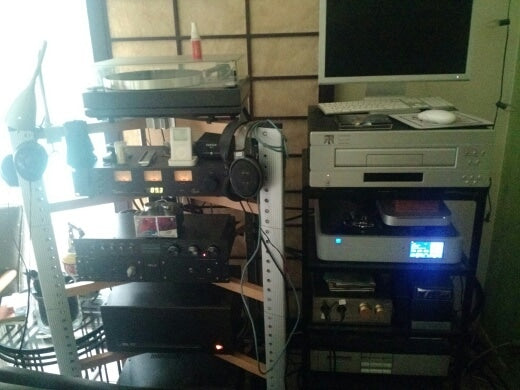
I regularly check the set-up for its IQ — its “Invisibility Quotient”. And as I said: objectively, it’s rarely been less “visible” — even sitting off axis, the speakers just about vanish. So why do I feel so unfulfilled?

I remember well the very first time I heard extraordinary digital. It was 2007 at a shop in LA where Scot Markwell worked. I went to hear the Antique Sound Lab Hurricane amps, but Scot was excited for me to hear something he had just gotten — The NovaPhysics Memory Player. And it was absolutely mind-blowing. Listening to records I had worked on was like being in the control room hearing the tape.

Ten years later, maybe I’ve just gotten used to good digital sound. And though I used to have a NovaPhysics Memory Player (courtesy of Mark Porzilli, its designer), I now have a DirectStream. Maybe the difference in what I hear is the difference in the design. It might be that somewhere in my pea brain, I still want the Memory Player’s sound — although, when I listen, as right now, the sound is just incredible. Maybe it’s just the never-ending quest of me being neurotic.

I’ve tried to discern why I hear almost no difference between 16/44.1 files and higher resolution ones. A series of emails with the eminent Ted Smith, while complicated with math, confirmed what I thought. Put simply: everything plays back as DSD, whether it’s 44.1 numerical stream or a 192k one, and that, in my simple way of putting it, minimizes the differences. For those not afraid of a little math, I’ll post Ted’s comments:

“Just to make things clear, everything is upsampled to 20 x the nominal DSD rate (which is 64 x the CD rate) = 56.448Mhz.  Not that it matters a lot to the end user but PCM is first upsampled to 352.8k or 384k (depending on whether it divides one or the other), then that is upsampled by 160 x or 147 x to get to 56.448Mhz.

“After that the signal is converted to a quad rate (11.2896MHz) single bit output with a sigma delta modulator.

“If his question was about how sigma delta modulators work, that’s pretty hard to explain accurately in a few words.  From the 30,000 ft. level, a sigma delta modulator outputs a 1 or 0 (which translate to a 1 or -1) depending on whether the low-pass filtered complete output stream so far is higher or lower than the input.  That amounts to a tight feedback loop around the decision about whether the next sample is a 1 or -1.  By construction it’s obvious that you get back the original signal with just a low pass filter since that’s what the feedback loop was driving the output to.  The devil is in the details.

“As Paul mentioned, there’s a much smaller difference than most people believe between a 16/44.1k signal and a 24/192k signal. In part, (that) is a natural result of a lot of oversamplers for 44.1k not being as good as they could be; with a 192k signal how the upsampler is designed/implemented isn’t as critical.”

So, since the output of the device is one-bit, i.e. the most spectacularly simple of filters, and we hear everything through this output, the great variety of lossless files are all driven towards this. And this is great. So what’s bugging me?

I don’t know. But I can speculate: the obvious thing is the different DACs, though that doesn’t answer just what the difference IS. Then there’s my hearing: maybe the tinnitus has really gotten worse and pervades listening, although I think I’d know that. Maybe after so many years of great sound, I’m just being more neurotic than I used to be.

But here’s what I think it is: I think the DirectStream DAC and the Memory Player do an equal but different job of decoding the signal — AND that difference is very slight, in the way-upper-mids to lower treble, AND I think I grew to love that presentation. As much as I love the DirectStream, I think I should add a touch of EQ to the signal to see about that.

But there’s another way to think about this. That’s that the slight elevation of upper-mids to lower-treble is false; that though we — or at least some of we — come to expect it of recording, and hear that slightly increased band as meaning greater presence, it only represents reality (we could even say it over-represents it). I wrote eons ago in the pages of TAS about walking in Pasadena with Allen Perkins and our wives and hearing a solo violinist echoing among the brickwork and noting how far removed it was from any recording. This comes to mind as I listen to a Water Lily recording done with the same equipment I own (Tim DeParavicini’s mics, mic amp and one-inch recorder) of the Philadelphia Orchestra, seated where Robert E. Greene suggests as an ideal listening spot, and wonder how anything could be more realistic.

Allegedly, I’ll be heading out to Porzilli’s in a month or so, and, allegedly, will return with another Memory Player. And if it hasn’t changed too drastically in the intervening years since I had one, I will get to resolve my neurosis.

PS – as you may know, Porzilli was the designer of the Pipedream speakers, and after that the Scaena. He has a new design — and it looks spectacular.


[1] The amps are vaguely for sale. Over 25 years ago, I realized that my whole system had been made by my friends, and with Richard’s death a few years back, and the purchase of BEL’s “assets”, the amps no longer feel quite like mine. When they sell, I’m planning on a pair of BHKs.

More from Issue 45

View All Articles in Issue 45

Search Copper Magazine

#234 A Life in High-End Audio: The Roy Hall Interview, Part One by Frank Doris Sep 07, 2026 #234 Jason Greenlaw Offers His Personal Perspective on Jazz Guitar in Vantage Point by Frank Doris Sep 07, 2026 #234 Transcendent Phoenix: Lucina Yue Brings the Ancient Konghou Into Modern Times by Frank Doris Sep 07, 2026 #234 We Must All Follow Our Bliss by B. Jan Montana Sep 07, 2026 #234 How to Play in a Rock Band, 27: Leveling Up by Frank Doris Sep 07, 2026 #234 Ross Valory: Traveling Into New Musical Territory With All of the Above by Ray Chelstowski Sep 07, 2026 #234 Singer/Songwriter John David Schrader: On the Need to Create by Joe Caplan Sep 07, 2026 #234 The People Who Make Audio Happen: More From T.H.E. Show SoCal 2026 by Harris Fogel Sep 07, 2026 #234 The Vinyl Beat Digs Into the Gadget Box by Rudy Radelic Sep 07, 2026 #234 The Rolling Stones: Foreign Tongues Spoken Loud by Wayne Robins Sep 07, 2026 #234 Musical Moments by Rich Isaacs Sep 07, 2026 #234 Rags for Solo Piano and a Dog: David Chesky's Ragtime Music for the Modern Age by Frankly Speaking Sep 07, 2026 #234 HIGH END 2026, Vienna: Here to Stay by Carsten Barnbeck Sep 07, 2026 #234 From The Audiophile’s Guide: The Two Main Types of Loudpeakers – Box and Panel by Paul McGowan Sep 07, 2026 #234 Letting it Slide by Frank Doris Sep 07, 2026 #234 PS Audio in the News by PS Audio Staff Sep 07, 2026 #234 Long Playing by Peter Xeni Sep 07, 2026 #234 La Mer by B. Jan Montana Sep 07, 2026 #233 A Report From The Total Hi-Fi Experience Show SoCal 2026 by B. Jan Montana Aug 03, 2026 #233 Bluegrass Meets Country, Folk, Jazz and More in All That We Carried by The Squid City Slingers by Frank Doris Aug 03, 2026 #233 Corey Glover and One Tribe Nation: A Variegated Musical Collective by Ray Chelstowski Aug 03, 2026 #233 Excursions with Clive: The Late Clive Davis, A Personal History by Wayne Robins Aug 03, 2026 #233 AI, Art, and Music: A Conversation With Synthography Art by Joe Caplan Aug 03, 2026 #233 New American Symphonies: A Rediscovered Gem and a Vital Contemporary Work by Frank Doris Aug 03, 2026 #233 The Vinyl Beat: Genesis, the Dave Clark Five, Antonio Carlos Jobim and More by Rudy Radelic Aug 03, 2026 #233 How to Play in a Rock Band, 26: When It's Time to Record Your Music by Frank Doris Aug 03, 2026 #233 More From T.H.E. Show 2026, and the People Who Made it Happen by Harris Fogel Aug 03, 2026 #233 Underappreciated Artists, Part Three: Icehouse by Rich Isaacs Aug 03, 2026 #233 The Surprisingly Rich and Varied Music of Somalia by Steve Kindig Aug 03, 2026 #233 A Remarkable Discographic Legacy: The LP Recordings of the Basel Symphony Orchestra by Stephan Haberthür Aug 03, 2026 #233 From The Audiophile’s Guide: The Importance of Loudspeakers by Paul McGowan Aug 03, 2026 #233 From Swimming Pool to New Listening Room: A Conversation with Norman Varney of AV RoomService by Gilles Laferrière Aug 03, 2026 #233 PS Audio in the News by PS Audio Staff Aug 03, 2026 #233 Audio Jewelry by Peter Xeni Aug 03, 2026 #233 Enrich Your Life by Frank Doris Aug 03, 2026 #233 The Searcher by James Schrimpf Aug 03, 2026 #232 What came first: Art or Music? A Conversation With Artist Jose Acosta by Joe Caplan Jul 06, 2026 #232 Blow By Blow: The Jeff Beck Story: An Insightful Book About a Guitar Icon by Ray Chelstowski Jul 06, 2026 #232 Creed Over Camaraderie? by B. Jan Montana Jul 06, 2026 #232 Chronicles of a Sound Pilgrim at the 2026 Montreal Audiofest by Hugues Morin Jul 06, 2026 #232 The Vinyl Beat: Summer Grooves by Rudy Radelic Jul 06, 2026 #232 Hibbing Hillbilly Dylan's Acoustic Rock by Wayne Robins Jul 06, 2026 #232 Quad Quads and Plasmatronics Tweeters: An Extraordinary System Comes to Life by Frank Doris Jul 06, 2026 #232 In Praise of Live Music, Once Again by Ted Shafran Jul 06, 2026 #232 Allnic Audio’s L-9000 Preamplifier: Design and Engineering Innovation by Howard Kneller Jul 06, 2026 #232 “Best Of” Lists and Rage Bait: Enough Already by Frank Doris Jul 06, 2026 #232 Quick Takes: Bud Shank, Paulo Almeida, Jakob Dreyer, Tim Eriksen and Peter Irvine by Frank Doris Jul 06, 2026

Why Doesn’t My System Sound Better? (Or: A Neurotic’s Confession)

By any objective measure, it sounds incredible.

But you know how people like us are: obsessive to a degree that’s way past the point of fault. Maybe I’m romanticizing how it used to sound. Maybe the placement of things makes a bigger difference than I suppose. Maybe I don’t care enough or can’t hear well enough anymore.

Currently, my set-up consists of a DirectStream DAC through an old PS Audio PS-IV preamp (always used with the line-amp out of circuit – so, really, just a source-selector and volume control), and then into a pair of Brown Electronic Labs 1001 Mk. IV/Vs[1], and then my speakers: an astonishing pair built for me over 20 years ago by Richard Marsh (after a pair he had built for himself), using Dynaudio speakers, cabs from somewhere in Canada, crossover components of his design, and Cardas and other internal wire. They’re roughly a D’Appolito design, with five drivers: two 10-inch woofers, two fairly large mid-range drivers, and Dynaudio’s most exotic tweeter per side. Many years ago, at the suggestion of Robert E. Greene, I got a pair of felt surrounds for the tweeters to minimize diffraction –– made for me by a man in Texas. Right now, the cabling is from Audioquest: Wind interconnects and Rocket 88 speaker cables have replaced my old Cardas.

I regularly check the set-up for its IQ — its “Invisibility Quotient”. And as I said: objectively, it’s rarely been less “visible” — even sitting off axis, the speakers just about vanish. So why do I feel so unfulfilled?

I remember well the very first time I heard extraordinary digital. It was 2007 at a shop in LA where Scot Markwell worked. I went to hear the Antique Sound Lab Hurricane amps, but Scot was excited for me to hear something he had just gotten — The NovaPhysics Memory Player. And it was absolutely mind-blowing. Listening to records I had worked on was like being in the control room hearing the tape.

Ten years later, maybe I’ve just gotten used to good digital sound. And though I used to have a NovaPhysics Memory Player (courtesy of Mark Porzilli, its designer), I now have a DirectStream. Maybe the difference in what I hear is the difference in the design. It might be that somewhere in my pea brain, I still want the Memory Player’s sound — although, when I listen, as right now, the sound is just incredible. Maybe it’s just the never-ending quest of me being neurotic.

I’ve tried to discern why I hear almost no difference between 16/44.1 files and higher resolution ones. A series of emails with the eminent Ted Smith, while complicated with math, confirmed what I thought. Put simply: everything plays back as DSD, whether it’s 44.1 numerical stream or a 192k one, and that, in my simple way of putting it, minimizes the differences. For those not afraid of a little math, I’ll post Ted’s comments:

“Just to make things clear, everything is upsampled to 20 x the nominal DSD rate (which is 64 x the CD rate) = 56.448Mhz.  Not that it matters a lot to the end user but PCM is first upsampled to 352.8k or 384k (depending on whether it divides one or the other), then that is upsampled by 160 x or 147 x to get to 56.448Mhz.

“After that the signal is converted to a quad rate (11.2896MHz) single bit output with a sigma delta modulator.

“If his question was about how sigma delta modulators work, that’s pretty hard to explain accurately in a few words.  From the 30,000 ft. level, a sigma delta modulator outputs a 1 or 0 (which translate to a 1 or -1) depending on whether the low-pass filtered complete output stream so far is higher or lower than the input.  That amounts to a tight feedback loop around the decision about whether the next sample is a 1 or -1.  By construction it’s obvious that you get back the original signal with just a low pass filter since that’s what the feedback loop was driving the output to.  The devil is in the details.

“As Paul mentioned, there’s a much smaller difference than most people believe between a 16/44.1k signal and a 24/192k signal. In part, (that) is a natural result of a lot of oversamplers for 44.1k not being as good as they could be; with a 192k signal how the upsampler is designed/implemented isn’t as critical.”

So, since the output of the device is one-bit, i.e. the most spectacularly simple of filters, and we hear everything through this output, the great variety of lossless files are all driven towards this. And this is great. So what’s bugging me?

I don’t know. But I can speculate: the obvious thing is the different DACs, though that doesn’t answer just what the difference IS. Then there’s my hearing: maybe the tinnitus has really gotten worse and pervades listening, although I think I’d know that. Maybe after so many years of great sound, I’m just being more neurotic than I used to be.

But here’s what I think it is: I think the DirectStream DAC and the Memory Player do an equal but different job of decoding the signal — AND that difference is very slight, in the way-upper-mids to lower treble, AND I think I grew to love that presentation. As much as I love the DirectStream, I think I should add a touch of EQ to the signal to see about that.

But there’s another way to think about this. That’s that the slight elevation of upper-mids to lower-treble is false; that though we — or at least some of we — come to expect it of recording, and hear that slightly increased band as meaning greater presence, it only represents reality (we could even say it over-represents it). I wrote eons ago in the pages of TAS about walking in Pasadena with Allen Perkins and our wives and hearing a solo violinist echoing among the brickwork and noting how far removed it was from any recording. This comes to mind as I listen to a Water Lily recording done with the same equipment I own (Tim DeParavicini’s mics, mic amp and one-inch recorder) of the Philadelphia Orchestra, seated where Robert E. Greene suggests as an ideal listening spot, and wonder how anything could be more realistic.

Allegedly, I’ll be heading out to Porzilli’s in a month or so, and, allegedly, will return with another Memory Player. And if it hasn’t changed too drastically in the intervening years since I had one, I will get to resolve my neurosis.

PS – as you may know, Porzilli was the designer of the Pipedream speakers, and after that the Scaena. He has a new design — and it looks spectacular.


[1] The amps are vaguely for sale. Over 25 years ago, I realized that my whole system had been made by my friends, and with Richard’s death a few years back, and the purchase of BEL’s “assets”, the amps no longer feel quite like mine. When they sell, I’m planning on a pair of BHKs.

0 comments

Leave a comment

0 Comments

Your avatar

Loading comments...

🗑️ Delete Comment

Enter moderator password to delete this comment:

✏️ Edit Comment

Enter your email to verify ownership: