COPPER

A PS Audio Publication

Issue 17 • Free Online Magazine

Issue 17 VINTAGE WHINE

VPI: 38 Years and Counting

VPI: 38 Years and Counting
Harry Pearson, founder of The Absolute Sound, contributed to the success of a number of high-end audio manufacturers, and probably to the demise of a few, as well. But the only company I know of that Harry helped provoke into existence is VPI. (Don’t ask what “VPI” stands for—industry oldsters know, but to ask is to be told, “if I tell you, I’ll have to kill you”. Far be it for me to reveal the secret.)Harry Weisfeld VPI

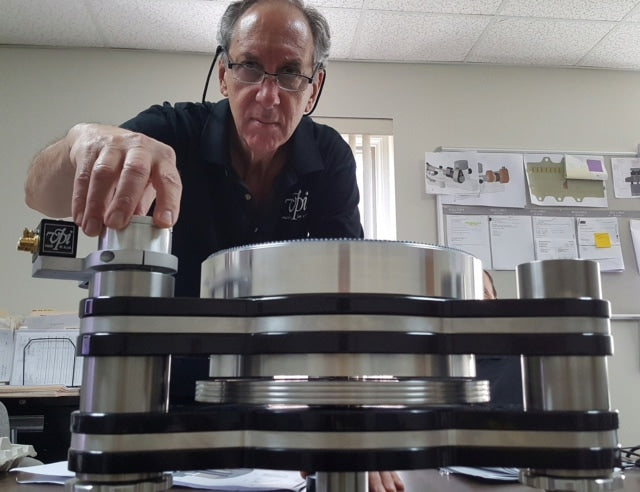
Harry Weisfeld with the Titan

VPI founder Harry Weisfeld was a lifelong audiophile when he met HP at an audio dealership, and a friendship ensued. In 1976, Harry visited the infamous HP manse in Sea Cliff, New York, and after a startling before/after demo, came to covet a record cleaning machine made by the English company, Keith Monks. Problem was, it was a lot of money, $1700 ($7195 in 2016 bucks), more than the newlywed Harry could justify paying. (It was also notoriously fragile, finicky, expensive to maintain and prone to break down—but that’s another story.)

At that time, Harry was an engineer and sheet-metal contractor, working on the construction of some major NYC buildings.  As is the case of many in audio, he was also a racer, drag-racing and maintaining  a Hemi-powered Dodge. So: he had skills, and knew how to design and make things, or get them made.

VPI Industries’ first products were record weights and a turntable isolation base similar to the one made by Mitchell Cotter.  After considerable experimentation, Harry W. took the prototype of his cleaning machine to Harry P., who pronounced it better than the Keith Monks—at a projected price of 20% that of the English unit. The VPI unit was noisy, but it worked well, and was stable and relatively bulletproof.

The cleaning machine was dubbed the HW-16, and is still in production. Most of the original production run from the late ‘70’s and early ‘80’s is still in use, relentlessly de-gunking records. The “Magic Brick” appeared soon after, a hefty wooden block filled with steel plates, designed to provide physical damping to components while simultaneously absorbing stray flux. Despite the skepticism the Brick provoked, it worked, and worked well—enough so that the company is in the process of reviving it as a product.

The company’s first turntable, the HW-19, remained in production for many years, and was updated into Mk. 2, 3, and 4 versions. The upgradability of the HW-19 became an earmark of subsequent VPI products, allowing an entry-level product to be improved to near-top-line performance. The TNT followed, Weisfeld’s first venture into state-of-the-art territory. It, too, remained in production for many years, accommodating a number of updates and improvements.
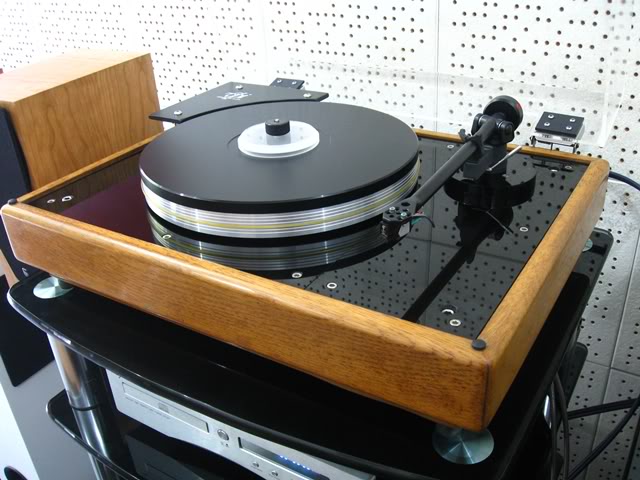
VPI's first turntable, the HW-19

VPI’s first turntable, the HW-19

The company began selling products internationally in 1980, and Harry was able to devote all his time to VPI, along with wife Sheila, in 1983. The Weisfeld’s first son, Jonathan, was born in 1978; second son Mathew was born in 1985. Sadly, Jonathan was killed in a car accident with two other boys in 1995. He had been working with his father on a tonearm design,which was released after Jonathan’s death as the JMW Memorial Tonearm. Co-founder Sheila passed away from cancer in 2011, and son Mat made his first  CES appearance for the company a month later, in January, 2012.

Clearly, there have been upheavals during the time of the company’s existence, both in the world of LPs and in the Weisfeld family. At a late-‘80’s CES, during the rise of CDs and digital audio, a fellow manufacturer asked Harry what he was going to do in five years—presuming that the market for records and playback gear would be nothing but a memory by then.

“I dunno,” said Harry. “I’ll think of something.”

As it turned out, all Harry had to do was keep on keeping on: as others exited the market, VPIs share of the shrinking market grew. When the market grew, as it has over the past decade, the company was well-positioned with a familiar name, a history of technical innovation, and durable, upgradable products—and business boomed.

Son Mat was a high-school technology teacher at the time of his mother’s death, and for a while, split his time between teaching and working at VPI. In fairly short order, Mat went full-time at VPI, and was named President of the company by Harry…who promptly retired.
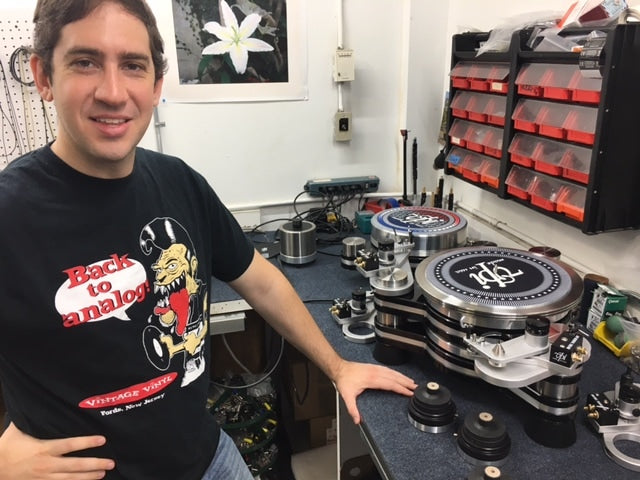
Matt Weisfeld

Mat Weisfeld

In the past few years, Mat has introduced a string of new models, showing his own particular style with the Nomad, Traveler, Player, Prime, Avenger, and others. It’s hard to keep up.

Harry has been busy during his retirement. Annoyed at the proliferation of gigantic, Rube Goldberg-esque turntables with six- and seven-figure price tags, he designed the massive Titan, promising state-of-the-art performance at a fraction of the cost of those other units. $48,000 is by no means chump change, but the combination of rim-drive, magnetic coupling, extensive multi-level isolation, multiple arm bases and an all-new, all-analog speed control unit is clearly not cheap to make.

Says the man who has likely heard and owned every credible turntable ever made, “It’s the first turntable I’ve ever heard that sounds like reel-to-reel tape.”  Harry owns seven reel-to-reel decks and is contemplating building his own…so  that’s quite a statement.

Meanwhile, Mat Weisfeld and new wife Jane are ready to take the second generation —and third?— of VPI to even greater heights. Knowing Harry, his “retirement” will consist of more than playing golf!

More from Issue 17

View All Articles in Issue 17

Search Copper Magazine

#231 Piano Prodigy Jude Kofie Releases His Debut Album On Octave Records by Frank Doris Jun 01, 2026 #231 Underappreciated Artists, Part Two: City Boy by Rich Isaacs Jun 01, 2026 #231 Music and the Art of Creation: Talking With Saxophonist Rob Scheps by Joe Caplan Jun 01, 2026 #231 How to Play in a Rock Band, 24: Further Adventures at the 2026 Montauk Music Festival by Frank Doris Jun 01, 2026 #231 Courtney Barnett: Creature of Habit by Wayne Robins Jun 01, 2026 #231 Angine de Poitrine: Interstellar Guitar Rock Saviors Headed for Late-Night TV Pop Stardom? by Mark Lepage Jun 01, 2026 #231 My Impressions of AXPONA 2026, Part One by Frank Doris Jun 01, 2026 #231 2026 La Jolla Concours d'Elegance: Another Aesthetic Feast by B. Jan Montana Jun 01, 2026 #231 Country Music Icon Jo Dee Messina’s Bridges: A New Beginning by Ray Chelstowski Jun 01, 2026 #231 The Luxury Dispatch Hosts a Video Podcast With Ken Kessler by Ken Kessler Jun 01, 2026 #231 The Vinyl Beat: Tracking in the Motor City by Rudy Radelic Jun 01, 2026 #231 Lots of Fun With DSP: The Ferrum Audio WANDLA DAC and Its Tube Mode by Frank Doris Jun 01, 2026 #231 From The Audiophile's Guide: Digital Source Components and Streaming Audio by Paul McGowan Jun 01, 2026 #231 Onkyo’s Monster M-510 power amplifier by The Staff at Just Audio Jun 01, 2026 #231 PS Audio in the News by PS Audio Staff Jun 01, 2026 #231 Naming Convention by Peter Xeni Jun 01, 2026 #231 Les Invisibles by Frank Doris Jun 01, 2026 #231 Wildlife Scene by James Schrimpf Jun 01, 2026 #230 Camaraderie by B. Jan Montana May 04, 2026 #230 AXPONA 2026: A Family Gathering by Paul McGowan May 04, 2026 #230 Pianist Ryan Benthall Explores Jazz Realms and Far Beyond With Divine Sky by Frank Doris May 04, 2026 #230 The Vinyl Beat in AXPONA-Land by Rudy Radelic May 04, 2026 #230 Teddy Thompson’s Musical Growth Deepens With Never Be the Same by Ray Chelstowski May 04, 2026 #230 More Fun in the Sun: Florida Audio Expo, Part Two by Frank Doris May 04, 2026 #230 CanJam NYC 2026 Show Report: Heady Sound, Part Two by Frank Doris and Harris Fogel May 04, 2026 #230 Sonic Youth On Murray Street by Wayne Robins May 04, 2026 #230 Graffeo Coffee: A Symphony of Sensory Experience by Joe Caplan May 04, 2026 #230 The Saul Authority: The Story of Hi-Fi Pioneer Saul Marantz by Olivier Meunier-Plante May 04, 2026 #230 How to Play in a Rock Band, 23: Encounters With Famous Musicians, Part Two by Frank Doris May 04, 2026 #230 An Outlier in the Rack: A Vintage BIC Beam Box by The Staff at Just Audio May 04, 2026 #230 PS Audio in the News by PS Audio Staff May 04, 2026 #230 A Cautionary Tale by Rich Isaacs May 04, 2026 #230 Reel-to-Reel Roots, Part 33 (Revised): Ken Kessler Reports On the 2026 (British) AudioJumble by Ken Kessler May 04, 2026 #230 Text Messaging by Frank Doris May 04, 2026 #230 The Audiophile Rat Race by Peter Xeni May 04, 2026 #230 On the Rocks by Rich Isaacs May 04, 2026 #229 The Earliest Stars of Country Music, Part Three by Jeff Weiner Apr 06, 2026 #229 The Healing Power of Music and Sound at the Omega Institute by Joe Caplan Apr 06, 2026 #229 CanJam NYC 2026 Show Report: Heady Sound, Part One by Frank Doris Apr 06, 2026 #229 Florida Audio Expo 2026: Warming Up to High-End Audio, Part One by Frank Doris Apr 06, 2026 #229 Quick Takes: Anne Bisson, Sam Morrison, The Velvet Underground, and the Stooges by Frank Doris Apr 06, 2026 #229 The Vinyl Beat: New Arrivals, and Old Audio Show Demo Scores to Settle by Rudy Radelic Apr 06, 2026 #229 Harvard Gets a High-End Audio Education by Frank Doris Apr 06, 2026 #229 No Country for Old Knees by B. Jan Montana Apr 06, 2026 #229 How To Play in A Rock Band, 22: Encounters With Famous Musicians, Part 1 by Frank Doris Apr 06, 2026 #229 The Soulful Grooves of Guinea-Bissau by Steve Kindig Apr 06, 2026 #229 Four-Hand Piano Performance at Its Finest by Stephan Haberthür Apr 06, 2026

VPI: 38 Years and Counting

VPI: 38 Years and Counting
Harry Pearson, founder of The Absolute Sound, contributed to the success of a number of high-end audio manufacturers, and probably to the demise of a few, as well. But the only company I know of that Harry helped provoke into existence is VPI. (Don’t ask what “VPI” stands for—industry oldsters know, but to ask is to be told, “if I tell you, I’ll have to kill you”. Far be it for me to reveal the secret.)Harry Weisfeld VPI

Harry Weisfeld with the Titan

VPI founder Harry Weisfeld was a lifelong audiophile when he met HP at an audio dealership, and a friendship ensued. In 1976, Harry visited the infamous HP manse in Sea Cliff, New York, and after a startling before/after demo, came to covet a record cleaning machine made by the English company, Keith Monks. Problem was, it was a lot of money, $1700 ($7195 in 2016 bucks), more than the newlywed Harry could justify paying. (It was also notoriously fragile, finicky, expensive to maintain and prone to break down—but that’s another story.)

At that time, Harry was an engineer and sheet-metal contractor, working on the construction of some major NYC buildings.  As is the case of many in audio, he was also a racer, drag-racing and maintaining  a Hemi-powered Dodge. So: he had skills, and knew how to design and make things, or get them made.

VPI Industries’ first products were record weights and a turntable isolation base similar to the one made by Mitchell Cotter.  After considerable experimentation, Harry W. took the prototype of his cleaning machine to Harry P., who pronounced it better than the Keith Monks—at a projected price of 20% that of the English unit. The VPI unit was noisy, but it worked well, and was stable and relatively bulletproof.

The cleaning machine was dubbed the HW-16, and is still in production. Most of the original production run from the late ‘70’s and early ‘80’s is still in use, relentlessly de-gunking records. The “Magic Brick” appeared soon after, a hefty wooden block filled with steel plates, designed to provide physical damping to components while simultaneously absorbing stray flux. Despite the skepticism the Brick provoked, it worked, and worked well—enough so that the company is in the process of reviving it as a product.

The company’s first turntable, the HW-19, remained in production for many years, and was updated into Mk. 2, 3, and 4 versions. The upgradability of the HW-19 became an earmark of subsequent VPI products, allowing an entry-level product to be improved to near-top-line performance. The TNT followed, Weisfeld’s first venture into state-of-the-art territory. It, too, remained in production for many years, accommodating a number of updates and improvements.

VPI's first turntable, the HW-19

VPI’s first turntable, the HW-19

The company began selling products internationally in 1980, and Harry was able to devote all his time to VPI, along with wife Sheila, in 1983. The Weisfeld’s first son, Jonathan, was born in 1978; second son Mathew was born in 1985. Sadly, Jonathan was killed in a car accident with two other boys in 1995. He had been working with his father on a tonearm design,which was released after Jonathan’s death as the JMW Memorial Tonearm. Co-founder Sheila passed away from cancer in 2011, and son Mat made his first  CES appearance for the company a month later, in January, 2012.

Clearly, there have been upheavals during the time of the company’s existence, both in the world of LPs and in the Weisfeld family. At a late-‘80’s CES, during the rise of CDs and digital audio, a fellow manufacturer asked Harry what he was going to do in five years—presuming that the market for records and playback gear would be nothing but a memory by then.

“I dunno,” said Harry. “I’ll think of something.”

As it turned out, all Harry had to do was keep on keeping on: as others exited the market, VPIs share of the shrinking market grew. When the market grew, as it has over the past decade, the company was well-positioned with a familiar name, a history of technical innovation, and durable, upgradable products—and business boomed.

Son Mat was a high-school technology teacher at the time of his mother’s death, and for a while, split his time between teaching and working at VPI. In fairly short order, Mat went full-time at VPI, and was named President of the company by Harry…who promptly retired.

Matt Weisfeld

Mat Weisfeld

In the past few years, Mat has introduced a string of new models, showing his own particular style with the Nomad, Traveler, Player, Prime, Avenger, and others. It’s hard to keep up.

Harry has been busy during his retirement. Annoyed at the proliferation of gigantic, Rube Goldberg-esque turntables with six- and seven-figure price tags, he designed the massive Titan, promising state-of-the-art performance at a fraction of the cost of those other units. $48,000 is by no means chump change, but the combination of rim-drive, magnetic coupling, extensive multi-level isolation, multiple arm bases and an all-new, all-analog speed control unit is clearly not cheap to make.

Says the man who has likely heard and owned every credible turntable ever made, “It’s the first turntable I’ve ever heard that sounds like reel-to-reel tape.”  Harry owns seven reel-to-reel decks and is contemplating building his own…so  that’s quite a statement.

Meanwhile, Mat Weisfeld and new wife Jane are ready to take the second generation —and third?— of VPI to even greater heights. Knowing Harry, his “retirement” will consist of more than playing golf!

0 comments

Leave a comment

0 Comments

Your avatar

Loading comments...

🗑️ Delete Comment

Enter moderator password to delete this comment:

✏️ Edit Comment

Enter your email to verify ownership: