COPPER

A PS Audio Publication

Issue 17 • Free Online Magazine

Issue 17 VINTAGE WHINE

VPI: 38 Years and Counting

VPI: 38 Years and Counting
Harry Pearson, founder of The Absolute Sound, contributed to the success of a number of high-end audio manufacturers, and probably to the demise of a few, as well. But the only company I know of that Harry helped provoke into existence is VPI. (Don’t ask what “VPI” stands for—industry oldsters know, but to ask is to be told, “if I tell you, I’ll have to kill you”. Far be it for me to reveal the secret.)Harry Weisfeld VPI

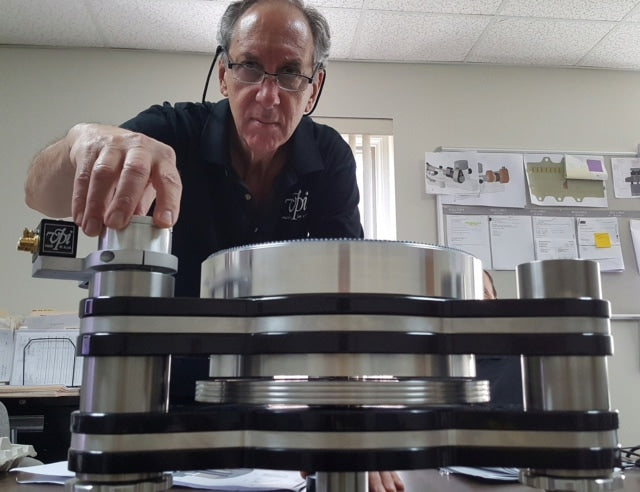
Harry Weisfeld with the Titan

VPI founder Harry Weisfeld was a lifelong audiophile when he met HP at an audio dealership, and a friendship ensued. In 1976, Harry visited the infamous HP manse in Sea Cliff, New York, and after a startling before/after demo, came to covet a record cleaning machine made by the English company, Keith Monks. Problem was, it was a lot of money, $1700 ($7195 in 2016 bucks), more than the newlywed Harry could justify paying. (It was also notoriously fragile, finicky, expensive to maintain and prone to break down—but that’s another story.)

At that time, Harry was an engineer and sheet-metal contractor, working on the construction of some major NYC buildings.  As is the case of many in audio, he was also a racer, drag-racing and maintaining  a Hemi-powered Dodge. So: he had skills, and knew how to design and make things, or get them made.

VPI Industries’ first products were record weights and a turntable isolation base similar to the one made by Mitchell Cotter.  After considerable experimentation, Harry W. took the prototype of his cleaning machine to Harry P., who pronounced it better than the Keith Monks—at a projected price of 20% that of the English unit. The VPI unit was noisy, but it worked well, and was stable and relatively bulletproof.

The cleaning machine was dubbed the HW-16, and is still in production. Most of the original production run from the late ‘70’s and early ‘80’s is still in use, relentlessly de-gunking records. The “Magic Brick” appeared soon after, a hefty wooden block filled with steel plates, designed to provide physical damping to components while simultaneously absorbing stray flux. Despite the skepticism the Brick provoked, it worked, and worked well—enough so that the company is in the process of reviving it as a product.

The company’s first turntable, the HW-19, remained in production for many years, and was updated into Mk. 2, 3, and 4 versions. The upgradability of the HW-19 became an earmark of subsequent VPI products, allowing an entry-level product to be improved to near-top-line performance. The TNT followed, Weisfeld’s first venture into state-of-the-art territory. It, too, remained in production for many years, accommodating a number of updates and improvements.
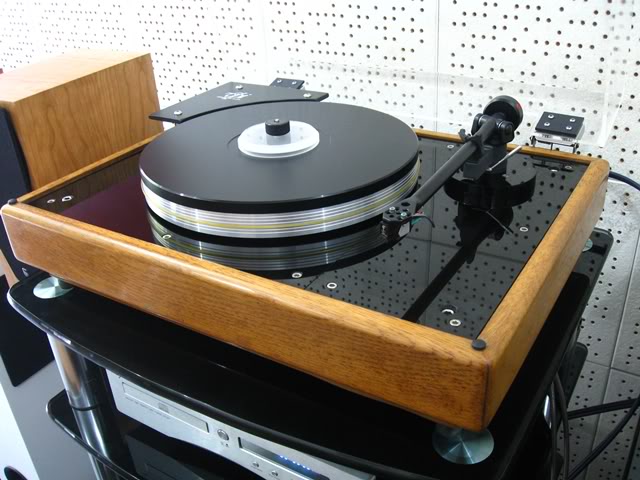
VPI's first turntable, the HW-19

VPI’s first turntable, the HW-19

The company began selling products internationally in 1980, and Harry was able to devote all his time to VPI, along with wife Sheila, in 1983. The Weisfeld’s first son, Jonathan, was born in 1978; second son Mathew was born in 1985. Sadly, Jonathan was killed in a car accident with two other boys in 1995. He had been working with his father on a tonearm design,which was released after Jonathan’s death as the JMW Memorial Tonearm. Co-founder Sheila passed away from cancer in 2011, and son Mat made his first  CES appearance for the company a month later, in January, 2012.

Clearly, there have been upheavals during the time of the company’s existence, both in the world of LPs and in the Weisfeld family. At a late-‘80’s CES, during the rise of CDs and digital audio, a fellow manufacturer asked Harry what he was going to do in five years—presuming that the market for records and playback gear would be nothing but a memory by then.

“I dunno,” said Harry. “I’ll think of something.”

As it turned out, all Harry had to do was keep on keeping on: as others exited the market, VPIs share of the shrinking market grew. When the market grew, as it has over the past decade, the company was well-positioned with a familiar name, a history of technical innovation, and durable, upgradable products—and business boomed.

Son Mat was a high-school technology teacher at the time of his mother’s death, and for a while, split his time between teaching and working at VPI. In fairly short order, Mat went full-time at VPI, and was named President of the company by Harry…who promptly retired.
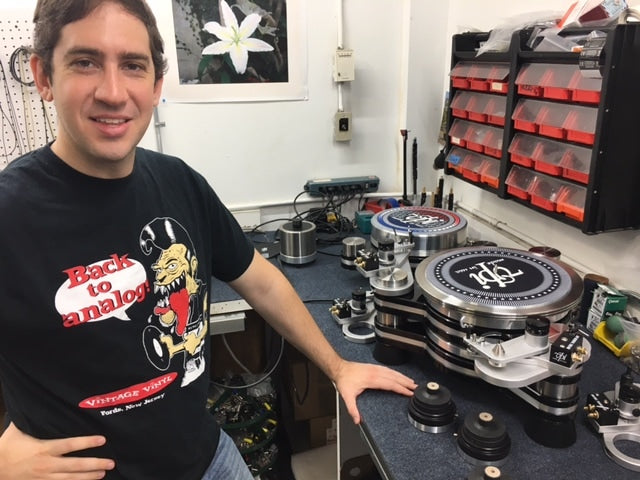
Matt Weisfeld

Mat Weisfeld

In the past few years, Mat has introduced a string of new models, showing his own particular style with the Nomad, Traveler, Player, Prime, Avenger, and others. It’s hard to keep up.

Harry has been busy during his retirement. Annoyed at the proliferation of gigantic, Rube Goldberg-esque turntables with six- and seven-figure price tags, he designed the massive Titan, promising state-of-the-art performance at a fraction of the cost of those other units. $48,000 is by no means chump change, but the combination of rim-drive, magnetic coupling, extensive multi-level isolation, multiple arm bases and an all-new, all-analog speed control unit is clearly not cheap to make.

Says the man who has likely heard and owned every credible turntable ever made, “It’s the first turntable I’ve ever heard that sounds like reel-to-reel tape.”  Harry owns seven reel-to-reel decks and is contemplating building his own…so  that’s quite a statement.

Meanwhile, Mat Weisfeld and new wife Jane are ready to take the second generation —and third?— of VPI to even greater heights. Knowing Harry, his “retirement” will consist of more than playing golf!

More from Issue 17

View All Articles in Issue 17

Search Copper Magazine

#227 Seth Lewis Gets in the Groove With Take a Look Around: a Tribute to the Meters by Frank Doris Feb 02, 2026 #227 Passport to Sound: May Anwar’s Audio Learning Experience for Young People by Frank Doris Feb 02, 2026 #227 Conjectures on Cosmic Consciousness by B. Jan Montana Feb 02, 2026 #227 The Big Takeover Turns 45 by Wayne Robins Feb 02, 2026 #227 Music and Chocolate: On the Sensory Connection by Joe Caplan Feb 02, 2026 #227 Singer/Songwriter Chris Berardo: Getting Wilder All the Time by Ray Chelstowski Feb 02, 2026 #227 The Earliest Stars of Country Music, Part One by Jeff Weiner Feb 02, 2026 #227 The Vinyl Beat Goes Down to Tijuana (By Way of Los Angeles), Part Two by Rudy Radelic Feb 02, 2026 #227 How to Play in a Rock Band, 20: On the Road With Blood, Sweat & Tears’ Guitarist Gabe Cummins by Frank Doris Feb 02, 2026 #227 From The Audiophile’s Guide: Audio Specs and Measuring by Paul McGowan Feb 02, 2026 #227 Our Brain is Always Listening by Peter Trübner Feb 02, 2026 #227 PS Audio in the News by PS Audio Staff Feb 02, 2026 #227 The Listening Chair: Sleek Style and Sound From the Luxman L3 by Howard Kneller Feb 02, 2026 #227 The Los Angeles and Orange County Audio Society Celebrates Its 32nd Anniversary, Honoring David and Sheryl Lee Wilson and Bernie Grundman by Harris Fogel Feb 02, 2026 #227 Back to My Reel-to-Reel Roots, Part 26: Half Full – Not Half Empty, Redux by Ken Kessler Feb 02, 2026 #227 That's What Puzzles Us... by Frank Doris Feb 02, 2026 #227 Record-Breaking by Peter Xeni Feb 02, 2026 #227 The Long and Winding Road by B. Jan Montana Feb 02, 2026 #226 JJ Murphy’s Sleep Paralysis is a Genre-Bending Musical Journey Through Jazz, Fusion and More by Frank Doris Jan 05, 2026 #226 Stewardship by Consent by B. Jan Montana Jan 05, 2026 #226 Food, Music, and Sensory Experience: An Interview With Professor Jonathan Zearfoss of the Culinary Institute of America by Joe Caplan Jan 05, 2026 #226 Studio Confidential: A Who’s Who of Recording Engineers Tell Their Stories by Frank Doris Jan 05, 2026 #226 Pilot Radio is Reborn, 50 Years Later: Talking With CEO Barak Epstein by Frank Doris Jan 05, 2026 #226 The Vinyl Beat Goes Down to Tijuana (By Way of Los Angeles), Part One by Rudy Radelic Jan 05, 2026 #226 Capital Audiofest 2025: Must-See Stereo, Part Two by Frank Doris Jan 05, 2026 #226 My Morning Jacket’s Carl Broemel and Tyler Ramsey Collaborate on Their Acoustic Guitar Album, Celestun by Ray Chelstowski Jan 05, 2026 #226 The People Who Make Audio Happen: CanJam SoCal 2025, Part Two by Harris Fogel Jan 05, 2026 #226 How to Play in a Rock Band, 19: Touring Can Make You Crazy, Part One by Frank Doris Jan 05, 2026 #226 Linda Ronstadt Goes Bigger by Wayne Robins Jan 05, 2026 #226 From The Audiophile’s Guide: Active Room Correction and Digital Signal Processing by Paul McGowan Jan 05, 2026 #226 PS Audio in the News by Frank Doris Jan 05, 2026 #226 Back to My Reel-to-Reel Roots, Part 25: Half-Full, Not Empty by Ken Kessler Jan 05, 2026 #226 Happy New Year! by Frank Doris Jan 05, 2026 #226 Turn It Down! by Peter Xeni Jan 05, 2026 #226 Ghost Riders by James Schrimpf Jan 05, 2026 #226 A Factory Tour of Audio Manufacturer German Physiks by Markus "Marsu" Manthey Jan 04, 2026 #225 Capital Audiofest 2025: Must-See Stereo, Part One by Frank Doris Dec 01, 2025 #225 Otis Taylor and the Electrics Delivers a Powerful Set of Hypnotic Modern Blues by Frank Doris Dec 01, 2025 #225 A Christmas Miracle by B. Jan Montana Dec 01, 2025 #225 T.H.E. Show New York 2025, Part Two: Plenty to See, Hear, and Enjoy by Frank Doris Dec 01, 2025 #225 Underappreciated Artists, Part One: Martin Briley by Rich Isaacs Dec 01, 2025 #225 Rock and Roll is Here to Stay by Wayne Robins Dec 01, 2025 #225 A Lifetime of Holiday Record (and CD) Listening by Rudy Radelic Dec 01, 2025 #225 Little Feat: Not Saying Goodbye, Not Yet by Ray Chelstowski Dec 01, 2025 #225 How to Play in a Rock Band, Part 18: Dealing With Burnout by Frank Doris Dec 01, 2025 #225 The People Who Make Audio Happen: CanJam SoCal 2025 by Harris Fogel Dec 01, 2025 #225 Chicago’s Sonic Sanctuaries: Four Hi‑Fi Listening Bars Channeling the Jazz‑Kissa Spirit by Olivier Meunier-Plante Dec 01, 2025

VPI: 38 Years and Counting

VPI: 38 Years and Counting
Harry Pearson, founder of The Absolute Sound, contributed to the success of a number of high-end audio manufacturers, and probably to the demise of a few, as well. But the only company I know of that Harry helped provoke into existence is VPI. (Don’t ask what “VPI” stands for—industry oldsters know, but to ask is to be told, “if I tell you, I’ll have to kill you”. Far be it for me to reveal the secret.)Harry Weisfeld VPI

Harry Weisfeld with the Titan

VPI founder Harry Weisfeld was a lifelong audiophile when he met HP at an audio dealership, and a friendship ensued. In 1976, Harry visited the infamous HP manse in Sea Cliff, New York, and after a startling before/after demo, came to covet a record cleaning machine made by the English company, Keith Monks. Problem was, it was a lot of money, $1700 ($7195 in 2016 bucks), more than the newlywed Harry could justify paying. (It was also notoriously fragile, finicky, expensive to maintain and prone to break down—but that’s another story.)

At that time, Harry was an engineer and sheet-metal contractor, working on the construction of some major NYC buildings.  As is the case of many in audio, he was also a racer, drag-racing and maintaining  a Hemi-powered Dodge. So: he had skills, and knew how to design and make things, or get them made.

VPI Industries’ first products were record weights and a turntable isolation base similar to the one made by Mitchell Cotter.  After considerable experimentation, Harry W. took the prototype of his cleaning machine to Harry P., who pronounced it better than the Keith Monks—at a projected price of 20% that of the English unit. The VPI unit was noisy, but it worked well, and was stable and relatively bulletproof.

The cleaning machine was dubbed the HW-16, and is still in production. Most of the original production run from the late ‘70’s and early ‘80’s is still in use, relentlessly de-gunking records. The “Magic Brick” appeared soon after, a hefty wooden block filled with steel plates, designed to provide physical damping to components while simultaneously absorbing stray flux. Despite the skepticism the Brick provoked, it worked, and worked well—enough so that the company is in the process of reviving it as a product.

The company’s first turntable, the HW-19, remained in production for many years, and was updated into Mk. 2, 3, and 4 versions. The upgradability of the HW-19 became an earmark of subsequent VPI products, allowing an entry-level product to be improved to near-top-line performance. The TNT followed, Weisfeld’s first venture into state-of-the-art territory. It, too, remained in production for many years, accommodating a number of updates and improvements.

VPI's first turntable, the HW-19

VPI’s first turntable, the HW-19

The company began selling products internationally in 1980, and Harry was able to devote all his time to VPI, along with wife Sheila, in 1983. The Weisfeld’s first son, Jonathan, was born in 1978; second son Mathew was born in 1985. Sadly, Jonathan was killed in a car accident with two other boys in 1995. He had been working with his father on a tonearm design,which was released after Jonathan’s death as the JMW Memorial Tonearm. Co-founder Sheila passed away from cancer in 2011, and son Mat made his first  CES appearance for the company a month later, in January, 2012.

Clearly, there have been upheavals during the time of the company’s existence, both in the world of LPs and in the Weisfeld family. At a late-‘80’s CES, during the rise of CDs and digital audio, a fellow manufacturer asked Harry what he was going to do in five years—presuming that the market for records and playback gear would be nothing but a memory by then.

“I dunno,” said Harry. “I’ll think of something.”

As it turned out, all Harry had to do was keep on keeping on: as others exited the market, VPIs share of the shrinking market grew. When the market grew, as it has over the past decade, the company was well-positioned with a familiar name, a history of technical innovation, and durable, upgradable products—and business boomed.

Son Mat was a high-school technology teacher at the time of his mother’s death, and for a while, split his time between teaching and working at VPI. In fairly short order, Mat went full-time at VPI, and was named President of the company by Harry…who promptly retired.

Matt Weisfeld

Mat Weisfeld

In the past few years, Mat has introduced a string of new models, showing his own particular style with the Nomad, Traveler, Player, Prime, Avenger, and others. It’s hard to keep up.

Harry has been busy during his retirement. Annoyed at the proliferation of gigantic, Rube Goldberg-esque turntables with six- and seven-figure price tags, he designed the massive Titan, promising state-of-the-art performance at a fraction of the cost of those other units. $48,000 is by no means chump change, but the combination of rim-drive, magnetic coupling, extensive multi-level isolation, multiple arm bases and an all-new, all-analog speed control unit is clearly not cheap to make.

Says the man who has likely heard and owned every credible turntable ever made, “It’s the first turntable I’ve ever heard that sounds like reel-to-reel tape.”  Harry owns seven reel-to-reel decks and is contemplating building his own…so  that’s quite a statement.

Meanwhile, Mat Weisfeld and new wife Jane are ready to take the second generation —and third?— of VPI to even greater heights. Knowing Harry, his “retirement” will consist of more than playing golf!

0 comments

Leave a comment

0 Comments

Your avatar

Loading comments...

🗑️ Delete Comment

Enter moderator password to delete this comment:

✏️ Edit Comment

Enter your email to verify ownership: