COPPER

A PS Audio Publication

Issue 52 • Free Online Magazine

Issue 52 VINTAGE WHINE

The Mysterious Binder

The Mysterious Binder

I wrote about ephemera back in Copper #37. In that column I wrote (and I’m quoting myself because I don’t think I can say it any better now): “I also learned that there was a fancy name for the category of collectibles that included those [train] schedules, along with brochures, flyers, catalogs—all the stuff that was never expected to be saved. Because of the inherently ephemeral nature of such things—here today, gone tomorrow—that category is known as ephemera (ee-FEM-er-uh). A lovely name, no? Almost Biblical.”

Our itinerant recording engineer/DIY builder of things that don’t usually burst into flames, Duncan Taylor, plopped a black leatherette binder in front of me this morning. Having been bitten in the ass by all manner of legal documents in the past, I cautiously lifted the corner of the cover.

“This was my granddad’s stuff, ” Dunc said, as I leafed through a sheaf of receipts, warranty cards, manuals, booklets, and product literature. The stuff was all about audio gear—amps, tuners, speakers, cartridges, and turntables, from the ’50s to the ’70s.

“I guess the tube doesn’t fall far from the amplifier,” I said.

“Yeah, I got the bug from him,” Duncan said.

So what was in that binder?

My first impression was that I’d unearthed one of my Dad’s innumerable files. Dad also stashed receipts and warranty cards for things long-vanished from the face of the Earth. I’m not sure if pack-rattery was a trait of the Depression generation, or if it was just a coincidence. But there they were, dozens of palm-sized yellow and white paper receipts with the familiar bluish tracery of a multi-leaf pad, with the spidery handwriting and occasional misspellings characteristic of human effort. These days the anonymous machine-printed thermal paper receipts provide no evidence of human involvement, and that damned thermal crap will likely fade away in a decade. Someday, future generations will look at their forebear’s file folders, filled with slightly-sticky pieces of paper, all blank—and those future archaeologists will wonder, “what the hell—“.

Anyway. Not the case here. I recognized some of the companies listed on the receipts: David Beatty Stereo and Burstein-Applebee were still around in Kansas City back when I started in audio. House of Sound and Sight of West Palm Beach was still around in the ’70’s; that receipt in the center is for a P-E (Perpetuum-Ebner, a peculiar name, even more-peculiarly revived) turntable and a Bang & Olufsen SP-14 cartridge.  The Allied receipts—a whole pile of them—all say “Allied Radio Shack”. I hadn’t realized that Allied was also a Tandy property in the chain’s declining years. Even more surprising was the discovery, courtesy of Wikipedia, that Allied is still around as a wholesale distributor.
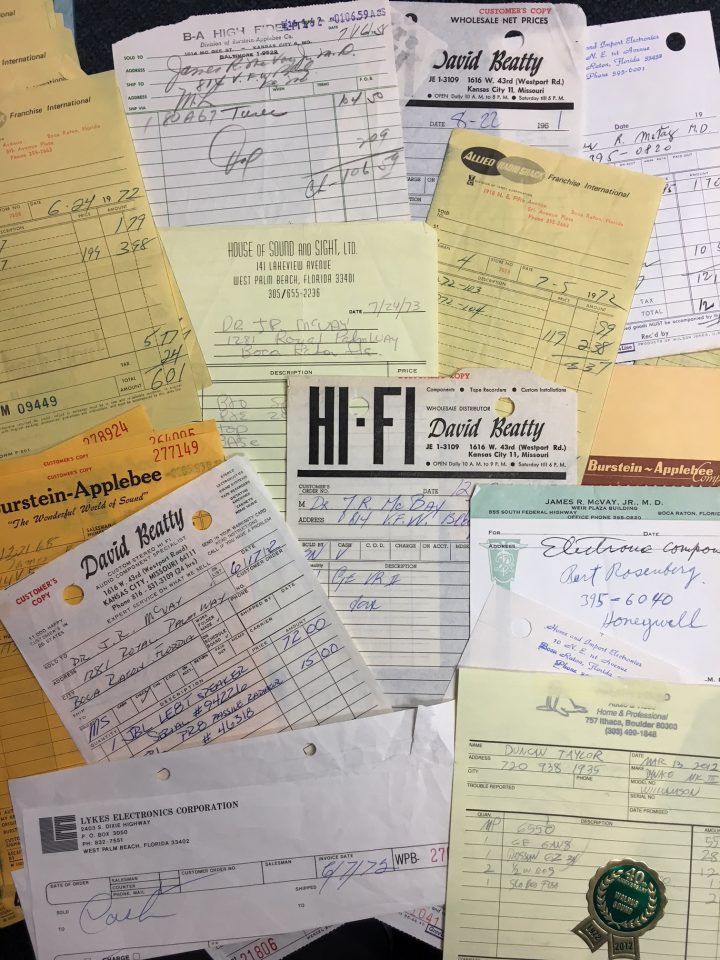


Stuff. And lots of it.

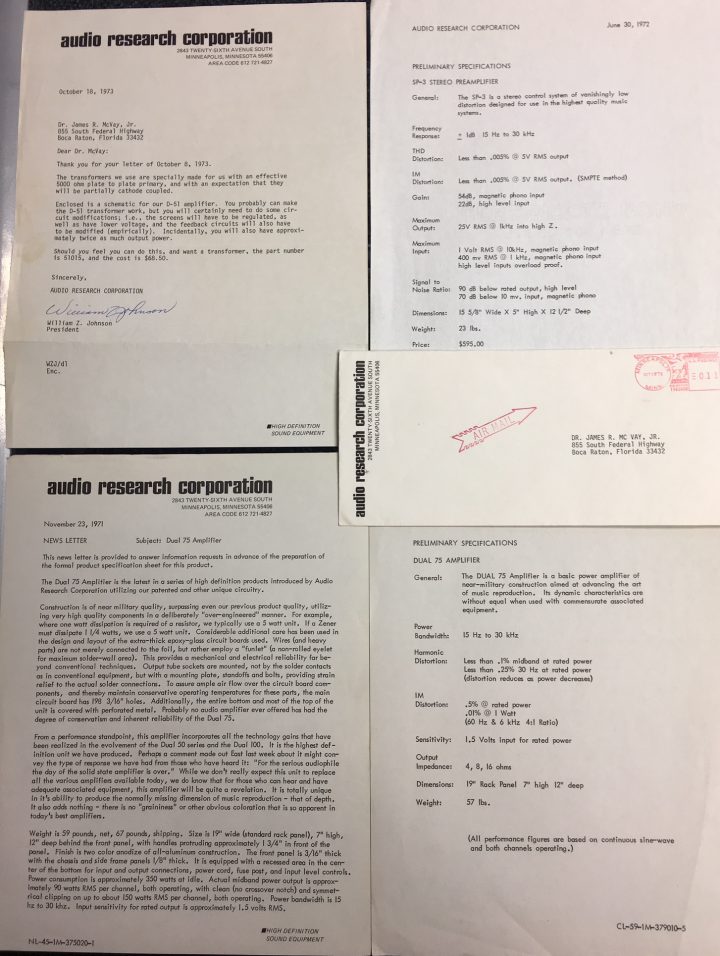
Sorting the binder’s contents by category—once a student librarian, always a student librarian—I discovered a familiar batch of material from Audio Research Corporation, familiar because I’d received much of it from ARC myself. God bless those patient manufacturers who faithfully responded to the handwritten requests of 16-year-old me.

What I never had was a letter from company President, Bill Johnson, though I met him a number of times.  Duncan’s grandfather, Dr. James McVay, may have been  known to Johnson, judging by the friendly tone of the note. The rest of the batch was the familiar stuff: info on the then-new Dual 75 amp, news of the Magneplanar speakers then distributed by ARC, a schematic of the Dual 51, and the literature for the SP-3A-1 preamp. Not only had I had all the paper material, I’d had a tri-amped set of Maggie Tympanis with D-51s and D-75. The passive crossover is news to me (I’d had an electronic crossover, the EC-4), and it was good to see the familiar name of Wendell Diller—still around as Magneplanar’s sales manager.
There were a few other pieces of literature and ephemera from the late ’60’s and ‘early ’70s: a JBL warranty card  from the Arnold Wolf period (’69-’80) for the classic LE8T fullranger;  a brochure for the AR-5, little brother to the AR-3a; an Empire full-range brochure, complete with cheesy sexist pics. 

But the mother lode was an assortment of material from the mid-to-late ’50s. Some of it was really eye-opening.

You guessed it: we’ll go into those goodies in the next issue of Copper. 

More from Issue 52

View All Articles in Issue 52

Search Copper Magazine

#234 A Life in High-End Audio: The Roy Hall Interview, Part One by Frank Doris Sep 07, 2026 #234 Jason Greenlaw Offers His Personal Perspective on Jazz Guitar in Vantage Point by Frank Doris Sep 07, 2026 #234 Transcendent Phoenix: Lucina Yue Brings the Ancient Konghou Into Modern Times by Frank Doris Sep 07, 2026 #234 We Must All Follow Our Bliss by B. Jan Montana Sep 07, 2026 #234 How to Play in a Rock Band, 27: Leveling Up by Frank Doris Sep 07, 2026 #234 Ross Valory: Traveling Into New Musical Territory With All of the Above by Ray Chelstowski Sep 07, 2026 #234 Singer/Songwriter John David Schrader: On the Need to Create by Joe Caplan Sep 07, 2026 #234 The People Who Make Audio Happen: More From T.H.E. Show SoCal 2026 by Harris Fogel Sep 07, 2026 #234 The Vinyl Beat Digs Into the Gadget Box by Rudy Radelic Sep 07, 2026 #234 The Rolling Stones: Foreign Tongues Spoken Loud by Wayne Robins Sep 07, 2026 #234 Musical Moments by Rich Isaacs Sep 07, 2026 #234 Rags for Solo Piano and a Dog: David Chesky's Ragtime Music for the Modern Age by Frankly Speaking Sep 07, 2026 #234 HIGH END 2026, Vienna: Here to Stay by Carsten Barnbeck Sep 07, 2026 #234 From The Audiophile’s Guide: The Two Main Types of Loudpeakers – Box and Panel by Paul McGowan Sep 07, 2026 #234 Letting it Slide by Frank Doris Sep 07, 2026 #234 PS Audio in the News by PS Audio Staff Sep 07, 2026 #234 Long Playing by Peter Xeni Sep 07, 2026 #234 La Mer by B. Jan Montana Sep 07, 2026 #233 A Report From The Total Hi-Fi Experience Show SoCal 2026 by B. Jan Montana Aug 03, 2026 #233 Bluegrass Meets Country, Folk, Jazz and More in All That We Carried by The Squid City Slingers by Frank Doris Aug 03, 2026 #233 Corey Glover and One Tribe Nation: A Variegated Musical Collective by Ray Chelstowski Aug 03, 2026 #233 Excursions with Clive: The Late Clive Davis, A Personal History by Wayne Robins Aug 03, 2026 #233 AI, Art, and Music: A Conversation With Synthography Art by Joe Caplan Aug 03, 2026 #233 New American Symphonies: A Rediscovered Gem and a Vital Contemporary Work by Frank Doris Aug 03, 2026 #233 The Vinyl Beat: Genesis, the Dave Clark Five, Antonio Carlos Jobim and More by Rudy Radelic Aug 03, 2026 #233 How to Play in a Rock Band, 26: When It's Time to Record Your Music by Frank Doris Aug 03, 2026 #233 More From T.H.E. Show 2026, and the People Who Made it Happen by Harris Fogel Aug 03, 2026 #233 Underappreciated Artists, Part Three: Icehouse by Rich Isaacs Aug 03, 2026 #233 The Surprisingly Rich and Varied Music of Somalia by Steve Kindig Aug 03, 2026 #233 A Remarkable Discographic Legacy: The LP Recordings of the Basel Symphony Orchestra by Stephan Haberthür Aug 03, 2026 #233 From The Audiophile’s Guide: The Importance of Loudspeakers by Paul McGowan Aug 03, 2026 #233 From Swimming Pool to New Listening Room: A Conversation with Norman Varney of AV RoomService by Gilles Laferrière Aug 03, 2026 #233 PS Audio in the News by PS Audio Staff Aug 03, 2026 #233 Audio Jewelry by Peter Xeni Aug 03, 2026 #233 Enrich Your Life by Frank Doris Aug 03, 2026 #233 The Searcher by James Schrimpf Aug 03, 2026 #232 What came first: Art or Music? A Conversation With Artist Jose Acosta by Joe Caplan Jul 06, 2026 #232 Blow By Blow: The Jeff Beck Story: An Insightful Book About a Guitar Icon by Ray Chelstowski Jul 06, 2026 #232 Creed Over Camaraderie? by B. Jan Montana Jul 06, 2026 #232 Chronicles of a Sound Pilgrim at the 2026 Montreal Audiofest by Hugues Morin Jul 06, 2026 #232 The Vinyl Beat: Summer Grooves by Rudy Radelic Jul 06, 2026 #232 Hibbing Hillbilly Dylan's Acoustic Rock by Wayne Robins Jul 06, 2026 #232 Quad Quads and Plasmatronics Tweeters: An Extraordinary System Comes to Life by Frank Doris Jul 06, 2026 #232 In Praise of Live Music, Once Again by Ted Shafran Jul 06, 2026 #232 Allnic Audio’s L-9000 Preamplifier: Design and Engineering Innovation by Howard Kneller Jul 06, 2026 #232 “Best Of” Lists and Rage Bait: Enough Already by Frank Doris Jul 06, 2026 #232 Quick Takes: Bud Shank, Paulo Almeida, Jakob Dreyer, Tim Eriksen and Peter Irvine by Frank Doris Jul 06, 2026

The Mysterious Binder

The Mysterious Binder

I wrote about ephemera back in Copper #37. In that column I wrote (and I’m quoting myself because I don’t think I can say it any better now): “I also learned that there was a fancy name for the category of collectibles that included those [train] schedules, along with brochures, flyers, catalogs—all the stuff that was never expected to be saved. Because of the inherently ephemeral nature of such things—here today, gone tomorrow—that category is known as ephemera (ee-FEM-er-uh). A lovely name, no? Almost Biblical.”

Our itinerant recording engineer/DIY builder of things that don’t usually burst into flames, Duncan Taylor, plopped a black leatherette binder in front of me this morning. Having been bitten in the ass by all manner of legal documents in the past, I cautiously lifted the corner of the cover.

“This was my granddad’s stuff, ” Dunc said, as I leafed through a sheaf of receipts, warranty cards, manuals, booklets, and product literature. The stuff was all about audio gear—amps, tuners, speakers, cartridges, and turntables, from the ’50s to the ’70s.

“I guess the tube doesn’t fall far from the amplifier,” I said.

“Yeah, I got the bug from him,” Duncan said.

So what was in that binder?

My first impression was that I’d unearthed one of my Dad’s innumerable files. Dad also stashed receipts and warranty cards for things long-vanished from the face of the Earth. I’m not sure if pack-rattery was a trait of the Depression generation, or if it was just a coincidence. But there they were, dozens of palm-sized yellow and white paper receipts with the familiar bluish tracery of a multi-leaf pad, with the spidery handwriting and occasional misspellings characteristic of human effort. These days the anonymous machine-printed thermal paper receipts provide no evidence of human involvement, and that damned thermal crap will likely fade away in a decade. Someday, future generations will look at their forebear’s file folders, filled with slightly-sticky pieces of paper, all blank—and those future archaeologists will wonder, “what the hell—“.

Anyway. Not the case here. I recognized some of the companies listed on the receipts: David Beatty Stereo and Burstein-Applebee were still around in Kansas City back when I started in audio. House of Sound and Sight of West Palm Beach was still around in the ’70’s; that receipt in the center is for a P-E (Perpetuum-Ebner, a peculiar name, even more-peculiarly revived) turntable and a Bang & Olufsen SP-14 cartridge.  The Allied receipts—a whole pile of them—all say “Allied Radio Shack”. I hadn’t realized that Allied was also a Tandy property in the chain’s declining years. Even more surprising was the discovery, courtesy of Wikipedia, that Allied is still around as a wholesale distributor.


Stuff. And lots of it.

Sorting the binder’s contents by category—once a student librarian, always a student librarian—I discovered a familiar batch of material from Audio Research Corporation, familiar because I’d received much of it from ARC myself. God bless those patient manufacturers who faithfully responded to the handwritten requests of 16-year-old me.

What I never had was a letter from company President, Bill Johnson, though I met him a number of times.  Duncan’s grandfather, Dr. James McVay, may have been  known to Johnson, judging by the friendly tone of the note. The rest of the batch was the familiar stuff: info on the then-new Dual 75 amp, news of the Magneplanar speakers then distributed by ARC, a schematic of the Dual 51, and the literature for the SP-3A-1 preamp. Not only had I had all the paper material, I’d had a tri-amped set of Maggie Tympanis with D-51s and D-75. The passive crossover is news to me (I’d had an electronic crossover, the EC-4), and it was good to see the familiar name of Wendell Diller—still around as Magneplanar’s sales manager.

There were a few other pieces of literature and ephemera from the late ’60’s and ‘early ’70s: a JBL warranty card  from the Arnold Wolf period (’69-’80) for the classic LE8T fullranger;  a brochure for the AR-5, little brother to the AR-3a; an Empire full-range brochure, complete with cheesy sexist pics. 

But the mother lode was an assortment of material from the mid-to-late ’50s. Some of it was really eye-opening.

You guessed it: we’ll go into those goodies in the next issue of Copper. 

0 comments

Leave a comment

0 Comments

Your avatar

Loading comments...

🗑️ Delete Comment

Enter moderator password to delete this comment:

✏️ Edit Comment

Enter your email to verify ownership: