COPPER

A PS Audio Publication

Issue 100 • Free Online Magazine

Issue 100 OFF THE CHARTS

Talking Heads: This Ain't No Fooling Around

Talking Heads: This Ain't No Fooling Around

Recently I had the pleasure of seeing the live show David Byrne’s American Utopia on Broadway (more on that later), and it gave me the urge to revisit the weird and wonderful world of Talking Heads.

The band’s original members – Byrne on vocals and guitar, Chris Frantz on drums, and Tina Weymouth on bass – met in the early 1970s at the Rhode Island School of Design. By 1975 they’d all found their way to New York City, where they fit right into the American punk and burgeoning New Wave movements. A friend had seen the term “talking heads” defined in an article in TV Guide as a head-and-shoulders shot that’s considered “all content and no action,” and it seemed like an appropriate band name. Their first gig was at CBGB, opening for the Ramones.

Sire Records signed them in 1976, and their debut album Talking Heads: 77 came out the following year. Its single “Psycho Killer” broke into the Billboard Top 100 and is still one of the band’s best-known songs. But the album has plenty of other goodies on offer. The record had assistance from Jerry Harrison on guitar and backing vocals, plus he served as the album’s producer. After this, the trio invited Harrison to join the band officially.


One of the first Talking Heads singles. The B-side “I Wish You Wouldn’t Say That” was unreleased on LP until 1992.

“Last Week/Next Week…Carefree” features a jumpy melody designed to go with the words in the most gloriously ridiculous way (the repeated phrase “last week” is sung on two notes a full octave apart). Besides its vocal humor, maybe the song’s most distinctive feature is the saxophone part, uncredited but probably played by Harrison.


“The Book I Read” exemplifies a number of Byrne’s traits as a songwriter. First, there’s the fast-picked, repetitive guitar lick that gives this song a touch of reggae influence. Next, there’s the lack of pretention in the lyrics and melody, just an idea laid out in a simple way that somehow manages to defy musical expectations. And then, of course, there’s the content: a love song to an author, a glimpse into Byrne’s unaffected intellectual joy.


The album More Songs About Buildings and Food came out in 1978, providing a massive hit with the band’s cover of Al Green’s “Take Me to the River.”


The original “Take Me to the River” 45.

The album’s other songs are all originals. “With Our Love” is a prime example of the Talking Heads’ use of guitar layers as prickly percussion. It also shows their unique concept of chordal harmony. (I teach music theory, a subject where the rules can crush you, so it’s always fun to see somebody deviously crushing the rules for a change!) The verses are in G minor, and not only doesn’t it follow a normal chord progression for that key, but the chorus switches randomly to A major, quite a surprising key change!


Brian Eno produced that album and also helped produce the 1979 album Fear of Music, recorded partly in Frantz’s and Weymouth’s loft apartment. Eno is also credited with “electronic treatments.” The album itself did very well in the US and the UK but only had one decently performing single, “Life During Wartime.”
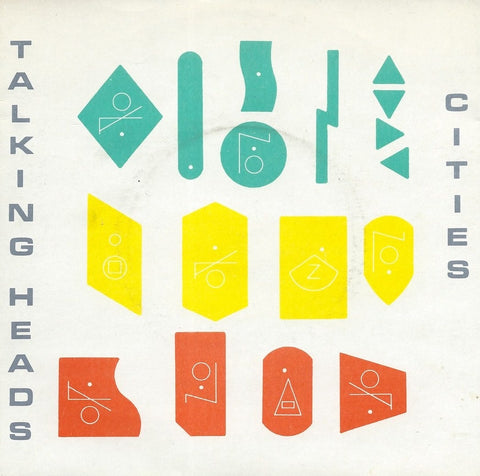

A lesser-known single, “Cities,” from the Fear of Music album.

“Memories Can’t Wait” demonstrates a heavier sound, tense and creepy with dissonances, reverb, and the extremely limited pitches of its melody. Yet Byrne develops the introspective material outward by flipping up into falsetto.


The 1980 album Remain in Light found Eno at the helm again, this time working with two experimental notions. The first was to equalize the members’ input so Talking Heads would seem to be more than an alternate name for “David Byrne and His Backing Band.” The second idea was to weave in African-influenced polyrhythms, now that the band had discovered the music of Nigerian multi-instrumentalist and Afrobeat pioneer Fela Kuti.

One of the African-infused songs is “Crosseyed and Painless,” which was a hit in dance clubs for its magnetic rhythms but largely ignored on radio, probably thanks to its paranoid lyrics. In today’s era of everyone screaming “Fake news!” at each other, it’s an ideal time for this song to make a comeback.


Speaking in Tongues (1983) became a historically important album when it provided material for the 1984 Talking Heads concert film, Stop Making Sense, directed by Jonathan Demme and capturing the New Wave on celluloid perhaps better than any other feature-length movie. Among its most memorable moments is Byrne singing “Girlfriend Is Better” in a hilariously wide-shouldered suit that casts a Titan-sized shadow on the back scrim.

“Girlfriend Is Better” was released as a single from the movie soundtrack, not the album, but it never charted in the U.S. Here’s that droll movie clip:


Critics were not prepared for the stylistic turn of the next album, Little Creatures (1985), which brings in elements of country and bluegrass music. Fans were happy, however, pushing the record to No. 20 on the Billboard 200. “And She Was” charted as the biggest US single from the album.

There’s not much of an Americana sound to the song “Give Me Back My Name,” which owes more to The Cure than to The Carter Family. It’s another example of the inexplicable chord progressions that make Talking Heads identifiable and unique. The melody is unusually somber and subdued, as are the mystical lyrics and Byrne’s melancholy delivery.


Talking Heads’ eighth and final album was Naked (1988). They turned to famed British producer Steve Lillywhite for guidance in an ambitious project melding improvisational tracks with the sounds of a wide range of international musicians. The album was mostly recorded in Paris, a central location for the musical guests to congregate from all over.

Artists contributing to the song “Mr. Jones” included Puerto Rican percussionist Manolo Badrena, Guinean kora harp player Mory Kanté, and an eight-piece brass chorus made up of some truly great Latin jazz specialists. Byrne reportedly improvised the lyrics over and over until they grew into something he was happy with.


Although Talking Heads stopped working together soon after this album came out, they didn’t officially announce their split until 1991. Harrison went on to become a successful record producer. Frantz and Weymouth (who have been married since 1977) had founded the Tom Tom Club in 1981, a side project connected with a pro-reggae movement known as the Compass Point All-Stars. Tom Tom Club has released a handful of albums over the decades, the most recent in 2012.

And then there’s David Byrne, who has released successful solo albums, writes musicals for off-Broadway and on, and supports the careers of young Latin percussionists whenever he gets the chance. That passion is clearly an impetus for David Byrne’s American Utopia, which features rhythmically spectacular arrangements of both Talking Heads classics and new songs. Twelve terrific musicians back the indefatigable 67-year-old Byrne. The show is slickly directed by five-time Tony Award-winner Alex Timbers and has choreography by Annie-B Parson, who takes some of Byrne’s famous Stop Making Sense gestures as her starting point.

If, like me, you thought you’d never get a chance to hear Talking Heads live, American Utopia is as close as you’re going to get.

Header image courtesy of Wikimedia Commons/Harrison and Wemouth by Michael Markos, Byrne and Frantz by Jean-Luc.

More from Issue 100

View All Articles in Issue 100

Search Copper Magazine

#233 A Report From The Total Hi-Fi Experience Show SoCal 2026 by B. Jan Montana Aug 03, 2026 #233 Bluegrass Meets Country, Folk, Jazz and More in All That We Carried by The Squid City Slingers by Frank Doris Aug 03, 2026 #233 Corey Glover and One Tribe Nation: A Variegated Musical Collective by Ray Chelstowski Aug 03, 2026 #233 Excursions with Clive: The Late Clive Davis, A Personal History by Wayne Robins Aug 03, 2026 #233 AI, Art, and Music: A Conversation With Synthography Art by Joe Caplan Aug 03, 2026 #233 New American Symphonies: A Rediscovered Gem and a Vital Contemporary Work by Frank Doris Aug 03, 2026 #233 The Vinyl Beat: Genesis, the Dave Clark Five, Antonio Carlos Jobim and More by Rudy Radelic Aug 03, 2026 #233 How to Play in a Rock Band, 26: When It's Time to Record Your Music by Frank Doris Aug 03, 2026 #233 More From T.H.E. Show 2026, and the People Who Made it Happen by Harris Fogel Aug 03, 2026 #233 Underappreciated Artists, Part Three: Icehouse by Rich Isaacs Aug 03, 2026 #233 The Surprisingly Rich and Varied Music of Somalia by Steve Kindig Aug 03, 2026 #233 A Remarkable Discographic Legacy: The LP Recordings of the Basel Symphony Orchestra by Stephan Haberthür Aug 03, 2026 #233 From The Audiophile’s Guide: The Importance of Loudspeakers by Paul McGowan Aug 03, 2026 #233 From Swimming Pool to New Listening Room: A Conversation with Norman Varney of AV RoomService by Gilles Laferrière Aug 03, 2026 #233 PS Audio in the News by PS Audio Staff Aug 03, 2026 #233 Audio Jewelry by Peter Xeni Aug 03, 2026 #233 Enrich Your Life by Frank Doris Aug 03, 2026 #233 The Searcher by James Schrimpf Aug 03, 2026 #232 What came first: Art or Music? A Conversation With Artist Jose Acosta by Joe Caplan Jul 06, 2026 #232 Blow By Blow: The Jeff Beck Story: An Insightful Book About a Guitar Icon by Ray Chelstowski Jul 06, 2026 #232 Creed Over Camaraderie? by B. Jan Montana Jul 06, 2026 #232 Chronicles of a Sound Pilgrim at the 2026 Montreal Audiofest by Hugues Morin Jul 06, 2026 #232 The Vinyl Beat: Summer Grooves by Rudy Radelic Jul 06, 2026 #232 Hibbing Hillbilly Dylan's Acoustic Rock by Wayne Robins Jul 06, 2026 #232 Quad Quads and Plasmatronics Tweeters: An Extraordinary System Comes to Life by Frank Doris Jul 06, 2026 #232 In Praise of Live Music, Once Again by Ted Shafran Jul 06, 2026 #232 Allnic Audio’s L-9000 Preamplifier: Design and Engineering Innovation by Howard Kneller Jul 06, 2026 #232 “Best Of” Lists and Rage Bait: Enough Already by Frank Doris Jul 06, 2026 #232 Quick Takes: Bud Shank, Paulo Almeida, Jakob Dreyer, Tim Eriksen and Peter Irvine by Frank Doris Jul 06, 2026 #232 My Impressions of AXPONA 2026, Part 2 by Frank Doris Jul 06, 2026 #232 How to Play in a Rock Band, 25: Encounters With Famous Musicians, Part Three by Frank Doris Jul 06, 2026 #232 Budgets, and Systems From Small to Outrageous by Paul McGowan Jul 06, 2026 #232 PS Audio in the News by PS Audio Staff Jul 06, 2026 #232 Hand It Over by Frank Doris Jul 06, 2026 #232 Difference of Opinion by Peter Xeni Jul 06, 2026 #232 Wabi-sabi Tree by James Schrimpf Jul 06, 2026 #231 Piano Prodigy Jude Kofie Releases His Debut Album On Octave Records by Frank Doris Jun 01, 2026 #231 Underappreciated Artists, Part Two: City Boy by Rich Isaacs Jun 01, 2026 #231 Music and the Art of Creation: Talking With Saxophonist Rob Scheps by Joe Caplan Jun 01, 2026 #231 How to Play in a Rock Band, 24: Further Adventures at the 2026 Montauk Music Festival by Frank Doris Jun 01, 2026 #231 Courtney Barnett: Creature of Habit by Wayne Robins Jun 01, 2026 #231 Angine de Poitrine: Interstellar Guitar Rock Saviors Headed for Late-Night TV Pop Stardom? by Mark Lepage Jun 01, 2026 #231 My Impressions of AXPONA 2026, Part One by Frank Doris Jun 01, 2026 #231 2026 La Jolla Concours d'Elegance: Another Aesthetic Feast by B. Jan Montana Jun 01, 2026 #231 Country Music Icon Jo Dee Messina’s Bridges: A New Beginning by Ray Chelstowski Jun 01, 2026 #231 The Luxury Dispatch Hosts a Video Podcast With Ken Kessler by Ken Kessler Jun 01, 2026 #231 The Vinyl Beat: Tracking in the Motor City by Rudy Radelic Jun 01, 2026

Talking Heads: This Ain't No Fooling Around

Talking Heads: This Ain't No Fooling Around

Recently I had the pleasure of seeing the live show David Byrne’s American Utopia on Broadway (more on that later), and it gave me the urge to revisit the weird and wonderful world of Talking Heads.

The band’s original members – Byrne on vocals and guitar, Chris Frantz on drums, and Tina Weymouth on bass – met in the early 1970s at the Rhode Island School of Design. By 1975 they’d all found their way to New York City, where they fit right into the American punk and burgeoning New Wave movements. A friend had seen the term “talking heads” defined in an article in TV Guide as a head-and-shoulders shot that’s considered “all content and no action,” and it seemed like an appropriate band name. Their first gig was at CBGB, opening for the Ramones.

Sire Records signed them in 1976, and their debut album Talking Heads: 77 came out the following year. Its single “Psycho Killer” broke into the Billboard Top 100 and is still one of the band’s best-known songs. But the album has plenty of other goodies on offer. The record had assistance from Jerry Harrison on guitar and backing vocals, plus he served as the album’s producer. After this, the trio invited Harrison to join the band officially.


One of the first Talking Heads singles. The B-side “I Wish You Wouldn’t Say That” was unreleased on LP until 1992.

“Last Week/Next Week…Carefree” features a jumpy melody designed to go with the words in the most gloriously ridiculous way (the repeated phrase “last week” is sung on two notes a full octave apart). Besides its vocal humor, maybe the song’s most distinctive feature is the saxophone part, uncredited but probably played by Harrison.


“The Book I Read” exemplifies a number of Byrne’s traits as a songwriter. First, there’s the fast-picked, repetitive guitar lick that gives this song a touch of reggae influence. Next, there’s the lack of pretention in the lyrics and melody, just an idea laid out in a simple way that somehow manages to defy musical expectations. And then, of course, there’s the content: a love song to an author, a glimpse into Byrne’s unaffected intellectual joy.


The album More Songs About Buildings and Food came out in 1978, providing a massive hit with the band’s cover of Al Green’s “Take Me to the River.”


The original “Take Me to the River” 45.

The album’s other songs are all originals. “With Our Love” is a prime example of the Talking Heads’ use of guitar layers as prickly percussion. It also shows their unique concept of chordal harmony. (I teach music theory, a subject where the rules can crush you, so it’s always fun to see somebody deviously crushing the rules for a change!) The verses are in G minor, and not only doesn’t it follow a normal chord progression for that key, but the chorus switches randomly to A major, quite a surprising key change!


Brian Eno produced that album and also helped produce the 1979 album Fear of Music, recorded partly in Frantz’s and Weymouth’s loft apartment. Eno is also credited with “electronic treatments.” The album itself did very well in the US and the UK but only had one decently performing single, “Life During Wartime.”


A lesser-known single, “Cities,” from the Fear of Music album.

“Memories Can’t Wait” demonstrates a heavier sound, tense and creepy with dissonances, reverb, and the extremely limited pitches of its melody. Yet Byrne develops the introspective material outward by flipping up into falsetto.


The 1980 album Remain in Light found Eno at the helm again, this time working with two experimental notions. The first was to equalize the members’ input so Talking Heads would seem to be more than an alternate name for “David Byrne and His Backing Band.” The second idea was to weave in African-influenced polyrhythms, now that the band had discovered the music of Nigerian multi-instrumentalist and Afrobeat pioneer Fela Kuti.

One of the African-infused songs is “Crosseyed and Painless,” which was a hit in dance clubs for its magnetic rhythms but largely ignored on radio, probably thanks to its paranoid lyrics. In today’s era of everyone screaming “Fake news!” at each other, it’s an ideal time for this song to make a comeback.


Speaking in Tongues (1983) became a historically important album when it provided material for the 1984 Talking Heads concert film, Stop Making Sense, directed by Jonathan Demme and capturing the New Wave on celluloid perhaps better than any other feature-length movie. Among its most memorable moments is Byrne singing “Girlfriend Is Better” in a hilariously wide-shouldered suit that casts a Titan-sized shadow on the back scrim.

“Girlfriend Is Better” was released as a single from the movie soundtrack, not the album, but it never charted in the U.S. Here’s that droll movie clip:


Critics were not prepared for the stylistic turn of the next album, Little Creatures (1985), which brings in elements of country and bluegrass music. Fans were happy, however, pushing the record to No. 20 on the Billboard 200. “And She Was” charted as the biggest US single from the album.

There’s not much of an Americana sound to the song “Give Me Back My Name,” which owes more to The Cure than to The Carter Family. It’s another example of the inexplicable chord progressions that make Talking Heads identifiable and unique. The melody is unusually somber and subdued, as are the mystical lyrics and Byrne’s melancholy delivery.


Talking Heads’ eighth and final album was Naked (1988). They turned to famed British producer Steve Lillywhite for guidance in an ambitious project melding improvisational tracks with the sounds of a wide range of international musicians. The album was mostly recorded in Paris, a central location for the musical guests to congregate from all over.

Artists contributing to the song “Mr. Jones” included Puerto Rican percussionist Manolo Badrena, Guinean kora harp player Mory Kanté, and an eight-piece brass chorus made up of some truly great Latin jazz specialists. Byrne reportedly improvised the lyrics over and over until they grew into something he was happy with.


Although Talking Heads stopped working together soon after this album came out, they didn’t officially announce their split until 1991. Harrison went on to become a successful record producer. Frantz and Weymouth (who have been married since 1977) had founded the Tom Tom Club in 1981, a side project connected with a pro-reggae movement known as the Compass Point All-Stars. Tom Tom Club has released a handful of albums over the decades, the most recent in 2012.

And then there’s David Byrne, who has released successful solo albums, writes musicals for off-Broadway and on, and supports the careers of young Latin percussionists whenever he gets the chance. That passion is clearly an impetus for David Byrne’s American Utopia, which features rhythmically spectacular arrangements of both Talking Heads classics and new songs. Twelve terrific musicians back the indefatigable 67-year-old Byrne. The show is slickly directed by five-time Tony Award-winner Alex Timbers and has choreography by Annie-B Parson, who takes some of Byrne’s famous Stop Making Sense gestures as her starting point.

If, like me, you thought you’d never get a chance to hear Talking Heads live, American Utopia is as close as you’re going to get.

Header image courtesy of Wikimedia Commons/Harrison and Wemouth by Michael Markos, Byrne and Frantz by Jean-Luc.

0 comments

Leave a comment

0 Comments

Your avatar

Loading comments...

🗑️ Delete Comment

Enter moderator password to delete this comment:

✏️ Edit Comment

Enter your email to verify ownership: