COPPER

A PS Audio Publication

Issue 101 • Free Online Magazine

Issue 101 FEATURED

Queen of the Salons

Queen of the Salons

A Paris Salon, drawing by Adrien Moreau (1843-1906)

She was considered to be the Queen of the Salons; a great beauty and the “unchallenged sovereign of sophisticated Paris…the most distinguished lady in the whole of Parisian society.” [1] Élisabeth de Caraman-Chimay was also called the “Queen of Music” by the Paris press and was one of the most famous and influential salonnières who helped shape the musical taste of 19th-century Europe.

Salonnières like Élisabeth de Caraman-Chimay were the gratin (“upper crust”) of French society: educated women who generally married for money and status, and were discouraged by a male dominated society from working for a living or even leaving their homes. To escape their isolation these wealthy and often flamboyant women hosted cultural gatherings in their homes where both women and men could meet, share common interests, and exchange ideas in ways they wouldn’t be able to in the restrictive world outside.

The salonnières promoted and supported musicians, commissioned and premiered new works, and sometimes guided the music performances. The most prominent salonnières were so influential that some musicians would first appear at private music salons in order to build their reputations—reputations that could lead to public performances.

“Historically exempt from working for a living, the grandees of fin de siècle Paris [many of whom were salonnières] treated pageantry as their full-time job. They were known as the monde, or grand monde (“great world”)…and devoted themselves to a never-ending stream of dinners, concerts, plays, balls, cotillions, charity bazaars, costume parties, and embassy soirées.

‘The ladies of the monde, or mondaines, were not only the chief organizers and ornaments of this 24-hour party culture; they were its gatekeepers, and they extended few invitations to plebeians, whom they collectively termed “the Losers’ Club.” Then as now, their airy scorn for outsiders only increased the fascination these women held for that ostensible club’s members, fueling an explosion in the presse mondaine: an aggregate of daily, weekly, and monthly broadsheets that existed to gratify the general public’s insatiable curiosity about how the one percent lived. This booming industry prefigured the juggernaut of celebrity tabloids, gossip blogs, reality shows, and social media that pervades our culture today.”[2]

“They viewed themselves, and were praised by Proust and others, as the exotic golden birds of French high society. ‘When confined to an aviary or a cage,’ Élisabeth wrote, ‘woman cultivates her plumage and her song for reasons of pleasure, power.’ Her kinsman, the gay aesthete Robert de Montesquiou, called her ‘the Swan’…and she adopted mythic personas from Swan Lake, Lohengrin and the story of Leda, wrapping herself in a frothy winglike cloak of swan’s plumes, gliding in white satin mules [slippers] trimmed with swan’s feathers or waving a gigantic swan’s-down fan.”[3]

Élisabeth de Caraman-Chimay. (Source: Wikipedia)

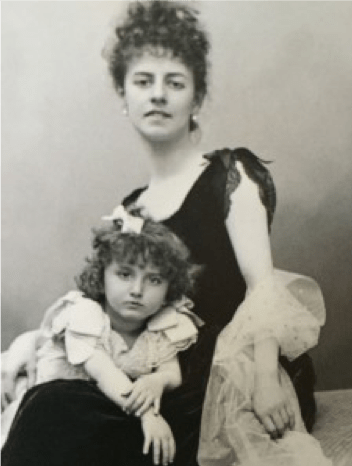
With her daughter. (Credit: I.pinimg/com)

Élisabeth de Caraman-Chimay (1860-1952), later Élisabeth Comtesse Greffulhe, was born into a family already interested in music and arts patronage. In 1881 Élisabeth married Count Henry Greffulhe, a wealthy French heir, socialite, and politician. Unfortunately the Count was possessive and a philanderer who restricted Élisabeth’s social activities. Élisabeth responded by establishing a music salon and opening it to contemporary Parisian artists.

Composer Gabrielle Fauré met Élisabeth in 1887. Fauré organized concerts for her gatherings and dedicated his Pavane to her. She suggested a more elaborate version of the Pavane with dancers and an invisible chorus, then arranged for the first complete performance of the new version at a garden party she held in 1891.

During the early1890s Élisabeth extended her influence by renting one of Paris’ largest concert halls and organizing a performance of Handel’s Messiah. Praised as one of the greatest events of the year, the Countess gained a reputation as a modern woman who had progressive political ideas and innovative musical taste.

Following the success of her Messiah, Élisabeth founded an organization with the aim   of promoting living French composers. The “Société des Grandes Auditions Musicales de France” was established in 1890 with a committee that included composers Franck, Chausson, Chabrier, d’Indy, Widor, and composer/conductor Camille Chevillard. The goal was to “give performances of complete works by composers old and new, and to be a center for French composers, to ensure to our country the first performance of their works.”[4]The press recognized that this was not simply a reunion of dilettantes but a distinguished national association serving a public need. The project quickly gained financial support from numerous members of the aristocracy, inspiring wealthy women to turn their financial support to public institutions and individual composers.

Winnaretta Singer: Self-portrait 1885. (Source: en.wikipedia.org)

Winnaretta Singer (1865-1943) was a musician, artist, and another of the most influential salonnières. Born in Yonkers, New York, Singer was the 20th of 24 children fathered by the inventor of the modern sewing machine. She welcomed musicians to her famous Paris Salon for over 50 years and commissioned works from many of them.

Like other wealthy women of the time, she married a European aristocrat in order to gain a title. At age 22 she wed prince Louis-Vilfred de Scey-Montbéliard but her marriage, like Élisabeth’s, was a disaster. “On his wedding night, when the prince entered the honeymoon chamber, he found the princess atop a large wardrobe, an umbrella in hand, yelling, ‘If you touch me, I’ll kill you!” [5] The marriage was annulled after five years. In 1893 she married another prince, Edmond de Polignac, who was reportedly gay but didn’t create a problem because Winnaretta was already having affairs with women. Their platonic union was happy but brief: he died in 1901.

Fauré was part of Winnaretta’s circle as well as Élisabeth’s. Through her patronage of, and friendship with, Fauré she learned how hard it was for emerging contemporary  composers to have their compositions performed in public venues. As a result, Singer hosted a salon in her mansion that lasted from 1888 to 1939 and was open to everyone who was anyone in the arts. Prominent guests included Nadia Boulanger, Benjamin Britten, Cole Porter, Kurt Weill, Sergei Diaghilev, Isadora Duncan, Marcel Proust (who based some of his scenes in Remembrance of Things Past on the times he spent at  salons), Colette, Claude Monet, and Jean Cocteau, and there were first performances of music by Chabrier, d’Indy, Ravel, Fauré, and Manuel de Falla (with the harpsichord part performed by Wanda Landowska). Claude Debussy’s compositions were featured almost every month between 1905-1907, and many premieres of his works took place at the mansion, too.

Singer commissioned works from many young composers including Stravinsky, Satie, Milhaud, Poulenc, and Françaix, and supported soloists Clara Haskil, Dinu Lipatti, Arthur Rubinstein, and Vladimir Horowitz. In areas of interest beyond the salons she also funded public housing in Paris and partnered with Marie Curie to send mobile radiology units — in limousines — to the front during World War I.

Singer’s arts patronage continues today through the Fondation Singer-Polignac which she initiated in 1928 and has been housed in her Paris mansion since 1945. The foundation presents concerts and other programs, and funds scientific projects as well as artistic ones.

Claude Debussy and the salon of Winnaretta Singer. (Source: parisianmusicsalon.wordpress.com/claude-debussy)

In addition to France, there were other prominent salons around the world like the one  led by Clara Schumann, acclaimed as one of the best pianists in Europe and recognized as one of the foremost composers of lieder in the 19th-century. Clara and her husband Robert championed each other’s works but, as usual for the time, her husband’s career took precedence.

Adele Bloch-Bauer, a society woman and hostess of a renowned Viennese Salon at the beginning of the 20th-century, entertained guests that included Gustav Mahler and Richard Strauss. She appeared fragile and delicate on one hand; elegant, intellectual, self-conscious and smug on the other, and was often caught engaging in the unladylike  habit of smoking. Bloch-Bauer was immortalized by artist Gustav Klimt in the famous silver and gold portrait he painted of her in 1907.

Adele Bloch-Bauer. (Source: Neue Galerie New York)

One of the foremost opera singers of her day, Australian Pauline Viardot promoted the careers of composers whose work she admired. As a teacher, she invited her students to  attend her salon where they learned lessons through performance practice and were able to make industry connections.

Laure de Sade (great-granddaughter of the Marquis de Sade), who became Comtesse de Chevigné, cultivated her persona as a sophisticated intellectual and swaggering rebel. She enjoyed shocking people, never shied away from cursing (in defiance of aristocratic manners), and spoke proudly of the Marquis’ X-rated opus. At the Bal des Bêtes in 1885 when 1,700 guests came costumed as insects, vermin, crustaceans, and big-game animals, she appeared as a white snowy owl, symbol of Minerva, goddess of wisdom. And in 1891, at the fashionable Black and White Ball, she defied the dress code by appearing as an androgynous harlequin in yellow and blue. Laure was a patron of artists and composers including Francis Poulenc and Ned Rorem; in keeping with the grand monde culture, the private recitals in her salon typically starred performers so famous that crowned heads from all over Europe clamored to be invited.

Geneviève Halévy Bizet Straus had connections to Bohemia and the artistic world through her first marriage to composer Georges Bizet. She established a salon regularly attended by Turgenev, Berlioz, Massenet, Gounod, Degas, and Alexandre Dumas; after her second marriage Geneviève started a new salon. As a Jewish bourgeoisie with a formidable family tree, she was also active in protesting the antisemitism of the 1880s and 1890s.

German-speaking Jews at that time had a dilemma: They saw new opportunities in Germany but didn’t have the comfort or support of a secure community. In addition, German society imposed the usual gender role restrictions as well as anti-semitism. Cultivated Jewish women were able to face the dilemma by starting salons:

“From 1800 on, salons performed a political and social miracle. The salon allowed Jewish women to establish a venue in their homes in which Jews and non-Jews could meet in relative equality. Like-minded people could study art, literature, philosophy or music together. This handful of educated, acculturated Jewish women could escape the restrictions of their social ghetto. Naturally the women had to be in well-connected families, either to money or to culture. In these mixed gatherings of nobles, high civil servants, writers, philosophers and artists, Jewish salonnières created a vehicle for Jewish integration, providing a context in which patrons and artists freely exchanged ideas.”[6]

With or without plumage, with or without costumed crustaceans or androgynous  harlequins, salonnières opened their homes so composers could connect with patrons and perform new music in private settings. Even though salons catered to the “upper crust” they had positive effects on the outside world by providing places where people were able to meet and express themselves away from social norms and 19th-century conventions, by helping change the ways money was allocated for the arts and public institutions, and by creating social awareness. Some of our most familiar pieces were introduced in these salons and the successful careers of many important 19th- and 20th-century composers were guided by what the salonnières and their guests had to offer.


[1] Georg Predota,“Muses and Musings La Comtesse Greffulhe: Female Entrepreneurial Power,”  Interlude (Oct. 2, 2017)

[2] Caroline Weber, “How Three 19th-century Parisian It Girls Became the Original Kardashians,” W magazine (May 2018)

[3]   Elaine Showalter, “French High Society During the Belle Époque,” The N.Y. Times (July 13, 2018)

[4] Georg Predota,“Muses and Musings La Comtesse Greffulhe: Female Entrepreneurial Power,”  Interlude (Oct. 2, 2017)

[5] Sylvia Kahan, Music’s Modern Muse (University of Rochester Press, 2006)

[6] Helen Webberley, “Cultural Salons and Jewish Women in 19th Century Berlin,” Limmud Oz Conference, Sydney, (July 2005)

More from Issue 101

View All Articles in Issue 101

Search Copper Magazine

#226 JJ Murphy’s Sleep Paralysis is a Genre-Bending Musical Journey Through Jazz, Fusion and More by Frank Doris Jan 05, 2026 #226 Stewardship by Consent by B. Jan Montana Jan 05, 2026 #226 Food, Music, and Sensory Experience: An Interview With Professor Jonathan Zearfoss of the Culinary Institute of America by Joe Caplan Jan 05, 2026 #226 Studio Confidential: A Who’s Who of Recording Engineers Tell Their Stories by Frank Doris Jan 05, 2026 #226 Pilot Radio is Reborn, 50 Years Later: Talking With CEO Barak Epstein by Frank Doris Jan 05, 2026 #226 The Vinyl Beat Goes Down to Tijuana (By Way of Los Angeles), Part One by Rudy Radelic Jan 05, 2026 #226 Capital Audiofest 2025: Must-See Stereo, Part Two by Frank Doris Jan 05, 2026 #226 My Morning Jacket’s Carl Broemel and Tyler Ramsey Collaborate on Their Acoustic Guitar Album, Celestun by Ray Chelstowski Jan 05, 2026 #226 The People Who Make Audio Happen: CanJam SoCal 2025, Part Two by Harris Fogel Jan 05, 2026 #226 How to Play in a Rock Band, 19: Touring Can Make You Crazy, Part One by Frank Doris Jan 05, 2026 #226 Linda Ronstadt Goes Bigger by Wayne Robins Jan 05, 2026 #226 From The Audiophile’s Guide: Active Room Correction and Digital Signal Processing by Paul McGowan Jan 05, 2026 #226 PS Audio in the News by Frank Doris Jan 05, 2026 #226 Back to My Reel-to-Reel Roots, Part 25: Half-Full, Not Empty by Ken Kessler Jan 05, 2026 #226 Happy New Year! by Frank Doris Jan 05, 2026 #226 Turn It Down! by Peter Xeni Jan 05, 2026 #226 Ghost Riders by James Schrimpf Jan 05, 2026 #226 A Factory Tour of Audio Manufacturer German Physiks by Markus "Marsu" Manthey Jan 04, 2026 #225 Capital Audiofest 2025: Must-See Stereo, Part One by Frank Doris Dec 01, 2025 #225 Otis Taylor and the Electrics Delivers a Powerful Set of Hypnotic Modern Blues by Frank Doris Dec 01, 2025 #225 A Christmas Miracle by B. Jan Montana Dec 01, 2025 #225 T.H.E. Show New York 2025, Part Two: Plenty to See, Hear, and Enjoy by Frank Doris Dec 01, 2025 #225 Underappreciated Artists, Part One: Martin Briley by Rich Isaacs Dec 01, 2025 #225 Rock and Roll is Here to Stay by Wayne Robins Dec 01, 2025 #225 A Lifetime of Holiday Record (and CD) Listening by Rudy Radelic Dec 01, 2025 #225 Little Feat: Not Saying Goodbye, Not Yet by Ray Chelstowski Dec 01, 2025 #225 How to Play in a Rock Band, Part 18: Dealing With Burnout by Frank Doris Dec 01, 2025 #225 The People Who Make Audio Happen: CanJam SoCal 2025 by Harris Fogel Dec 01, 2025 #225 Chicago’s Sonic Sanctuaries: Four Hi‑Fi Listening Bars Channeling the Jazz‑Kissa Spirit by Olivier Meunier-Plante Dec 01, 2025 #225 From The Audiophile’s Guide: Controlling Bass Frequencies Through Membrane Absorbers (and How to Build Your Own) by Paul McGowan Dec 01, 2025 #225 Your Editor’s Tips for Attending Audio Shows by Frank Doris Dec 01, 2025 #225 PS Audio in the News by Frank Doris Dec 01, 2025 #225 Back to My Reel-to-Reel Roots, Part 24 by Ken Kessler Dec 01, 2025 #225 Holiday Music by Frank Doris Dec 01, 2025 #225 Puppy Prognostication by Peter Xeni Dec 01, 2025 #225 How to Post Comments on Copper by Frank Doris Dec 01, 2025 #225 Living Color by Rudy Radelic Dec 01, 2025 #224 T.H.E. Show New York 2025, Part One: A New Beginning by Frank Doris Nov 03, 2025 #224 Fool’s Leap of Faith is the Extraordinary Octave Records Debut from Singer/Songwriter Tyler Burba and Visit by Frank Doris Nov 03, 2025 #224 The Beatles’ “Aeolian Cadences.” What? by Wayne Robins Nov 03, 2025 #224 Persona Non Grata by B. Jan Montana Nov 03, 2025 #224 Talking With Recording Engineer Barry Diament of Soundkeeper Recordings, Part Two by Frank Doris Nov 03, 2025 #224 B Sides, B Movies, and Beware of Zombies by Rudy Radelic Nov 03, 2025 #224 The Burn-In Chronicles: 1,000 Hours to Sonic Salvation by Olivier Meunier-Plante Nov 03, 2025 #224 A Conversation With Mat Weisfeld of VPI Industries by Joe Caplan Nov 03, 2025 #224 Blues-Rocker Kenny Wayne Shepherd Celebrates 30 Years of Ledbetter Heights by Ray Chelstowski Nov 03, 2025 #224 Playing in a Rock Band, 17: When Good Gigs Go Bad, Part Two by Frank Doris Nov 03, 2025

Queen of the Salons

Queen of the Salons

A Paris Salon, drawing by Adrien Moreau (1843-1906)

She was considered to be the Queen of the Salons; a great beauty and the “unchallenged sovereign of sophisticated Paris…the most distinguished lady in the whole of Parisian society.” [1] Élisabeth de Caraman-Chimay was also called the “Queen of Music” by the Paris press and was one of the most famous and influential salonnières who helped shape the musical taste of 19th-century Europe.

Salonnières like Élisabeth de Caraman-Chimay were the gratin (“upper crust”) of French society: educated women who generally married for money and status, and were discouraged by a male dominated society from working for a living or even leaving their homes. To escape their isolation these wealthy and often flamboyant women hosted cultural gatherings in their homes where both women and men could meet, share common interests, and exchange ideas in ways they wouldn’t be able to in the restrictive world outside.

The salonnières promoted and supported musicians, commissioned and premiered new works, and sometimes guided the music performances. The most prominent salonnières were so influential that some musicians would first appear at private music salons in order to build their reputations—reputations that could lead to public performances.

“Historically exempt from working for a living, the grandees of fin de siècle Paris [many of whom were salonnières] treated pageantry as their full-time job. They were known as the monde, or grand monde (“great world”)…and devoted themselves to a never-ending stream of dinners, concerts, plays, balls, cotillions, charity bazaars, costume parties, and embassy soirées.

‘The ladies of the monde, or mondaines, were not only the chief organizers and ornaments of this 24-hour party culture; they were its gatekeepers, and they extended few invitations to plebeians, whom they collectively termed “the Losers’ Club.” Then as now, their airy scorn for outsiders only increased the fascination these women held for that ostensible club’s members, fueling an explosion in the presse mondaine: an aggregate of daily, weekly, and monthly broadsheets that existed to gratify the general public’s insatiable curiosity about how the one percent lived. This booming industry prefigured the juggernaut of celebrity tabloids, gossip blogs, reality shows, and social media that pervades our culture today.”[2]

“They viewed themselves, and were praised by Proust and others, as the exotic golden birds of French high society. ‘When confined to an aviary or a cage,’ Élisabeth wrote, ‘woman cultivates her plumage and her song for reasons of pleasure, power.’ Her kinsman, the gay aesthete Robert de Montesquiou, called her ‘the Swan’…and she adopted mythic personas from Swan Lake, Lohengrin and the story of Leda, wrapping herself in a frothy winglike cloak of swan’s plumes, gliding in white satin mules [slippers] trimmed with swan’s feathers or waving a gigantic swan’s-down fan.”[3]

Élisabeth de Caraman-Chimay. (Source: Wikipedia)

With her daughter. (Credit: I.pinimg/com)

Élisabeth de Caraman-Chimay (1860-1952), later Élisabeth Comtesse Greffulhe, was born into a family already interested in music and arts patronage. In 1881 Élisabeth married Count Henry Greffulhe, a wealthy French heir, socialite, and politician. Unfortunately the Count was possessive and a philanderer who restricted Élisabeth’s social activities. Élisabeth responded by establishing a music salon and opening it to contemporary Parisian artists.

Composer Gabrielle Fauré met Élisabeth in 1887. Fauré organized concerts for her gatherings and dedicated his Pavane to her. She suggested a more elaborate version of the Pavane with dancers and an invisible chorus, then arranged for the first complete performance of the new version at a garden party she held in 1891.

During the early1890s Élisabeth extended her influence by renting one of Paris’ largest concert halls and organizing a performance of Handel’s Messiah. Praised as one of the greatest events of the year, the Countess gained a reputation as a modern woman who had progressive political ideas and innovative musical taste.

Following the success of her Messiah, Élisabeth founded an organization with the aim   of promoting living French composers. The “Société des Grandes Auditions Musicales de France” was established in 1890 with a committee that included composers Franck, Chausson, Chabrier, d’Indy, Widor, and composer/conductor Camille Chevillard. The goal was to “give performances of complete works by composers old and new, and to be a center for French composers, to ensure to our country the first performance of their works.”[4]The press recognized that this was not simply a reunion of dilettantes but a distinguished national association serving a public need. The project quickly gained financial support from numerous members of the aristocracy, inspiring wealthy women to turn their financial support to public institutions and individual composers.

Winnaretta Singer: Self-portrait 1885. (Source: en.wikipedia.org)

Winnaretta Singer (1865-1943) was a musician, artist, and another of the most influential salonnières. Born in Yonkers, New York, Singer was the 20th of 24 children fathered by the inventor of the modern sewing machine. She welcomed musicians to her famous Paris Salon for over 50 years and commissioned works from many of them.

Like other wealthy women of the time, she married a European aristocrat in order to gain a title. At age 22 she wed prince Louis-Vilfred de Scey-Montbéliard but her marriage, like Élisabeth’s, was a disaster. “On his wedding night, when the prince entered the honeymoon chamber, he found the princess atop a large wardrobe, an umbrella in hand, yelling, ‘If you touch me, I’ll kill you!” [5] The marriage was annulled after five years. In 1893 she married another prince, Edmond de Polignac, who was reportedly gay but didn’t create a problem because Winnaretta was already having affairs with women. Their platonic union was happy but brief: he died in 1901.

Fauré was part of Winnaretta’s circle as well as Élisabeth’s. Through her patronage of, and friendship with, Fauré she learned how hard it was for emerging contemporary  composers to have their compositions performed in public venues. As a result, Singer hosted a salon in her mansion that lasted from 1888 to 1939 and was open to everyone who was anyone in the arts. Prominent guests included Nadia Boulanger, Benjamin Britten, Cole Porter, Kurt Weill, Sergei Diaghilev, Isadora Duncan, Marcel Proust (who based some of his scenes in Remembrance of Things Past on the times he spent at  salons), Colette, Claude Monet, and Jean Cocteau, and there were first performances of music by Chabrier, d’Indy, Ravel, Fauré, and Manuel de Falla (with the harpsichord part performed by Wanda Landowska). Claude Debussy’s compositions were featured almost every month between 1905-1907, and many premieres of his works took place at the mansion, too.

Singer commissioned works from many young composers including Stravinsky, Satie, Milhaud, Poulenc, and Françaix, and supported soloists Clara Haskil, Dinu Lipatti, Arthur Rubinstein, and Vladimir Horowitz. In areas of interest beyond the salons she also funded public housing in Paris and partnered with Marie Curie to send mobile radiology units — in limousines — to the front during World War I.

Singer’s arts patronage continues today through the Fondation Singer-Polignac which she initiated in 1928 and has been housed in her Paris mansion since 1945. The foundation presents concerts and other programs, and funds scientific projects as well as artistic ones.

Claude Debussy and the salon of Winnaretta Singer. (Source: parisianmusicsalon.wordpress.com/claude-debussy)

In addition to France, there were other prominent salons around the world like the one  led by Clara Schumann, acclaimed as one of the best pianists in Europe and recognized as one of the foremost composers of lieder in the 19th-century. Clara and her husband Robert championed each other’s works but, as usual for the time, her husband’s career took precedence.

Adele Bloch-Bauer, a society woman and hostess of a renowned Viennese Salon at the beginning of the 20th-century, entertained guests that included Gustav Mahler and Richard Strauss. She appeared fragile and delicate on one hand; elegant, intellectual, self-conscious and smug on the other, and was often caught engaging in the unladylike  habit of smoking. Bloch-Bauer was immortalized by artist Gustav Klimt in the famous silver and gold portrait he painted of her in 1907.

Adele Bloch-Bauer. (Source: Neue Galerie New York)

One of the foremost opera singers of her day, Australian Pauline Viardot promoted the careers of composers whose work she admired. As a teacher, she invited her students to  attend her salon where they learned lessons through performance practice and were able to make industry connections.

Laure de Sade (great-granddaughter of the Marquis de Sade), who became Comtesse de Chevigné, cultivated her persona as a sophisticated intellectual and swaggering rebel. She enjoyed shocking people, never shied away from cursing (in defiance of aristocratic manners), and spoke proudly of the Marquis’ X-rated opus. At the Bal des Bêtes in 1885 when 1,700 guests came costumed as insects, vermin, crustaceans, and big-game animals, she appeared as a white snowy owl, symbol of Minerva, goddess of wisdom. And in 1891, at the fashionable Black and White Ball, she defied the dress code by appearing as an androgynous harlequin in yellow and blue. Laure was a patron of artists and composers including Francis Poulenc and Ned Rorem; in keeping with the grand monde culture, the private recitals in her salon typically starred performers so famous that crowned heads from all over Europe clamored to be invited.

Geneviève Halévy Bizet Straus had connections to Bohemia and the artistic world through her first marriage to composer Georges Bizet. She established a salon regularly attended by Turgenev, Berlioz, Massenet, Gounod, Degas, and Alexandre Dumas; after her second marriage Geneviève started a new salon. As a Jewish bourgeoisie with a formidable family tree, she was also active in protesting the antisemitism of the 1880s and 1890s.

German-speaking Jews at that time had a dilemma: They saw new opportunities in Germany but didn’t have the comfort or support of a secure community. In addition, German society imposed the usual gender role restrictions as well as anti-semitism. Cultivated Jewish women were able to face the dilemma by starting salons:

“From 1800 on, salons performed a political and social miracle. The salon allowed Jewish women to establish a venue in their homes in which Jews and non-Jews could meet in relative equality. Like-minded people could study art, literature, philosophy or music together. This handful of educated, acculturated Jewish women could escape the restrictions of their social ghetto. Naturally the women had to be in well-connected families, either to money or to culture. In these mixed gatherings of nobles, high civil servants, writers, philosophers and artists, Jewish salonnières created a vehicle for Jewish integration, providing a context in which patrons and artists freely exchanged ideas.”[6]

With or without plumage, with or without costumed crustaceans or androgynous  harlequins, salonnières opened their homes so composers could connect with patrons and perform new music in private settings. Even though salons catered to the “upper crust” they had positive effects on the outside world by providing places where people were able to meet and express themselves away from social norms and 19th-century conventions, by helping change the ways money was allocated for the arts and public institutions, and by creating social awareness. Some of our most familiar pieces were introduced in these salons and the successful careers of many important 19th- and 20th-century composers were guided by what the salonnières and their guests had to offer.


[1] Georg Predota,“Muses and Musings La Comtesse Greffulhe: Female Entrepreneurial Power,”  Interlude (Oct. 2, 2017)

[2] Caroline Weber, “How Three 19th-century Parisian It Girls Became the Original Kardashians,” W magazine (May 2018)

[3]   Elaine Showalter, “French High Society During the Belle Époque,” The N.Y. Times (July 13, 2018)

[4] Georg Predota,“Muses and Musings La Comtesse Greffulhe: Female Entrepreneurial Power,”  Interlude (Oct. 2, 2017)

[5] Sylvia Kahan, Music’s Modern Muse (University of Rochester Press, 2006)

[6] Helen Webberley, “Cultural Salons and Jewish Women in 19th Century Berlin,” Limmud Oz Conference, Sydney, (July 2005)

0 comments

Leave a comment

0 Comments

Your avatar

Loading comments...

🗑️ Delete Comment

Enter moderator password to delete this comment: