COPPER

A PS Audio Publication

Issue 32 • Free Online Magazine

Issue 32 VINTAGE WHINE

Horns!

If there’s a more contentious topic in audio than that of horn loudspeakers, I don’t know what it is.—Okay, that’s not quite true: cables are a more contentious topic. I’m just not going there.

We’ve spent a lot of space in this column exploring the history of moving-coil loudspeakers from their creation by Jensen through their development at Bell Labs/Western Electric, the development of the acoustic suspension enclosure and dome drivers at AR, with detours through Weathers, Stan White, and Spica. We’ve also looked at electrostatic speakers from Quad and Acoustat, and those funky plasma drivers. It’s only fair that we take a look at horns through the years—and that will require revisiting Western Electric and its offspring.

Writing about the history of any field is a feat of genealogy in which family branches mysteriously break off, enlivened with a sprinkling of illegitimate offspring. Audio is like this, only ever so much so more so. Paths will cross and re-cross; familiar names will pop up again and again.

In order to understand horn loudspeakers, a little knowledge of their antecedents may be helpful. Going way back, the first horns used for sounding or making noise—I would hesitate to call them musical instruments—were formed from animal horns. The  “trumpets” mentioned in the Torah, the Old Testament, and the Quran were not the brass, valved instruments of modern times, but likely a shofar or something similar.  Generally made from a ram’s horn, a  shofar is more like a bugle, really, as it is valveless and the player’s embouchure is the only control of the horn’s pitch.

The word “bugle”, interestingly enough, is derived from “buculus”, which is Latin for a castrated bullock—so the origins of bugles are clear. Like a bugle, a shofar has a conical bore, meaning that the inner sound-chamber is shaped like a cone, whereas flutes and trumpets (among others) have a cylindrical bore.

The first horns most of us encounter in  life are also of conical bore: megaphones, including the rolled-up-paper versions often made in grade school. And of course horns can be used both ways—the hearing horn dating back t0 who-knows-when was essentially a megaphone in reverse.

The seventeenth century saw a number of polymaths appear in the worlds of science and engineering, and two in particular focused their attention on horns: Athanasius Kircher was a German Jesuit scholar who seemed to have studied almost everything, including microbes under a microscope. Kircher supposedly built “speaking trumpets” and proposed the use of room-sized horns to amplify the sound of musicians—although it’s not known if such giant horns were ever built.

The "speaking trumpet", shown in a drawing supposedly made by Athanasius Kircher.
 

A proposal by Kircher for use of a horn to “broadcast” the sound of musicians playing.

Kircher’s English counterpart was Sir Samuel Morland, who created a series of large speaking horns used by church choirs or orchestras. One such horn, known as the “Harrington Vamping Horn” (p. 154, right hand column) was said to be fully five feet in length, and still exists at its original church. Two other examples were said to be five and a half and six feet in length.  Morland also worked in hydraulics and developed mechanical calculators and cryptographic machines.

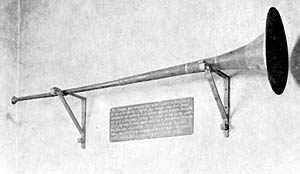
A similar tin horn, possibly not made by Morland, is still on display at East Leake church in Nottinghampshire. Eight feet long, it is clearly not of conical section, but is roughly exponential. It was supposedly in use by the church choir until 1855.
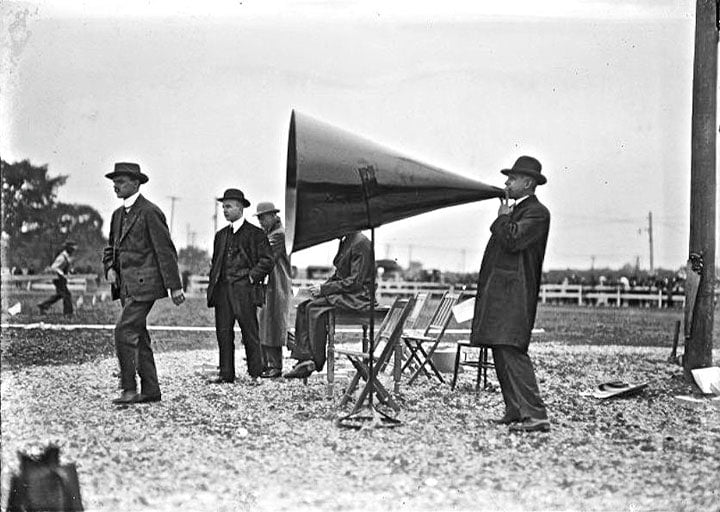
In the eighteenth century, theoretical work by Lagrange, Bernoulli, and Euler described the propagation of sound waves through horns, but contributed little to the development of practical devices. The nineteenth and early twentieth century saw conical megaphones used to amplify voices in public gatherings and in the military; such devices were usually of simple conical section.The term “megaphone” apparently was first associated with a device created by Thomas Edison around 1878.Edison was partially deaf and combined two hearing-horns with a central speaking horn in a single, cumbersome device. In the decades that followed, we saw the beginnings of horns associated with phonographic playback, with recording, and with playback by loudspeakers, as in the Western Electric horn shown in the construction plan atop this page. We’ll continue our discussion of horns in the next issue of Copper.

More from Issue 32

View All Articles in Issue 32

Search Copper Magazine

#234 A Life in High-End Audio: The Roy Hall Interview, Part One by Frank Doris Sep 07, 2026 #234 Jason Greenlaw Offers His Personal Perspective on Jazz Guitar in Vantage Point by Frank Doris Sep 07, 2026 #234 Transcendent Phoenix: Lucina Yue Brings the Ancient Konghou Into Modern Times by Frank Doris Sep 07, 2026 #234 We Must All Follow Our Bliss by B. Jan Montana Sep 07, 2026 #234 How to Play in a Rock Band, 27: Leveling Up by Frank Doris Sep 07, 2026 #234 Ross Valory: Traveling Into New Musical Territory With All of the Above by Ray Chelstowski Sep 07, 2026 #234 Singer/Songwriter John David Schrader: On the Need to Create by Joe Caplan Sep 07, 2026 #234 The People Who Make Audio Happen: More From T.H.E. Show SoCal 2026 by Harris Fogel Sep 07, 2026 #234 The Vinyl Beat Digs Into the Gadget Box by Rudy Radelic Sep 07, 2026 #234 The Rolling Stones: Foreign Tongues Spoken Loud by Wayne Robins Sep 07, 2026 #234 Musical Moments by Rich Isaacs Sep 07, 2026 #234 Rags for Solo Piano and a Dog: David Chesky's Ragtime Music for the Modern Age by Frankly Speaking Sep 07, 2026 #234 HIGH END 2026, Vienna: Here to Stay by Carsten Barnbeck Sep 07, 2026 #234 From The Audiophile’s Guide: The Two Main Types of Loudpeakers – Box and Panel by Paul McGowan Sep 07, 2026 #234 Letting it Slide by Frank Doris Sep 07, 2026 #234 PS Audio in the News by PS Audio Staff Sep 07, 2026 #234 Long Playing by Peter Xeni Sep 07, 2026 #234 La Mer by B. Jan Montana Sep 07, 2026 #233 A Report From The Total Hi-Fi Experience Show SoCal 2026 by B. Jan Montana Aug 03, 2026 #233 Bluegrass Meets Country, Folk, Jazz and More in All That We Carried by The Squid City Slingers by Frank Doris Aug 03, 2026 #233 Corey Glover and One Tribe Nation: A Variegated Musical Collective by Ray Chelstowski Aug 03, 2026 #233 Excursions with Clive: The Late Clive Davis, A Personal History by Wayne Robins Aug 03, 2026 #233 AI, Art, and Music: A Conversation With Synthography Art by Joe Caplan Aug 03, 2026 #233 New American Symphonies: A Rediscovered Gem and a Vital Contemporary Work by Frank Doris Aug 03, 2026 #233 The Vinyl Beat: Genesis, the Dave Clark Five, Antonio Carlos Jobim and More by Rudy Radelic Aug 03, 2026 #233 How to Play in a Rock Band, 26: When It's Time to Record Your Music by Frank Doris Aug 03, 2026 #233 More From T.H.E. Show 2026, and the People Who Made it Happen by Harris Fogel Aug 03, 2026 #233 Underappreciated Artists, Part Three: Icehouse by Rich Isaacs Aug 03, 2026 #233 The Surprisingly Rich and Varied Music of Somalia by Steve Kindig Aug 03, 2026 #233 A Remarkable Discographic Legacy: The LP Recordings of the Basel Symphony Orchestra by Stephan Haberthür Aug 03, 2026 #233 From The Audiophile’s Guide: The Importance of Loudspeakers by Paul McGowan Aug 03, 2026 #233 From Swimming Pool to New Listening Room: A Conversation with Norman Varney of AV RoomService by Gilles Laferrière Aug 03, 2026 #233 PS Audio in the News by PS Audio Staff Aug 03, 2026 #233 Audio Jewelry by Peter Xeni Aug 03, 2026 #233 Enrich Your Life by Frank Doris Aug 03, 2026 #233 The Searcher by James Schrimpf Aug 03, 2026 #232 What came first: Art or Music? A Conversation With Artist Jose Acosta by Joe Caplan Jul 06, 2026 #232 Blow By Blow: The Jeff Beck Story: An Insightful Book About a Guitar Icon by Ray Chelstowski Jul 06, 2026 #232 Creed Over Camaraderie? by B. Jan Montana Jul 06, 2026 #232 Chronicles of a Sound Pilgrim at the 2026 Montreal Audiofest by Hugues Morin Jul 06, 2026 #232 The Vinyl Beat: Summer Grooves by Rudy Radelic Jul 06, 2026 #232 Hibbing Hillbilly Dylan's Acoustic Rock by Wayne Robins Jul 06, 2026 #232 Quad Quads and Plasmatronics Tweeters: An Extraordinary System Comes to Life by Frank Doris Jul 06, 2026 #232 In Praise of Live Music, Once Again by Ted Shafran Jul 06, 2026 #232 Allnic Audio’s L-9000 Preamplifier: Design and Engineering Innovation by Howard Kneller Jul 06, 2026 #232 “Best Of” Lists and Rage Bait: Enough Already by Frank Doris Jul 06, 2026 #232 Quick Takes: Bud Shank, Paulo Almeida, Jakob Dreyer, Tim Eriksen and Peter Irvine by Frank Doris Jul 06, 2026

Horns!

If there’s a more contentious topic in audio than that of horn loudspeakers, I don’t know what it is.—Okay, that’s not quite true: cables are a more contentious topic. I’m just not going there.

We’ve spent a lot of space in this column exploring the history of moving-coil loudspeakers from their creation by Jensen through their development at Bell Labs/Western Electric, the development of the acoustic suspension enclosure and dome drivers at AR, with detours through Weathers, Stan White, and Spica. We’ve also looked at electrostatic speakers from Quad and Acoustat, and those funky plasma drivers. It’s only fair that we take a look at horns through the years—and that will require revisiting Western Electric and its offspring.

Writing about the history of any field is a feat of genealogy in which family branches mysteriously break off, enlivened with a sprinkling of illegitimate offspring. Audio is like this, only ever so much so more so. Paths will cross and re-cross; familiar names will pop up again and again.

In order to understand horn loudspeakers, a little knowledge of their antecedents may be helpful. Going way back, the first horns used for sounding or making noise—I would hesitate to call them musical instruments—were formed from animal horns. The  “trumpets” mentioned in the Torah, the Old Testament, and the Quran were not the brass, valved instruments of modern times, but likely a shofar or something similar.  Generally made from a ram’s horn, a  shofar is more like a bugle, really, as it is valveless and the player’s embouchure is the only control of the horn’s pitch.

The word “bugle”, interestingly enough, is derived from “buculus”, which is Latin for a castrated bullock—so the origins of bugles are clear. Like a bugle, a shofar has a conical bore, meaning that the inner sound-chamber is shaped like a cone, whereas flutes and trumpets (among others) have a cylindrical bore.

The first horns most of us encounter in  life are also of conical bore: megaphones, including the rolled-up-paper versions often made in grade school. And of course horns can be used both ways—the hearing horn dating back t0 who-knows-when was essentially a megaphone in reverse.

The seventeenth century saw a number of polymaths appear in the worlds of science and engineering, and two in particular focused their attention on horns: Athanasius Kircher was a German Jesuit scholar who seemed to have studied almost everything, including microbes under a microscope. Kircher supposedly built “speaking trumpets” and proposed the use of room-sized horns to amplify the sound of musicians—although it’s not known if such giant horns were ever built.

The "speaking trumpet", shown in a drawing supposedly made by Athanasius Kircher.
 

A proposal by Kircher for use of a horn to “broadcast” the sound of musicians playing.

Kircher’s English counterpart was Sir Samuel Morland, who created a series of large speaking horns used by church choirs or orchestras. One such horn, known as the “Harrington Vamping Horn” (p. 154, right hand column) was said to be fully five feet in length, and still exists at its original church. Two other examples were said to be five and a half and six feet in length.  Morland also worked in hydraulics and developed mechanical calculators and cryptographic machines.

A similar tin horn, possibly not made by Morland, is still on display at East Leake church in Nottinghampshire. Eight feet long, it is clearly not of conical section, but is roughly exponential. It was supposedly in use by the church choir until 1855.

In the eighteenth century, theoretical work by Lagrange, Bernoulli, and Euler described the propagation of sound waves through horns, but contributed little to the development of practical devices. The nineteenth and early twentieth century saw conical megaphones used to amplify voices in public gatherings and in the military; such devices were usually of simple conical section.The term “megaphone” apparently was first associated with a device created by Thomas Edison around 1878.Edison was partially deaf and combined two hearing-horns with a central speaking horn in a single, cumbersome device. In the decades that followed, we saw the beginnings of horns associated with phonographic playback, with recording, and with playback by loudspeakers, as in the Western Electric horn shown in the construction plan atop this page. We’ll continue our discussion of horns in the next issue of Copper.

0 comments

Leave a comment

0 Comments

Your avatar

Loading comments...

🗑️ Delete Comment

Enter moderator password to delete this comment:

✏️ Edit Comment

Enter your email to verify ownership: