COPPER

A PS Audio Publication

Issue 58 • Free Online Magazine

Issue 58 VINTAGE WHINE

Hadley Labs

At Axpona a few weeks ago, friend and mentor Richard Schram of Parasound suggested to me that, given my dual citizenship in the worlds of racing and audio, I should look at the life and works of Dawson Hadley. Richard indicated that Dawson had done significant work in both worlds.

When I wrote about Stan White back in Copper #s 12 and 13 , there wasn’t much reference material to tap, but I had dozens of emails from Stan, thanks to a by-chance-on-the internet personal relationship with him.

Writing about the semi-legendary Hadley Laboratories, known in internet forums as Marantz-killers with the sorta-8b model 601 tube amp and decidedly 7-ish 621 preamp, solid state though it may have been (hey, there was a 7T)—  and its namesake Dawson Hadley…well, there’s not a lot out there, and Dawson Hadley’s been dead for decades. I’ll do the best I can. Thanks to a connection from Kevin Deal, I received a great deal of excellent info from Dawson’s son Mike, and Dawson’s half-brother Jim.

A preliminary scan of the online literature reveals that Dawson had been deeply involved in the postwar racing world in SoCal, as both a dry lake racer and a drag racer. Just to clarify: these are deeply different worlds, akin to an Olympic athlete being capable of winning both 100 yard and 10,000 meter racers, under wildly different conditions. Hadley mingled with and often beat legendary racers who were the foundation of the Hot Rod Kar Kulture in southern California, showing up in the winner’s circle at Pomona drag strip, the launching pad of “Dyno” Don Nicholson, John Force, and many of the drag racing world’s biggest names. Running tank racers on dry lakes—aerodynamic top-speed racers based upon the belly tanks of WWII fighter planes—Hadley used his experience in tweaking engines (as the son of a machine-shop owner) to set new records.

The Pierson Brothers Coupe’ once owned and driven by Hadley ended up as the subject of what is probably the most incredible photo in Hot Rod history; the coupe’ was photographed in 1998 with pretty much anyone who was anyone in racing,  Seriously, look at the pic: Li’l’ John Buttera, Dan Gurney (!), Bud Meyer, the Pierson brothers, Carroll Shelby(!!), Vic Edelbrock, Alex Xydias, Pete Chapouris, Gray Baskerville…and BILLY GIBBONS of ZZ Top. Come ON.

Sadly, Dawson wasn’t there. —But I’m getting ahead of myself.

I went back and forth between audio and racing as different opportunities presented themselves—but why did Dawson completely break away from racing, and move into audio? His son Mike may have the answer:

“My dad got married and had the first of 5 children. I’m number 3. My mother told him to never race again. I guess he was afraid of her.”

That, I understand. Sounds like they had a good, solid relationship.

Mike continues: “While my dad never had a formal electronics education that I knew of, he understood electronics. To have him explain how semiconductors work was like  listening to the electron talk. In other words, it was backwards to anybody’s conventional explanation. Audio was possibly a secondary passion and a natural progression.”

And needless to say, the likelihood of getting killed building audio components was far lower than in racing at a high level, especially back in the ’50s and ’60s.

In the tradition of entrepreneurs everywhere, the company started up in Hadley’s garage. Mike: “I was 4 years old when my dad started Hadley Labs in our garage in Claremont. I believe he had 3 or 4 people working in the garage and the police came by one day and saw the cars parked on the street in front of the house. That’s when Hadley Labs got the building on Olive Street in Claremont in 1964 or 1965, I was 4 years old so it’s a little fuzzy now.”

So–what were they building in there? Audio Magazine’s annual equipment directory in August, 1963 listed two products from Hadley Labs: first,the “Model 601 stereo amplifier…..a dual amplifier designed for the discriminating listener.”  The architecture of the 601 seems similar to that of the Marantz 8 and 8b, although the Hadley was designed with a faceplate with an ovoid meter, designed for display. The 8 and 8b were of standard hi-fi form-factor of the ’40s and ’50s, designed to be hidden away in a console or cupboard. The second Hadley product shown in Audio was the “Model 621 Solid-State preamp”, whose faceplate was somewhat reminiscent of the Marantz 7. An odd feature: separate tone-controls for each channel.

Literature for both products are shown below, along with a schematic of the 601. Output transformers of the 601 came from Woody Bullock of Bullock Magnetics, a now-defunct company located near Schwien Engineering, a family-owned business still run by Jim Hadley.

The March, 1964 issue of Hi-Fi/Stereo Review, the predecessor of Stereo Review, featured an uncommonly-gushy review of the 601 power amp by Julian Hirsch, known in later years for his insistence that all “properly designed” amps sound alike. The review begins: “There are a very few power amplifiers whose performance is so outstanding that they must be put into a special category for the most discriminating users. The Hadley 601 stereo power amplifier is a recent addition to this group.”

Hirsch goes on to describe how the 601 nearly doubled its rated 40-watt output before exhibiting significant distortion, and was stable under any load. Hirsch notes that “Capacitive loads, such as would be imposed by electrostatic speakers, actually improved the (square-)wave shape slightly, and without introducing ringing or instability.”

Needless to say, such performance is unusual, and difficult to achieve. Hirsch’s conclusion: “When listening to the Hadley 601, I experienced the same sense of total ease and almost limitless power reserve I associate with the two or three finest amplifiers I have used. The 601, a worthy addition to this select group, is guaranteed for two years (except tubes) and is priced at $319.50.” (Both the Audio listings and the Hirsch review can be found by searching the unwieldy but invaluable American Radio History website.)

About those prices: Audio listed both pieces at $319,50, when the Marantz 7 and 8 were each priced at $264,00—so this was a rarified realm at the time. Compensating for inflation, each Hadley piece would cost over $2,600 today. The 621 flyer shown above shows a price of $359.00, so at some point prices were bumped up—perhaps to compensate for the cost of high-quality components and chassis elements. Jim indicated that the 621 faceplate was typically engraved (and beautifully done), although he has samples of a slightly-different faceplate with silk-screened legends.

Jim notes, “The 601 was the first product by Hadley Labs. The schematic is for Revision C, and is dated Nov 26, 1963. Sales of the 621 Pre-Amp began in late 1964, with schematics dated in Oct. 1963. The 622 Amp schematics are dated Oct. 1965.” The solid-state 622 amp is shown below, and it was the final product from Hadley Labs. Warranty records held by Jim indicate that the company had over 20 dealers, and total production appears to have been about 300 units of the 621 and around 200 of the 622; there are no records for the 601. Jim concludes, “Sales ended in early 1969. All warranties were honored for the full five years, after which time operations were ceased.”

Mike Hadley provides more details of the end of Hadley Labs, and that which came after: “My dad had a business partner who pulled out in approximately 1967 or 1968 which put Hadley Labs into bankruptcy and it closed down in 1969.

“At that time I believe Dawson was working with Saul Marantz and then went to work for Marantz. I think that lasted until 1972.

“I do remember the Tushinsky brothers Joseph, Fred and Irving [founders of Superscope, the first US distributors of Sony, who bought Marantz from Saul Marantz—Ed.] from Marantz. They came by the house a few times. They had red Ferraris.

“The whole Marantz thing ended on a very bad note. When my dad quit Marantz the Tushinsky’s made sure he would never work for another audio company as long as he lived.

“My dad went back into the automotive business working for Tom Spaudling who made electronic ignitions for race cars. Spaulding later got bought out by Echlin/Accel Automotive. At the same time Dawson was working on an electronic multiport fuel injection system. Fairchild Semiconductor was going to finance the project but dropped it because they didn’t see any future in it.

“My dad then hooked up with Edelbrock to finish the development of the fuel injection system. This is the fuel injection system design that every car is now equipped with.

“After Dawson left Edelbrock in about 1982 or 1983 he did consulting and built electronic ignition systems for race cars. My dad died October of 1986 at age 50 of a heart attack.”

Both Spaulding and the Edelbrock family are deeply involved in the history of California hot-rodding and high-performance automotive products, so Dawson returned to his roots.

While this is still a somewhat-sketchy history of Hadley Labs, it’s far more information than has been available previously. Perhaps we can return to the topic again in the future, and flesh out the history. There’s clearly more to tell—for example, legendary designer Bascom King knew Dawson for many years: “Well, I first met Dawson in the late 50’s when he came up to demonstrate products in Gordon Mercer’s store, Audio Vision in Santa Barbara. I had been working for Gordon as a service technician and learning audio from him. Typically, vendors with products of interest might be invited up to play their equipment at Gordon’t house. He always had a very good sounding system at his house. So I attended several such sessions with Dawson. As a side issue, Gordon Mercer was a main mentor of mine who convinced me to attend California Polytechnic University to study Electrical Engineering. Gordon was an EE that had worked in New York for various companies including Fairchild Recording. He had been involved with a really good studio tape recorder at Fairchild and had it going before Ampex came out with their first offering. Somehow, I don’t remember how, Ampex made it to market first.

“Later, after graduating and in the late 60’s, Dawson was hired by Marantz after Marantz was bought by Superscope, to set up and run and factory in LA to make new Marantz products. I consulted with Dawson on a number of designs and had one of my designs, the Model 1120 integrated amplifier, produced.

“Dawson was a very good designer and prior to working for the new Marantz operation in LA had produced under Hadley Labs a number of very good sounding preamps and power amplifiers both tube and SS. He was a kind and gentle human being.

“A good friend and now deceased, Jim Bongiorno, worked for Dawson in Hadley Labs as a service technician – that being before Jim went to SAE and then forming GAS and finally Sumo and Spread Spectrum Technologies. I did a lot of circuit scheming and consulting with Jim also when he moved to LA and then closer to Santa Barbara.”

Thanks to Richard Schram for the initial prod, and particular thanks to Jim Hadley and Mike Hadley, without whose help and information this piece wouldn’t have been possible. Jim provided all the literature and photos other than the header pic and the Pierson Brothers Coupe’ pic.

More from Issue 58

View All Articles in Issue 58

Search Copper Magazine

#231 Piano Prodigy Jude Kofie Releases His Debut Album On Octave Records by Frank Doris Jun 01, 2026 #231 Underappreciated Artists, Part Two: City Boy by Rich Isaacs Jun 01, 2026 #231 Music and the Art of Creation: Talking With Saxophonist Rob Scheps by Joe Caplan Jun 01, 2026 #231 How to Play in a Rock Band, 24: Further Adventures at the 2026 Montauk Music Festival by Frank Doris Jun 01, 2026 #231 Courtney Barnett: Creature of Habit by Wayne Robins Jun 01, 2026 #231 Angine de Poitrine: Interstellar Guitar Rock Saviors Headed for Late-Night TV Pop Stardom? by Mark Lepage Jun 01, 2026 #231 My Impressions of AXPONA 2026, Part One by Frank Doris Jun 01, 2026 #231 2026 La Jolla Concours d'Elegance: Another Aesthetic Feast by B. Jan Montana Jun 01, 2026 #231 Country Music Icon Jo Dee Messina’s Bridges: A New Beginning by Ray Chelstowski Jun 01, 2026 #231 The Luxury Dispatch Hosts a Video Podcast With Ken Kessler by Ken Kessler Jun 01, 2026 #231 The Vinyl Beat: Tracking in the Motor City by Rudy Radelic Jun 01, 2026 #231 Lots of Fun With DSP: The Ferrum Audio WANDLA DAC and Its Tube Mode by Frank Doris Jun 01, 2026 #231 From The Audiophile's Guide: Digital Source Components and Streaming Audio by Paul McGowan Jun 01, 2026 #231 Onkyo’s Monster M-510 power amplifier by The Staff at Just Audio Jun 01, 2026 #231 PS Audio in the News by PS Audio Staff Jun 01, 2026 #231 Naming Convention by Peter Xeni Jun 01, 2026 #231 Les Invisibles by Frank Doris Jun 01, 2026 #231 Wildlife Scene by James Schrimpf Jun 01, 2026 #230 Camaraderie by B. Jan Montana May 04, 2026 #230 AXPONA 2026: A Family Gathering by Paul McGowan May 04, 2026 #230 Pianist Ryan Benthall Explores Jazz Realms and Far Beyond With Divine Sky by Frank Doris May 04, 2026 #230 The Vinyl Beat in AXPONA-Land by Rudy Radelic May 04, 2026 #230 Teddy Thompson’s Musical Growth Deepens With Never Be the Same by Ray Chelstowski May 04, 2026 #230 More Fun in the Sun: Florida Audio Expo, Part Two by Frank Doris May 04, 2026 #230 CanJam NYC 2026 Show Report: Heady Sound, Part Two by Frank Doris and Harris Fogel May 04, 2026 #230 Sonic Youth On Murray Street by Wayne Robins May 04, 2026 #230 Graffeo Coffee: A Symphony of Sensory Experience by Joe Caplan May 04, 2026 #230 The Saul Authority: The Story of Hi-Fi Pioneer Saul Marantz by Olivier Meunier-Plante May 04, 2026 #230 How to Play in a Rock Band, 23: Encounters With Famous Musicians, Part Two by Frank Doris May 04, 2026 #230 An Outlier in the Rack: A Vintage BIC Beam Box by The Staff at Just Audio May 04, 2026 #230 PS Audio in the News by PS Audio Staff May 04, 2026 #230 A Cautionary Tale by Rich Isaacs May 04, 2026 #230 Reel-to-Reel Roots, Part 33 (Revised): Ken Kessler Reports On the 2026 (British) AudioJumble by Ken Kessler May 04, 2026 #230 Text Messaging by Frank Doris May 04, 2026 #230 The Audiophile Rat Race by Peter Xeni May 04, 2026 #230 On the Rocks by Rich Isaacs May 04, 2026 #229 The Earliest Stars of Country Music, Part Three by Jeff Weiner Apr 06, 2026 #229 The Healing Power of Music and Sound at the Omega Institute by Joe Caplan Apr 06, 2026 #229 CanJam NYC 2026 Show Report: Heady Sound, Part One by Frank Doris Apr 06, 2026 #229 Florida Audio Expo 2026: Warming Up to High-End Audio, Part One by Frank Doris Apr 06, 2026 #229 Quick Takes: Anne Bisson, Sam Morrison, The Velvet Underground, and the Stooges by Frank Doris Apr 06, 2026 #229 The Vinyl Beat: New Arrivals, and Old Audio Show Demo Scores to Settle by Rudy Radelic Apr 06, 2026 #229 Harvard Gets a High-End Audio Education by Frank Doris Apr 06, 2026 #229 No Country for Old Knees by B. Jan Montana Apr 06, 2026 #229 How To Play in A Rock Band, 22: Encounters With Famous Musicians, Part 1 by Frank Doris Apr 06, 2026 #229 The Soulful Grooves of Guinea-Bissau by Steve Kindig Apr 06, 2026 #229 Four-Hand Piano Performance at Its Finest by Stephan Haberthür Apr 06, 2026

Hadley Labs

At Axpona a few weeks ago, friend and mentor Richard Schram of Parasound suggested to me that, given my dual citizenship in the worlds of racing and audio, I should look at the life and works of Dawson Hadley. Richard indicated that Dawson had done significant work in both worlds.

When I wrote about Stan White back in Copper #s 12 and 13 , there wasn’t much reference material to tap, but I had dozens of emails from Stan, thanks to a by-chance-on-the internet personal relationship with him.

Writing about the semi-legendary Hadley Laboratories, known in internet forums as Marantz-killers with the sorta-8b model 601 tube amp and decidedly 7-ish 621 preamp, solid state though it may have been (hey, there was a 7T)—  and its namesake Dawson Hadley…well, there’s not a lot out there, and Dawson Hadley’s been dead for decades. I’ll do the best I can. Thanks to a connection from Kevin Deal, I received a great deal of excellent info from Dawson’s son Mike, and Dawson’s half-brother Jim.

A preliminary scan of the online literature reveals that Dawson had been deeply involved in the postwar racing world in SoCal, as both a dry lake racer and a drag racer. Just to clarify: these are deeply different worlds, akin to an Olympic athlete being capable of winning both 100 yard and 10,000 meter racers, under wildly different conditions. Hadley mingled with and often beat legendary racers who were the foundation of the Hot Rod Kar Kulture in southern California, showing up in the winner’s circle at Pomona drag strip, the launching pad of “Dyno” Don Nicholson, John Force, and many of the drag racing world’s biggest names. Running tank racers on dry lakes—aerodynamic top-speed racers based upon the belly tanks of WWII fighter planes—Hadley used his experience in tweaking engines (as the son of a machine-shop owner) to set new records.

The Pierson Brothers Coupe’ once owned and driven by Hadley ended up as the subject of what is probably the most incredible photo in Hot Rod history; the coupe’ was photographed in 1998 with pretty much anyone who was anyone in racing,  Seriously, look at the pic: Li’l’ John Buttera, Dan Gurney (!), Bud Meyer, the Pierson brothers, Carroll Shelby(!!), Vic Edelbrock, Alex Xydias, Pete Chapouris, Gray Baskerville…and BILLY GIBBONS of ZZ Top. Come ON.

Sadly, Dawson wasn’t there. —But I’m getting ahead of myself.

I went back and forth between audio and racing as different opportunities presented themselves—but why did Dawson completely break away from racing, and move into audio? His son Mike may have the answer:

“My dad got married and had the first of 5 children. I’m number 3. My mother told him to never race again. I guess he was afraid of her.”

That, I understand. Sounds like they had a good, solid relationship.

Mike continues: “While my dad never had a formal electronics education that I knew of, he understood electronics. To have him explain how semiconductors work was like  listening to the electron talk. In other words, it was backwards to anybody’s conventional explanation. Audio was possibly a secondary passion and a natural progression.”

And needless to say, the likelihood of getting killed building audio components was far lower than in racing at a high level, especially back in the ’50s and ’60s.

In the tradition of entrepreneurs everywhere, the company started up in Hadley’s garage. Mike: “I was 4 years old when my dad started Hadley Labs in our garage in Claremont. I believe he had 3 or 4 people working in the garage and the police came by one day and saw the cars parked on the street in front of the house. That’s when Hadley Labs got the building on Olive Street in Claremont in 1964 or 1965, I was 4 years old so it’s a little fuzzy now.”

So–what were they building in there? Audio Magazine’s annual equipment directory in August, 1963 listed two products from Hadley Labs: first,the “Model 601 stereo amplifier…..a dual amplifier designed for the discriminating listener.”  The architecture of the 601 seems similar to that of the Marantz 8 and 8b, although the Hadley was designed with a faceplate with an ovoid meter, designed for display. The 8 and 8b were of standard hi-fi form-factor of the ’40s and ’50s, designed to be hidden away in a console or cupboard. The second Hadley product shown in Audio was the “Model 621 Solid-State preamp”, whose faceplate was somewhat reminiscent of the Marantz 7. An odd feature: separate tone-controls for each channel.

Literature for both products are shown below, along with a schematic of the 601. Output transformers of the 601 came from Woody Bullock of Bullock Magnetics, a now-defunct company located near Schwien Engineering, a family-owned business still run by Jim Hadley.

The March, 1964 issue of Hi-Fi/Stereo Review, the predecessor of Stereo Review, featured an uncommonly-gushy review of the 601 power amp by Julian Hirsch, known in later years for his insistence that all “properly designed” amps sound alike. The review begins: “There are a very few power amplifiers whose performance is so outstanding that they must be put into a special category for the most discriminating users. The Hadley 601 stereo power amplifier is a recent addition to this group.”

Hirsch goes on to describe how the 601 nearly doubled its rated 40-watt output before exhibiting significant distortion, and was stable under any load. Hirsch notes that “Capacitive loads, such as would be imposed by electrostatic speakers, actually improved the (square-)wave shape slightly, and without introducing ringing or instability.”

Needless to say, such performance is unusual, and difficult to achieve. Hirsch’s conclusion: “When listening to the Hadley 601, I experienced the same sense of total ease and almost limitless power reserve I associate with the two or three finest amplifiers I have used. The 601, a worthy addition to this select group, is guaranteed for two years (except tubes) and is priced at $319.50.” (Both the Audio listings and the Hirsch review can be found by searching the unwieldy but invaluable American Radio History website.)

About those prices: Audio listed both pieces at $319,50, when the Marantz 7 and 8 were each priced at $264,00—so this was a rarified realm at the time. Compensating for inflation, each Hadley piece would cost over $2,600 today. The 621 flyer shown above shows a price of $359.00, so at some point prices were bumped up—perhaps to compensate for the cost of high-quality components and chassis elements. Jim indicated that the 621 faceplate was typically engraved (and beautifully done), although he has samples of a slightly-different faceplate with silk-screened legends.

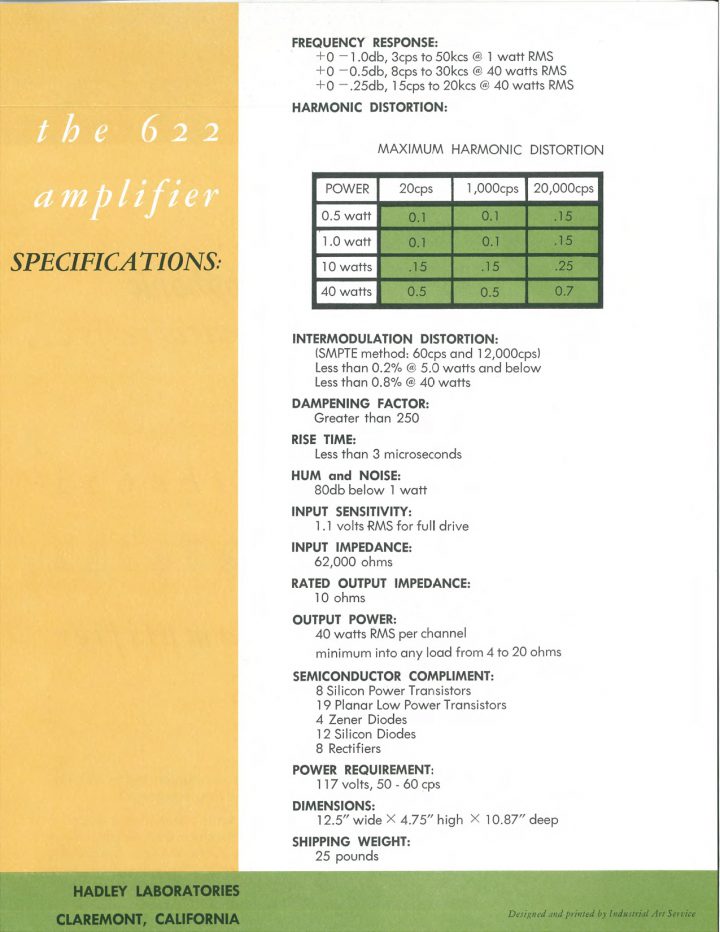
Jim notes, “The 601 was the first product by Hadley Labs. The schematic is for Revision C, and is dated Nov 26, 1963. Sales of the 621 Pre-Amp began in late 1964, with schematics dated in Oct. 1963. The 622 Amp schematics are dated Oct. 1965.” The solid-state 622 amp is shown below, and it was the final product from Hadley Labs. Warranty records held by Jim indicate that the company had over 20 dealers, and total production appears to have been about 300 units of the 621 and around 200 of the 622; there are no records for the 601. Jim concludes, “Sales ended in early 1969. All warranties were honored for the full five years, after which time operations were ceased.”

Mike Hadley provides more details of the end of Hadley Labs, and that which came after: “My dad had a business partner who pulled out in approximately 1967 or 1968 which put Hadley Labs into bankruptcy and it closed down in 1969.

“At that time I believe Dawson was working with Saul Marantz and then went to work for Marantz. I think that lasted until 1972.

“I do remember the Tushinsky brothers Joseph, Fred and Irving [founders of Superscope, the first US distributors of Sony, who bought Marantz from Saul Marantz—Ed.] from Marantz. They came by the house a few times. They had red Ferraris.

“The whole Marantz thing ended on a very bad note. When my dad quit Marantz the Tushinsky’s made sure he would never work for another audio company as long as he lived.

“My dad went back into the automotive business working for Tom Spaudling who made electronic ignitions for race cars. Spaulding later got bought out by Echlin/Accel Automotive. At the same time Dawson was working on an electronic multiport fuel injection system. Fairchild Semiconductor was going to finance the project but dropped it because they didn’t see any future in it.

“My dad then hooked up with Edelbrock to finish the development of the fuel injection system. This is the fuel injection system design that every car is now equipped with.

“After Dawson left Edelbrock in about 1982 or 1983 he did consulting and built electronic ignition systems for race cars. My dad died October of 1986 at age 50 of a heart attack.”

Both Spaulding and the Edelbrock family are deeply involved in the history of California hot-rodding and high-performance automotive products, so Dawson returned to his roots.

While this is still a somewhat-sketchy history of Hadley Labs, it’s far more information than has been available previously. Perhaps we can return to the topic again in the future, and flesh out the history. There’s clearly more to tell—for example, legendary designer Bascom King knew Dawson for many years: “Well, I first met Dawson in the late 50’s when he came up to demonstrate products in Gordon Mercer’s store, Audio Vision in Santa Barbara. I had been working for Gordon as a service technician and learning audio from him. Typically, vendors with products of interest might be invited up to play their equipment at Gordon’t house. He always had a very good sounding system at his house. So I attended several such sessions with Dawson. As a side issue, Gordon Mercer was a main mentor of mine who convinced me to attend California Polytechnic University to study Electrical Engineering. Gordon was an EE that had worked in New York for various companies including Fairchild Recording. He had been involved with a really good studio tape recorder at Fairchild and had it going before Ampex came out with their first offering. Somehow, I don’t remember how, Ampex made it to market first.

“Later, after graduating and in the late 60’s, Dawson was hired by Marantz after Marantz was bought by Superscope, to set up and run and factory in LA to make new Marantz products. I consulted with Dawson on a number of designs and had one of my designs, the Model 1120 integrated amplifier, produced.

“Dawson was a very good designer and prior to working for the new Marantz operation in LA had produced under Hadley Labs a number of very good sounding preamps and power amplifiers both tube and SS. He was a kind and gentle human being.

“A good friend and now deceased, Jim Bongiorno, worked for Dawson in Hadley Labs as a service technician – that being before Jim went to SAE and then forming GAS and finally Sumo and Spread Spectrum Technologies. I did a lot of circuit scheming and consulting with Jim also when he moved to LA and then closer to Santa Barbara.”

Thanks to Richard Schram for the initial prod, and particular thanks to Jim Hadley and Mike Hadley, without whose help and information this piece wouldn’t have been possible. Jim provided all the literature and photos other than the header pic and the Pierson Brothers Coupe’ pic.

0 comments

Leave a comment

0 Comments

Your avatar

Loading comments...

🗑️ Delete Comment

Enter moderator password to delete this comment:

✏️ Edit Comment

Enter your email to verify ownership: