COPPER

A PS Audio Publication

Issue 77 • Free Online Magazine

Issue 77 VINTAGE WHINE

Fairchild, Part 3

As I’ve indicated in the previous installments of Vintage Whine in Copper #75 and #76, the story of Sherman Fairchild goes far beyond the realm of audio, and at some point really should be detailed in a full-fledged biography—the range and extent of his interests and achievements beggars belief. Fairchild’s ventures in pro and consumer audio alone deserve far more space than I’m able to devote to them here.

This installment, we’re going to focus on Fairchild gear as it applied to records—both cutting discs and playing them back. But first, a caveat: if one were to explore the vintage audio products made by Marantz or McIntosh, or even Fisher or Scott, those are well-documented. There’s considerable reference material available on those products, and in some cases there are company histories available and even restorers who specialize in bringing classic models from those brands back to life.

As far as I can tell at this point of my research into Fairchild’s audio products—none of that exists for the brand. And so, it’s entirely likely that errors will be made in these stories, in spite of my best efforts to verify every factoid.

Keeping that in mind—onward!

Fairchild gear was involved in recording and cutting some of the most-revered records ever pressed. Last issue we showed cutting engineer George Piros at the controls of a Fairchild 523 cutting lathe, part of a pretty complete Fairchild suite at Reeves Sound Studios. According to our friend Tom Fine, his father Bob Fine worked at Reeves Studios in the late 1940’s, alongside Piros. Tom adds, “My father’s first studio, in Rockland County, had a Fairchild cutting lathe with a Miller Cutterhead. And of course the early Mercury Living Presence recordings were done on Fairchild tape machines….MLP wasn’t recorded in stereo until very late 1955, so everything from 1951-1955 was mono, and recorded on Fairchilds.”

As we’ve previously noted, Fairchild never did anything halfway, or on the cheap; the gear was built to be the best available, and was built to last. That 523’s cost of just under $3,000 was about the price of a new 1948 Cadillac, and today would equal about $32,000.

 Entering the ’50s, Fairchild was a leader in record playback. We’ve previously written about the Model 225 moving coil cartridge, which is still sought by collectors and retrophiles. It may have been a compact, lightweight device, but it appeared particularly robust—especially in comparison to many of today’s tiny megabuck cartridges.
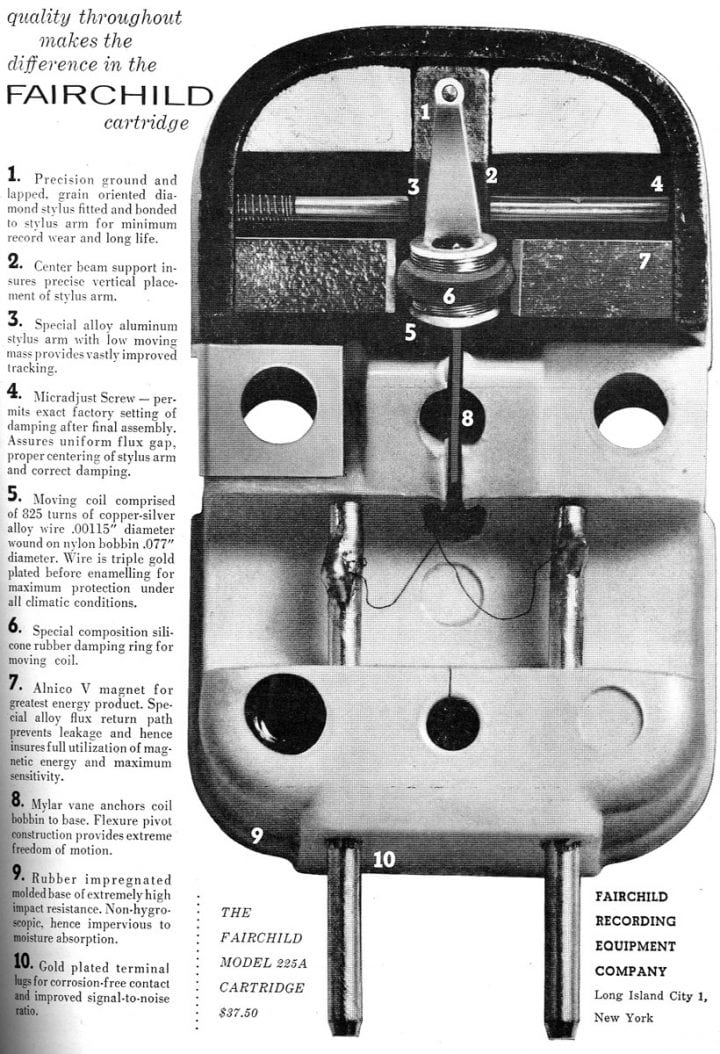
Not to keep harping on prices, but even that seemingly modest $37.50 in 1955 equals $350 today—of course, many moving coil cartridges today are ten or twenty times that. Or more.

In 1958, well-known audio engineer/man about town Bert Whyte wrote in Radio & TV News about the first Stereo record releases—and the new gear needed to play them. Of the Fairchild stereo playback gear, Whyte wrote “The arm used is the large studio turret head type which is found in many broadcasting stations. The cartridge is a novel design, utilizing two moving coils to pick up the ’45-45′ groove modulations of the Westrex system…the Fairchild stereo cartridge is at present quite a bit larger than its conventional 225 units [shown above] and for this reason the large studio arm is used….the present arm and cartridge works very well and it is actually available to those affluent people who can afford the rather breathtaking 250 dollar price tag. But then, there are always those who want to be ‘fustest with the mostest’.”

And yes… $250 in 1958? $2,200 today. Compared to many moving coil cartridges—a bargain!

The most-legendary piece of Fairchild phono playback gear is the 412-4 turntable. In 1957 Radio & TV News found the new table worthy of a four-page feature upon its introduction. Typically for Fairchild, the table was built like a piece of industrial machinery: the chassis was heavyweight steel,  the hysteresis-synchronous motor was suspended by spherical vibration mounts, drive was by two belts and an intermediate pulley for maximum decoupling, the main bearing was rifle-drilled Babbitt, the platter was a massive aluminum casting—well, you get the idea. But the really big news of the 412-4 was that platter speed was set and changed was not mechanical, but purely electronic, effected by an oscillator that changed the frequency of the current to the motor. In addition, the table could run on a.c. inputs from 85 to 135 volts, or on 50, 60, or 400 cycles—or from a battery supply!—all accomplished without any adjustments. Playing speeds were 16 2/3, 33 1/3, 45, and 78.26, adjustable plus or minus 5%.
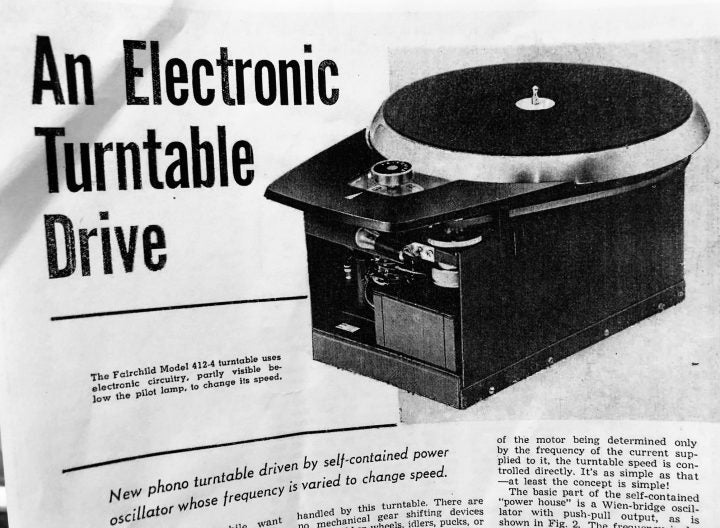
  

A single-speed 33 1/3 model 412 was available without the electronic speed control, which was available as a slide-in unit that could be added to the basic 412 at a later time.

Ever seen either version of the 412? Likely not, and neither have I. Next time: more Fairchild magic.

More from Issue 77

View All Articles in Issue 77

Search Copper Magazine

#229 The Earliest Stars of Country Music, Part Three by Jeff Weiner Apr 06, 2026 #229 The Healing Power of Music and Sound at the Omega Institute by Joe Caplan Apr 06, 2026 #229 CanJam NYC 2026 Show Report: Heady Sound, Part One by Frank Doris Apr 06, 2026 #229 Florida Audio Expo 2026: Warming Up to High-End Audio, Part One by Frank Doris Apr 06, 2026 #229 Quick Takes: Anne Bisson, Sam Morrison, The Velvet Underground, and the Stooges by Frank Doris Apr 06, 2026 #229 The Vinyl Beat: New Arrivals, and Old Audio Show Demo Scores to Settle by Rudy Radelic Apr 06, 2026 #229 Harvard Gets a High-End Audio Education by Frank Doris Apr 06, 2026 #229 No Country for Old Knees by B. Jan Montana Apr 06, 2026 #229 How To Play in A Rock Band, 22: Encounters With Famous Musicians, Part 1 by Frank Doris Apr 06, 2026 #229 The Soulful Grooves of Guinea-Bissau by Steve Kindig Apr 06, 2026 #229 Four-Hand Piano Performance at Its Finest by Stephan Haberthür Apr 06, 2026 #229 The People Who Make Audio Happen: Supreme Acoustics Systems’ Las Vegas Grand Opening by Harris Fogel Apr 06, 2026 #229 Blue Öyster Cult: Tyranny and Expectations by Wayne Robins Apr 06, 2026 #229 Guitarist Rick Vito’s Cinematic New Album, Slidemaster by Ray Chelstowski Apr 06, 2026 #229 Measurements and Observational Listening by Paul McGowan Apr 06, 2026 #229 PS Audio in the News by PS Audio Staff Apr 06, 2026 #229 Back to My Reel-to-Reel Roots, Part 28: The Cassette Strikes Back by Ken Kessler Apr 06, 2026 #229 Are You Receiving Me? by Frank Doris Apr 06, 2026 #229 Hospitality by Peter Xeni Apr 06, 2026 #229 Cantina Gateway by James Schrimpf Apr 06, 2026 #228 Serita’s Black Rose Duo Shakes Your Soul With a Blend of Funk, Rock, Blues and a Whole Lot More by Frank Doris Mar 02, 2026 #228 Vinyl, A Love Story by Wayne Robins Mar 02, 2026 #228 Thrill Seeker by B. Jan Montana Mar 02, 2026 #228 The Vinyl Beat: Donald Byrd, Bill Evans, Wes Montgomery, Eddie Palmieri and Frank Sinatra by Rudy Radelic Mar 02, 2026 #228 Listening to Prestige: The History of a Vitally Important Jazz Record Label by Frank Doris Mar 02, 2026 #228 How to Play in a Rock Band, 21: Touring With James Lee Stanley by Frank Doris Mar 02, 2026 #228 The NAMM 2026 Show: The Music Industry’s Premier Event by John Volanski Mar 02, 2026 #228 The Earliest Stars of Country Music, Part Two by Jeff Weiner Mar 02, 2026 #228 From The Audiophile's Guide: A Brief History of Stereophonic Sound by Paul McGowan Mar 02, 2026 #228 A Bone to Pick With Streaming Audio by Frank Doris Mar 02, 2026 #228 Blast Off With Bluesman Duke Robillard by Ray Chelstowski Mar 02, 2026 #228 A Visit to the Marten Loudspeaker Factory in Göteborg, Sweden by Ingo Schulz and Sebastian Polcyn Mar 02, 2026 #228 Pure Distortion by Peter Xeni Mar 02, 2026 #228 A Nagra Factory Tour by Markus "Marsu" Manthey Mar 02, 2026 #228 Back to My Reel-to-Reel Roots, Part 27: Noodge and Ye Shall Receive, Part Two by Ken Kessler Mar 02, 2026 #228 PS Audio in the News by PS Audio Staff Mar 02, 2026 #228 90-Degree Stereo by Frank Doris Mar 02, 2026 #228 The Keys to Art by Rich Isaacs Mar 02, 2026 #227 Seth Lewis Gets in the Groove With Take a Look Around: a Tribute to the Meters by Frank Doris Feb 02, 2026 #227 Passport to Sound: May Anwar’s Audio Learning Experience for Young People by Frank Doris Feb 02, 2026 #227 Conjectures on Cosmic Consciousness by B. Jan Montana Feb 02, 2026 #227 The Big Takeover Turns 45 by Wayne Robins Feb 02, 2026 #227 Music and Chocolate: On the Sensory Connection by Joe Caplan Feb 02, 2026 #227 Singer/Songwriter Chris Berardo: Getting Wilder All the Time by Ray Chelstowski Feb 02, 2026 #227 The Earliest Stars of Country Music, Part One by Jeff Weiner Feb 02, 2026 #227 The Vinyl Beat Goes Down to Tijuana (By Way of Los Angeles), Part Two by Rudy Radelic Feb 02, 2026 #227 How to Play in a Rock Band, 20: On the Road With Blood, Sweat & Tears’ Guitarist Gabe Cummins by Frank Doris Feb 02, 2026

Fairchild, Part 3

As I’ve indicated in the previous installments of Vintage Whine in Copper #75 and #76, the story of Sherman Fairchild goes far beyond the realm of audio, and at some point really should be detailed in a full-fledged biography—the range and extent of his interests and achievements beggars belief. Fairchild’s ventures in pro and consumer audio alone deserve far more space than I’m able to devote to them here.

This installment, we’re going to focus on Fairchild gear as it applied to records—both cutting discs and playing them back. But first, a caveat: if one were to explore the vintage audio products made by Marantz or McIntosh, or even Fisher or Scott, those are well-documented. There’s considerable reference material available on those products, and in some cases there are company histories available and even restorers who specialize in bringing classic models from those brands back to life.

As far as I can tell at this point of my research into Fairchild’s audio products—none of that exists for the brand. And so, it’s entirely likely that errors will be made in these stories, in spite of my best efforts to verify every factoid.

Keeping that in mind—onward!

Fairchild gear was involved in recording and cutting some of the most-revered records ever pressed. Last issue we showed cutting engineer George Piros at the controls of a Fairchild 523 cutting lathe, part of a pretty complete Fairchild suite at Reeves Sound Studios. According to our friend Tom Fine, his father Bob Fine worked at Reeves Studios in the late 1940’s, alongside Piros. Tom adds, “My father’s first studio, in Rockland County, had a Fairchild cutting lathe with a Miller Cutterhead. And of course the early Mercury Living Presence recordings were done on Fairchild tape machines….MLP wasn’t recorded in stereo until very late 1955, so everything from 1951-1955 was mono, and recorded on Fairchilds.”

As we’ve previously noted, Fairchild never did anything halfway, or on the cheap; the gear was built to be the best available, and was built to last. That 523’s cost of just under $3,000 was about the price of a new 1948 Cadillac, and today would equal about $32,000.

 Entering the ’50s, Fairchild was a leader in record playback. We’ve previously written about the Model 225 moving coil cartridge, which is still sought by collectors and retrophiles. It may have been a compact, lightweight device, but it appeared particularly robust—especially in comparison to many of today’s tiny megabuck cartridges.

Not to keep harping on prices, but even that seemingly modest $37.50 in 1955 equals $350 today—of course, many moving coil cartridges today are ten or twenty times that. Or more.

In 1958, well-known audio engineer/man about town Bert Whyte wrote in Radio & TV News about the first Stereo record releases—and the new gear needed to play them. Of the Fairchild stereo playback gear, Whyte wrote “The arm used is the large studio turret head type which is found in many broadcasting stations. The cartridge is a novel design, utilizing two moving coils to pick up the ’45-45′ groove modulations of the Westrex system…the Fairchild stereo cartridge is at present quite a bit larger than its conventional 225 units [shown above] and for this reason the large studio arm is used….the present arm and cartridge works very well and it is actually available to those affluent people who can afford the rather breathtaking 250 dollar price tag. But then, there are always those who want to be ‘fustest with the mostest’.”

And yes… $250 in 1958? $2,200 today. Compared to many moving coil cartridges—a bargain!

The most-legendary piece of Fairchild phono playback gear is the 412-4 turntable. In 1957 Radio & TV News found the new table worthy of a four-page feature upon its introduction. Typically for Fairchild, the table was built like a piece of industrial machinery: the chassis was heavyweight steel,  the hysteresis-synchronous motor was suspended by spherical vibration mounts, drive was by two belts and an intermediate pulley for maximum decoupling, the main bearing was rifle-drilled Babbitt, the platter was a massive aluminum casting—well, you get the idea. But the really big news of the 412-4 was that platter speed was set and changed was not mechanical, but purely electronic, effected by an oscillator that changed the frequency of the current to the motor. In addition, the table could run on a.c. inputs from 85 to 135 volts, or on 50, 60, or 400 cycles—or from a battery supply!—all accomplished without any adjustments. Playing speeds were 16 2/3, 33 1/3, 45, and 78.26, adjustable plus or minus 5%.


A single-speed 33 1/3 model 412 was available without the electronic speed control, which was available as a slide-in unit that could be added to the basic 412 at a later time.

Ever seen either version of the 412? Likely not, and neither have I. Next time: more Fairchild magic.

0 comments

Leave a comment

0 Comments

Your avatar

Loading comments...

🗑️ Delete Comment

Enter moderator password to delete this comment:

✏️ Edit Comment

Enter your email to verify ownership: