COPPER

A PS Audio Publication

Issue 77 • Free Online Magazine

Issue 77 VINTAGE WHINE

Fairchild, Part 3

As I’ve indicated in the previous installments of Vintage Whine in Copper #75 and #76, the story of Sherman Fairchild goes far beyond the realm of audio, and at some point really should be detailed in a full-fledged biography—the range and extent of his interests and achievements beggars belief. Fairchild’s ventures in pro and consumer audio alone deserve far more space than I’m able to devote to them here.

This installment, we’re going to focus on Fairchild gear as it applied to records—both cutting discs and playing them back. But first, a caveat: if one were to explore the vintage audio products made by Marantz or McIntosh, or even Fisher or Scott, those are well-documented. There’s considerable reference material available on those products, and in some cases there are company histories available and even restorers who specialize in bringing classic models from those brands back to life.

As far as I can tell at this point of my research into Fairchild’s audio products—none of that exists for the brand. And so, it’s entirely likely that errors will be made in these stories, in spite of my best efforts to verify every factoid.

Keeping that in mind—onward!

Fairchild gear was involved in recording and cutting some of the most-revered records ever pressed. Last issue we showed cutting engineer George Piros at the controls of a Fairchild 523 cutting lathe, part of a pretty complete Fairchild suite at Reeves Sound Studios. According to our friend Tom Fine, his father Bob Fine worked at Reeves Studios in the late 1940’s, alongside Piros. Tom adds, “My father’s first studio, in Rockland County, had a Fairchild cutting lathe with a Miller Cutterhead. And of course the early Mercury Living Presence recordings were done on Fairchild tape machines….MLP wasn’t recorded in stereo until very late 1955, so everything from 1951-1955 was mono, and recorded on Fairchilds.”

As we’ve previously noted, Fairchild never did anything halfway, or on the cheap; the gear was built to be the best available, and was built to last. That 523’s cost of just under $3,000 was about the price of a new 1948 Cadillac, and today would equal about $32,000.

 Entering the ’50s, Fairchild was a leader in record playback. We’ve previously written about the Model 225 moving coil cartridge, which is still sought by collectors and retrophiles. It may have been a compact, lightweight device, but it appeared particularly robust—especially in comparison to many of today’s tiny megabuck cartridges.
Not to keep harping on prices, but even that seemingly modest $37.50 in 1955 equals $350 today—of course, many moving coil cartridges today are ten or twenty times that. Or more.

In 1958, well-known audio engineer/man about town Bert Whyte wrote in Radio & TV News about the first Stereo record releases—and the new gear needed to play them. Of the Fairchild stereo playback gear, Whyte wrote “The arm used is the large studio turret head type which is found in many broadcasting stations. The cartridge is a novel design, utilizing two moving coils to pick up the ’45-45′ groove modulations of the Westrex system…the Fairchild stereo cartridge is at present quite a bit larger than its conventional 225 units [shown above] and for this reason the large studio arm is used….the present arm and cartridge works very well and it is actually available to those affluent people who can afford the rather breathtaking 250 dollar price tag. But then, there are always those who want to be ‘fustest with the mostest’.”

And yes… $250 in 1958? $2,200 today. Compared to many moving coil cartridges—a bargain!

The most-legendary piece of Fairchild phono playback gear is the 412-4 turntable. In 1957 Radio & TV News found the new table worthy of a four-page feature upon its introduction. Typically for Fairchild, the table was built like a piece of industrial machinery: the chassis was heavyweight steel,  the hysteresis-synchronous motor was suspended by spherical vibration mounts, drive was by two belts and an intermediate pulley for maximum decoupling, the main bearing was rifle-drilled Babbitt, the platter was a massive aluminum casting—well, you get the idea. But the really big news of the 412-4 was that platter speed was set and changed was not mechanical, but purely electronic, effected by an oscillator that changed the frequency of the current to the motor. In addition, the table could run on a.c. inputs from 85 to 135 volts, or on 50, 60, or 400 cycles—or from a battery supply!—all accomplished without any adjustments. Playing speeds were 16 2/3, 33 1/3, 45, and 78.26, adjustable plus or minus 5%.
  

A single-speed 33 1/3 model 412 was available without the electronic speed control, which was available as a slide-in unit that could be added to the basic 412 at a later time.

Ever seen either version of the 412? Likely not, and neither have I. Next time: more Fairchild magic.

More from Issue 77

View All Articles in Issue 77

Search Copper Magazine

#226 JJ Murphy’s Sleep Paralysis is a Genre-Bending Musical Journey Through Jazz, Fusion and More by Frank Doris Jan 05, 2026 #226 Stewardship by Consent by B. Jan Montana Jan 05, 2026 #226 Food, Music, and Sensory Experience: An Interview With Professor Jonathan Zearfoss of the Culinary Institute of America by Joe Caplan Jan 05, 2026 #226 Studio Confidential: A Who’s Who of Recording Engineers Tell Their Stories by Frank Doris Jan 05, 2026 #226 Pilot Radio is Reborn, 50 Years Later: Talking With CEO Barak Epstein by Frank Doris Jan 05, 2026 #226 The Vinyl Beat Goes Down to Tijuana (By Way of Los Angeles), Part One by Rudy Radelic Jan 05, 2026 #226 Capital Audiofest 2025: Must-See Stereo, Part Two by Frank Doris Jan 05, 2026 #226 My Morning Jacket’s Carl Broemel and Tyler Ramsey Collaborate on Their Acoustic Guitar Album, Celestun by Ray Chelstowski Jan 05, 2026 #226 The People Who Make Audio Happen: CanJam SoCal 2025, Part Two by Harris Fogel Jan 05, 2026 #226 How to Play in a Rock Band, 19: Touring Can Make You Crazy, Part One by Frank Doris Jan 05, 2026 #226 Linda Ronstadt Goes Bigger by Wayne Robins Jan 05, 2026 #226 From The Audiophile’s Guide: Active Room Correction and Digital Signal Processing by Paul McGowan Jan 05, 2026 #226 PS Audio in the News by Frank Doris Jan 05, 2026 #226 Back to My Reel-to-Reel Roots, Part 25: Half-Full, Not Empty by Ken Kessler Jan 05, 2026 #226 Happy New Year! by Frank Doris Jan 05, 2026 #226 Turn It Down! by Peter Xeni Jan 05, 2026 #226 Ghost Riders by James Schrimpf Jan 05, 2026 #226 A Factory Tour of Audio Manufacturer German Physiks by Markus "Marsu" Manthey Jan 04, 2026 #225 Capital Audiofest 2025: Must-See Stereo, Part One by Frank Doris Dec 01, 2025 #225 Otis Taylor and the Electrics Delivers a Powerful Set of Hypnotic Modern Blues by Frank Doris Dec 01, 2025 #225 A Christmas Miracle by B. Jan Montana Dec 01, 2025 #225 T.H.E. Show New York 2025, Part Two: Plenty to See, Hear, and Enjoy by Frank Doris Dec 01, 2025 #225 Underappreciated Artists, Part One: Martin Briley by Rich Isaacs Dec 01, 2025 #225 Rock and Roll is Here to Stay by Wayne Robins Dec 01, 2025 #225 A Lifetime of Holiday Record (and CD) Listening by Rudy Radelic Dec 01, 2025 #225 Little Feat: Not Saying Goodbye, Not Yet by Ray Chelstowski Dec 01, 2025 #225 How to Play in a Rock Band, Part 18: Dealing With Burnout by Frank Doris Dec 01, 2025 #225 The People Who Make Audio Happen: CanJam SoCal 2025 by Harris Fogel Dec 01, 2025 #225 Chicago’s Sonic Sanctuaries: Four Hi‑Fi Listening Bars Channeling the Jazz‑Kissa Spirit by Olivier Meunier-Plante Dec 01, 2025 #225 From The Audiophile’s Guide: Controlling Bass Frequencies Through Membrane Absorbers (and How to Build Your Own) by Paul McGowan Dec 01, 2025 #225 Your Editor’s Tips for Attending Audio Shows by Frank Doris Dec 01, 2025 #225 PS Audio in the News by Frank Doris Dec 01, 2025 #225 Back to My Reel-to-Reel Roots, Part 24 by Ken Kessler Dec 01, 2025 #225 Holiday Music by Frank Doris Dec 01, 2025 #225 Puppy Prognostication by Peter Xeni Dec 01, 2025 #225 How to Post Comments on Copper by Frank Doris Dec 01, 2025 #225 Living Color by Rudy Radelic Dec 01, 2025 #224 T.H.E. Show New York 2025, Part One: A New Beginning by Frank Doris Nov 03, 2025 #224 Fool’s Leap of Faith is the Extraordinary Octave Records Debut from Singer/Songwriter Tyler Burba and Visit by Frank Doris Nov 03, 2025 #224 The Beatles’ “Aeolian Cadences.” What? by Wayne Robins Nov 03, 2025 #224 Persona Non Grata by B. Jan Montana Nov 03, 2025 #224 Talking With Recording Engineer Barry Diament of Soundkeeper Recordings, Part Two by Frank Doris Nov 03, 2025 #224 B Sides, B Movies, and Beware of Zombies by Rudy Radelic Nov 03, 2025 #224 The Burn-In Chronicles: 1,000 Hours to Sonic Salvation by Olivier Meunier-Plante Nov 03, 2025 #224 A Conversation With Mat Weisfeld of VPI Industries by Joe Caplan Nov 03, 2025 #224 Blues-Rocker Kenny Wayne Shepherd Celebrates 30 Years of Ledbetter Heights by Ray Chelstowski Nov 03, 2025 #224 Playing in a Rock Band, 17: When Good Gigs Go Bad, Part Two by Frank Doris Nov 03, 2025

Fairchild, Part 3

As I’ve indicated in the previous installments of Vintage Whine in Copper #75 and #76, the story of Sherman Fairchild goes far beyond the realm of audio, and at some point really should be detailed in a full-fledged biography—the range and extent of his interests and achievements beggars belief. Fairchild’s ventures in pro and consumer audio alone deserve far more space than I’m able to devote to them here.

This installment, we’re going to focus on Fairchild gear as it applied to records—both cutting discs and playing them back. But first, a caveat: if one were to explore the vintage audio products made by Marantz or McIntosh, or even Fisher or Scott, those are well-documented. There’s considerable reference material available on those products, and in some cases there are company histories available and even restorers who specialize in bringing classic models from those brands back to life.

As far as I can tell at this point of my research into Fairchild’s audio products—none of that exists for the brand. And so, it’s entirely likely that errors will be made in these stories, in spite of my best efforts to verify every factoid.

Keeping that in mind—onward!

Fairchild gear was involved in recording and cutting some of the most-revered records ever pressed. Last issue we showed cutting engineer George Piros at the controls of a Fairchild 523 cutting lathe, part of a pretty complete Fairchild suite at Reeves Sound Studios. According to our friend Tom Fine, his father Bob Fine worked at Reeves Studios in the late 1940’s, alongside Piros. Tom adds, “My father’s first studio, in Rockland County, had a Fairchild cutting lathe with a Miller Cutterhead. And of course the early Mercury Living Presence recordings were done on Fairchild tape machines….MLP wasn’t recorded in stereo until very late 1955, so everything from 1951-1955 was mono, and recorded on Fairchilds.”

As we’ve previously noted, Fairchild never did anything halfway, or on the cheap; the gear was built to be the best available, and was built to last. That 523’s cost of just under $3,000 was about the price of a new 1948 Cadillac, and today would equal about $32,000.

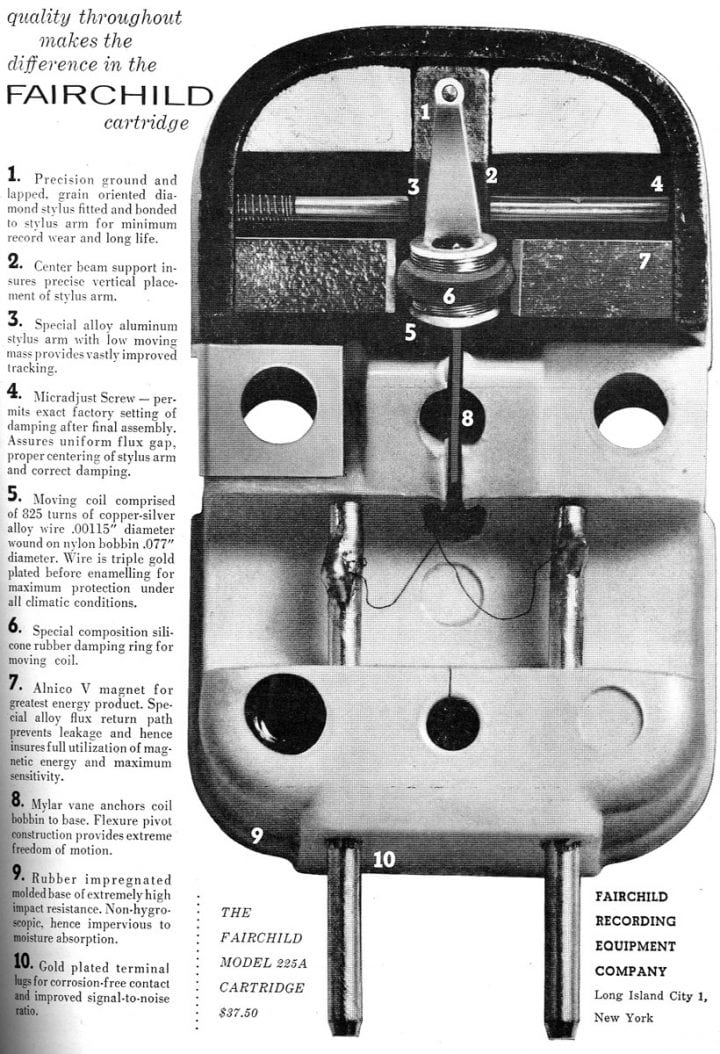
 Entering the ’50s, Fairchild was a leader in record playback. We’ve previously written about the Model 225 moving coil cartridge, which is still sought by collectors and retrophiles. It may have been a compact, lightweight device, but it appeared particularly robust—especially in comparison to many of today’s tiny megabuck cartridges.

Not to keep harping on prices, but even that seemingly modest $37.50 in 1955 equals $350 today—of course, many moving coil cartridges today are ten or twenty times that. Or more.

In 1958, well-known audio engineer/man about town Bert Whyte wrote in Radio & TV News about the first Stereo record releases—and the new gear needed to play them. Of the Fairchild stereo playback gear, Whyte wrote “The arm used is the large studio turret head type which is found in many broadcasting stations. The cartridge is a novel design, utilizing two moving coils to pick up the ’45-45′ groove modulations of the Westrex system…the Fairchild stereo cartridge is at present quite a bit larger than its conventional 225 units [shown above] and for this reason the large studio arm is used….the present arm and cartridge works very well and it is actually available to those affluent people who can afford the rather breathtaking 250 dollar price tag. But then, there are always those who want to be ‘fustest with the mostest’.”

And yes… $250 in 1958? $2,200 today. Compared to many moving coil cartridges—a bargain!

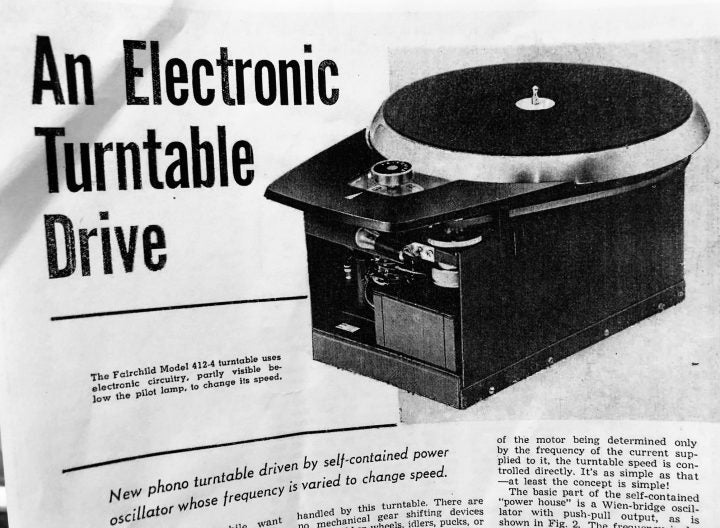
The most-legendary piece of Fairchild phono playback gear is the 412-4 turntable. In 1957 Radio & TV News found the new table worthy of a four-page feature upon its introduction. Typically for Fairchild, the table was built like a piece of industrial machinery: the chassis was heavyweight steel,  the hysteresis-synchronous motor was suspended by spherical vibration mounts, drive was by two belts and an intermediate pulley for maximum decoupling, the main bearing was rifle-drilled Babbitt, the platter was a massive aluminum casting—well, you get the idea. But the really big news of the 412-4 was that platter speed was set and changed was not mechanical, but purely electronic, effected by an oscillator that changed the frequency of the current to the motor. In addition, the table could run on a.c. inputs from 85 to 135 volts, or on 50, 60, or 400 cycles—or from a battery supply!—all accomplished without any adjustments. Playing speeds were 16 2/3, 33 1/3, 45, and 78.26, adjustable plus or minus 5%.


A single-speed 33 1/3 model 412 was available without the electronic speed control, which was available as a slide-in unit that could be added to the basic 412 at a later time.

Ever seen either version of the 412? Likely not, and neither have I. Next time: more Fairchild magic.

0 comments

Leave a comment

0 Comments

Your avatar

Loading comments...

🗑️ Delete Comment

Enter moderator password to delete this comment: