COPPER

A PS Audio Publication

Issue 40 • Free Online Magazine

Issue 40 VINTAGE WHINE

Bang & Olufsen, Part 1

Bang & Olufsen, Part 1

In 2013 I was fortunate to have a consulting gig with Bang & Olufsen, in Denmark. Drawing upon that experience, this piece will be partly travelogue, partly the usual brand  history, taking advantage of a unique collection of B & O products.

Struer is a small town of 10,000 or so in the Jutland peninsula of Denmark, located about as far away from Copenhagen as one can get and still be in Denmark. The first lesson learned by English-speakers visiting Denmark: those words in Danish may look similar to many words in English, but they are pronounced nothing like you’d expect. “Jutland”, for example, is pronounced something like “Yoolund”, with the last syllable simultaneously spat and hiccupped. There are swallows and gulps and plosives in unexpected places, the effect being like a more laid-back form of German. Sub-lesson #1: don’t ever say that to a Dane. They won’t like the comparison.

The second lesson learned by English-speakers visiting Denmark: nearly everyone speaks English. Thank God.

For an American traveling to Struer, the likeliest route is to fly into Frankfurt, and then take a puddle-jumper to Billund, in Denmark. The reason most folks fly into Billund is to visit the nearby Lego factory and the Legoland resort. Don’t laugh:  Lego’s business may be the business of fun, but it’s the world’s largest toy company, with revenues of over $5 billion. With a “b”.

The second reason travelers fly into Billund was my reason: to visit Bang & Olufsen in Struer, about 100 kilometers away. The drive meanders through a pastoral countryside, green meadows filled with herds of spotted cows, boundaries marked by tall fir trees. It was gray and overcast upon my arrival, and it finally hit me why the countryside seemed intensely familiar:  it looked just like southern Minnesota, where I grew up.

Aside from the windmills, it could be Minnesota. En route to Struer from Billund.

And that of course begs the question: how did Danes travel halfway around the world to find a place that looked just like home? Very weird.

Bang & Olufsen was founded in 1925 by Peter Bang and Svend Olufsen. One of their first products was a mains-power source for radio sets, designed to eliminate bulky, acid-filled batteries. In the 90+ years since then, B&O has become synonymous with elegant design. Though the factory employs fewer townsfolk than it once did, evidence of the company’s history in Struer can be seen everywhere. You’ll even see old B&O products in shop windows downtown.

A swoopy Beolit radio from the late '30's, in a shop window in downtown Struer.

…and an old Beocord disc-cutter in another shop window.

Given B&O’s long presence in Struer, it makes sense that the town museum houses a permanent exhibit of Bang & Olufsen products. It’s evident that right from the company’s beginnings, appearance and functionality of products was extremely important. Early products featured ornate detailing, while the ’30’s brought streamlined Deco styling, and even the occasional severe-looking Bauhaus design.
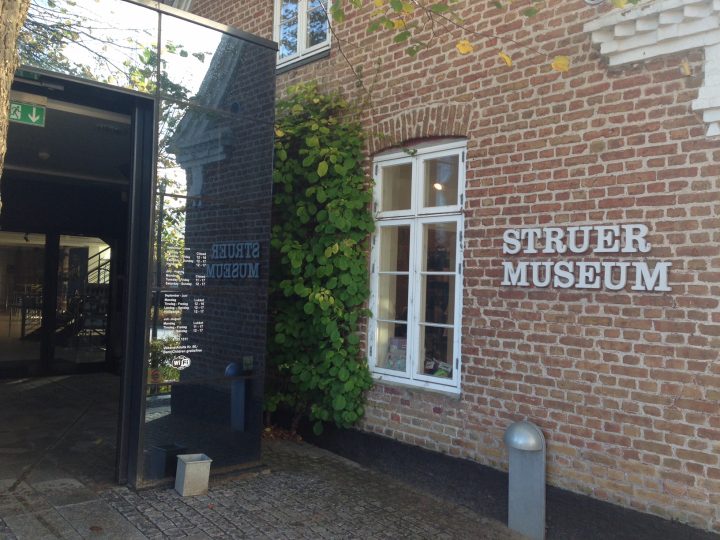
The town museum in Struer, home of the B&O historical collection.
"Radio and television factory that put Struer on the world map."
Entering the museum, a variety of B&O radios, large and small.
An early console phono-radio, with styling reminiscent of the American tombstone radios.
Cleaner styling, but still wood-y and warm.

This chrome and leather Bauhaus console was a sales failure—too austere for the market.

Early on, B&O produced a little of everything, including cinema systems including projectors, amplifiers, and loudspeakers with compression drivers and horns.

Even the projector was sleek and stylish.
Amplification for the cinema system. I think.
Compression driver and horn, also seen atop the page.

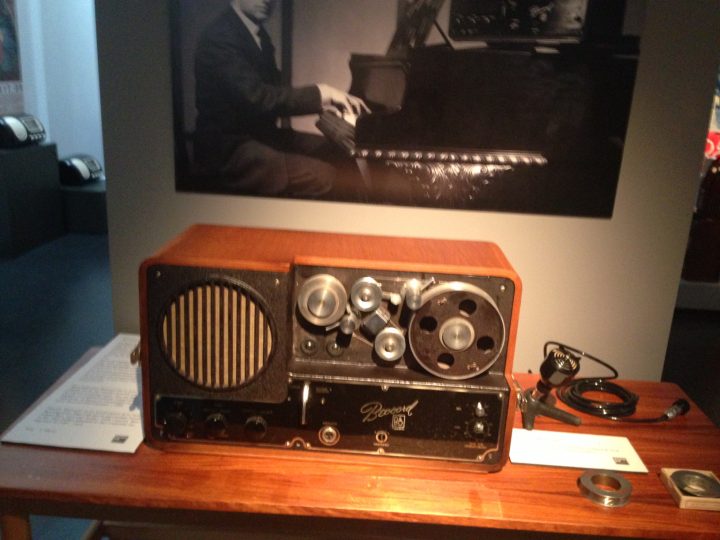
A beautiful Beocord wire recorder. A step towards the hi-fi era…sorta.

In the next Vintage Whine, we’ll follow B&O’s products  into the hi-fi age, and talk more about the company’s history.

[Apologies for the quality of photography: that was a couple of generations of iPhone ago, and the shots are fuzzier than expected. Mea culpa. —-Ed.]

More from Issue 40

View All Articles in Issue 40

Search Copper Magazine

#232 What came first: Art or Music? A Conversation With Artist Jose Acosta by Joe Caplan Jul 06, 2026 #232 Blow By Blow: The Jeff Beck Story: An Insightful Book About a Guitar Icon by Ray Chelstowski Jul 06, 2026 #232 Creed Over Camaraderie? by B. Jan Montana Jul 06, 2026 #232 Chronicles of a Sound Pilgrim at the 2026 Montreal Audiofest by Hugues Morin Jul 06, 2026 #232 The Vinyl Beat: Summer Grooves by Rudy Radelic Jul 06, 2026 #232 Hibbing Hillbilly Dylan's Acoustic Rock by Wayne Robins Jul 06, 2026 #232 Quad Quads and Plasmatronics Tweeters: An Extraordinary System Comes to Life by Frank Doris Jul 06, 2026 #232 In Praise of Live Music, Once Again by Ted Shafran Jul 06, 2026 #232 Allnic Audio’s L-9000 Preamplifier: Design and Engineering Innovation by Howard Kneller Jul 06, 2026 #232 “Best Of” Lists and Rage Bait: Enough Already by Frank Doris Jul 06, 2026 #232 Quick Takes: Bud Shank, Paulo Almeida, Jakob Dreyer, Tim Eriksen and Peter Irvine by Frank Doris Jul 06, 2026 #232 My Impressions of AXPONA 2026, Part 2 by Frank Doris Jul 06, 2026 #232 How to Play in a Rock Band, 25: Encounters With Famous Musicians, Part Three by Frank Doris Jul 06, 2026 #232 Budgets, and Systems From Small to Outrageous by Paul McGowan Jul 06, 2026 #232 PS Audio in the News by PS Audio Staff Jul 06, 2026 #232 Hand It Over by Frank Doris Jul 06, 2026 #232 Difference of Opinion by Peter Xeni Jul 06, 2026 #232 Wabi-sabi Tree by James Schrimpf Jul 06, 2026 #231 Piano Prodigy Jude Kofie Releases His Debut Album On Octave Records by Frank Doris Jun 01, 2026 #231 Underappreciated Artists, Part Two: City Boy by Rich Isaacs Jun 01, 2026 #231 Music and the Art of Creation: Talking With Saxophonist Rob Scheps by Joe Caplan Jun 01, 2026 #231 How to Play in a Rock Band, 24: Further Adventures at the 2026 Montauk Music Festival by Frank Doris Jun 01, 2026 #231 Courtney Barnett: Creature of Habit by Wayne Robins Jun 01, 2026 #231 Angine de Poitrine: Interstellar Guitar Rock Saviors Headed for Late-Night TV Pop Stardom? by Mark Lepage Jun 01, 2026 #231 My Impressions of AXPONA 2026, Part One by Frank Doris Jun 01, 2026 #231 2026 La Jolla Concours d'Elegance: Another Aesthetic Feast by B. Jan Montana Jun 01, 2026 #231 Country Music Icon Jo Dee Messina’s Bridges: A New Beginning by Ray Chelstowski Jun 01, 2026 #231 The Luxury Dispatch Hosts a Video Podcast With Ken Kessler by Ken Kessler Jun 01, 2026 #231 The Vinyl Beat: Tracking in the Motor City by Rudy Radelic Jun 01, 2026 #231 Lots of Fun With DSP: The Ferrum Audio WANDLA DAC and Its Tube Mode by Frank Doris Jun 01, 2026 #231 From The Audiophile's Guide: Digital Source Components and Streaming Audio by Paul McGowan Jun 01, 2026 #231 Onkyo’s Monster M-510 power amplifier by The Staff at Just Audio Jun 01, 2026 #231 PS Audio in the News by PS Audio Staff Jun 01, 2026 #231 Naming Convention by Peter Xeni Jun 01, 2026 #231 Les Invisibles by Frank Doris Jun 01, 2026 #231 Wildlife Scene by James Schrimpf Jun 01, 2026 #230 Camaraderie by B. Jan Montana May 04, 2026 #230 AXPONA 2026: A Family Gathering by Paul McGowan May 04, 2026 #230 Pianist Ryan Benthall Explores Jazz Realms and Far Beyond With Divine Sky by Frank Doris May 04, 2026 #230 The Vinyl Beat in AXPONA-Land by Rudy Radelic May 04, 2026 #230 Teddy Thompson’s Musical Growth Deepens With Never Be the Same by Ray Chelstowski May 04, 2026 #230 More Fun in the Sun: Florida Audio Expo, Part Two by Frank Doris May 04, 2026 #230 CanJam NYC 2026 Show Report: Heady Sound, Part Two by Frank Doris and Harris Fogel May 04, 2026 #230 Sonic Youth On Murray Street by Wayne Robins May 04, 2026 #230 Graffeo Coffee: A Symphony of Sensory Experience by Joe Caplan May 04, 2026 #230 The Saul Authority: The Story of Hi-Fi Pioneer Saul Marantz by Olivier Meunier-Plante May 04, 2026 #230 How to Play in a Rock Band, 23: Encounters With Famous Musicians, Part Two by Frank Doris May 04, 2026

Bang & Olufsen, Part 1

Bang & Olufsen, Part 1

In 2013 I was fortunate to have a consulting gig with Bang & Olufsen, in Denmark. Drawing upon that experience, this piece will be partly travelogue, partly the usual brand  history, taking advantage of a unique collection of B & O products.

Struer is a small town of 10,000 or so in the Jutland peninsula of Denmark, located about as far away from Copenhagen as one can get and still be in Denmark. The first lesson learned by English-speakers visiting Denmark: those words in Danish may look similar to many words in English, but they are pronounced nothing like you’d expect. “Jutland”, for example, is pronounced something like “Yoolund”, with the last syllable simultaneously spat and hiccupped. There are swallows and gulps and plosives in unexpected places, the effect being like a more laid-back form of German. Sub-lesson #1: don’t ever say that to a Dane. They won’t like the comparison.

The second lesson learned by English-speakers visiting Denmark: nearly everyone speaks English. Thank God.

For an American traveling to Struer, the likeliest route is to fly into Frankfurt, and then take a puddle-jumper to Billund, in Denmark. The reason most folks fly into Billund is to visit the nearby Lego factory and the Legoland resort. Don’t laugh:  Lego’s business may be the business of fun, but it’s the world’s largest toy company, with revenues of over $5 billion. With a “b”.

The second reason travelers fly into Billund was my reason: to visit Bang & Olufsen in Struer, about 100 kilometers away. The drive meanders through a pastoral countryside, green meadows filled with herds of spotted cows, boundaries marked by tall fir trees. It was gray and overcast upon my arrival, and it finally hit me why the countryside seemed intensely familiar:  it looked just like southern Minnesota, where I grew up.

Aside from the windmills, it could be Minnesota. En route to Struer from Billund.

And that of course begs the question: how did Danes travel halfway around the world to find a place that looked just like home? Very weird.

Bang & Olufsen was founded in 1925 by Peter Bang and Svend Olufsen. One of their first products was a mains-power source for radio sets, designed to eliminate bulky, acid-filled batteries. In the 90+ years since then, B&O has become synonymous with elegant design. Though the factory employs fewer townsfolk than it once did, evidence of the company’s history in Struer can be seen everywhere. You’ll even see old B&O products in shop windows downtown.

A swoopy Beolit radio from the late '30's, in a shop window in downtown Struer.

…and an old Beocord disc-cutter in another shop window.

Given B&O’s long presence in Struer, it makes sense that the town museum houses a permanent exhibit of Bang & Olufsen products. It’s evident that right from the company’s beginnings, appearance and functionality of products was extremely important. Early products featured ornate detailing, while the ’30’s brought streamlined Deco styling, and even the occasional severe-looking Bauhaus design.

The town museum in Struer, home of the B&O historical collection.
"Radio and television factory that put Struer on the world map."
Entering the museum, a variety of B&O radios, large and small.
An early console phono-radio, with styling reminiscent of the American tombstone radios.
Cleaner styling, but still wood-y and warm.

This chrome and leather Bauhaus console was a sales failure—too austere for the market.

Early on, B&O produced a little of everything, including cinema systems including projectors, amplifiers, and loudspeakers with compression drivers and horns.
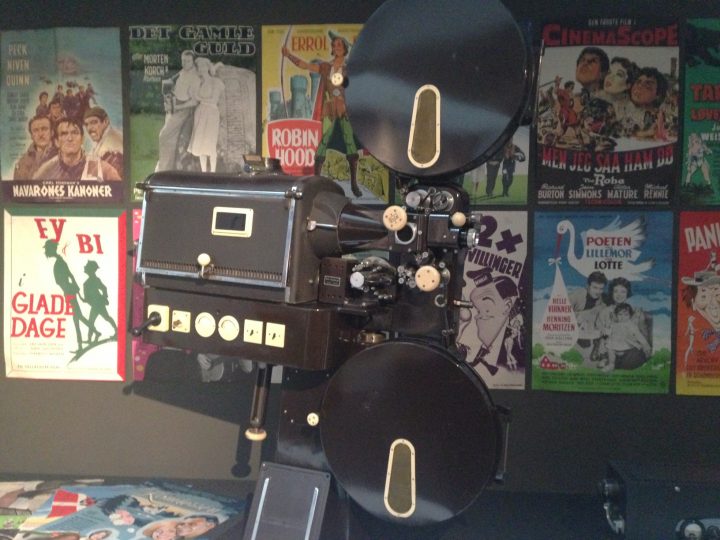
Even the projector was sleek and stylish.
Amplification for the cinema system. I think.
Compression driver and horn, also seen atop the page.

A beautiful Beocord wire recorder. A step towards the hi-fi era…sorta.

In the next Vintage Whine, we’ll follow B&O’s products  into the hi-fi age, and talk more about the company’s history.

[Apologies for the quality of photography: that was a couple of generations of iPhone ago, and the shots are fuzzier than expected. Mea culpa. —-Ed.]

0 comments

Leave a comment

0 Comments

Your avatar

Loading comments...

🗑️ Delete Comment

Enter moderator password to delete this comment:

✏️ Edit Comment

Enter your email to verify ownership: