COPPER

A PS Audio Publication

Issue 66 • Free Online Magazine

Issue 66 VINTAGE WHINE

50 Ways to Read a Record Part 2

50 Ways to Read a Record Part 2

In his last column, Jay Jay French mentioned the optical phono cartridge cartridge made by DS Audio in Japan. Ironically, “DS” stands for “Digital Stream”…go figure.

When you hear of an optical method of record playback, it’s easy to assume that it’s one of the laser-scanning methods that have been proposed and built over the decades—and we’ll get to those designs, eventually—but that’s not the case here. The DS cartridges track the record with a standard diamond stylus/cantilever asssembly. Inside their bodies, the cartridges contain an LED light source which is aimed at a photocell, and between those two elements is the cartridge’s cantilever. As the cartridge tracks the record, the output of the photocell is modulated by the cantilever movement, generating an output voltage which represents what’s in that squiggly groove.

Magnetic cartridges are velocity-sensing, so both increases in frequency and groove excursion cause the voltage output to increase. Photo cartridges like the DS and strain-gauge cartridges (Win, Soundsmith, others) are amplitude-sensing, responding only to the stylus’ movement. The DS and strain-gauge cartridges thus require their own particular equalization—a standard phono pre won’t work.

Here’s the interesting part about this technology: it’s not new. Philco, of all people, brought out the “Beam of Light” cartridge system on a number of products in 1941. It utilized a sapphire stylus mounted on a mirror, modulating light from a bulb—no LEDs there! They also had a 7-function wireless remote control called the “Mystery Control”—again, in 1941. You can take a look at both technologies here; on that page are links to two YouTube videos, one pretty uneventful one showing the cartridge at work, the other showing the remote in use.

From the ’40s through the ’60s (at least), the inexpensive cartridges found on most portable phonographs and other low-end turntables were of the ceramic or crystal type. Those cartridges utilized a simple piezoelectric generating element  which had much higher output than magnetic cartridges, and a simple RC network provided compliance to the RIAA compensation spec. More or less, anyway—within a couple dB. Hey, they were cheap.

The post-WWII era saw the reinvention of the phono cartridge. The arrival of the  microgroove LP record required the design of not just smaller styli, but the design of better tracking cartridges that would limit record wear. Stronger magnetic materials developed during the war led to smaller, lighter weight magnetic cartridges. The first major development in cartridges after the war were the VR (variable reluctance) cartridges introduced by GE in 1947, which are still highly regarded by fans of vintage audio. The cantilever moved between two pole pieces of the magnetic structure, varying flux-density of the circuit and generating a voltage in a coil. The VR cartridges originally had fixed styli; later variants had “turnover” styli for both microgroove and 78, or replaceable single styli, and in 1958, stereo versions hit the market.

The term “variable reluctance” refers to a principle of signal-generation, not a specific type of cartridge construction. To clarify: the major forms of magnetic cartridge construction are moving iron, moving magnet, and moving coil—and the moving iron types would be considered variable reluctance cartridges, as they utilize a moving element to modulate the flux in the magnetic circuit, generating a voltage.

Ortofon in Denmark had never abandoned the moving coil cartridge, which in the ’50s  were sold in the US under the brand name ESL. One of the first to revive the type in post-war America was designer Joseph Grado, whose name was later long associated with moving iron cartridges. Grado was an opera singer, watchmaker and inventor; he was also a friend of hi-fi pioneer Saul Marantz, who introduced Grado to Sherman Fairchild.

Fairchild was a multimillionaire serial entrepreneur who founded dozens of companies in many  fields including aircraft, aerial photography, and the Fairchild Recording Equipment Corporation, devoted to products for professional and broadcast audio. The Recording Equipment Corporation, based in Long Island City,  also dabbled in home hi-fi—and that’s where Grado went.
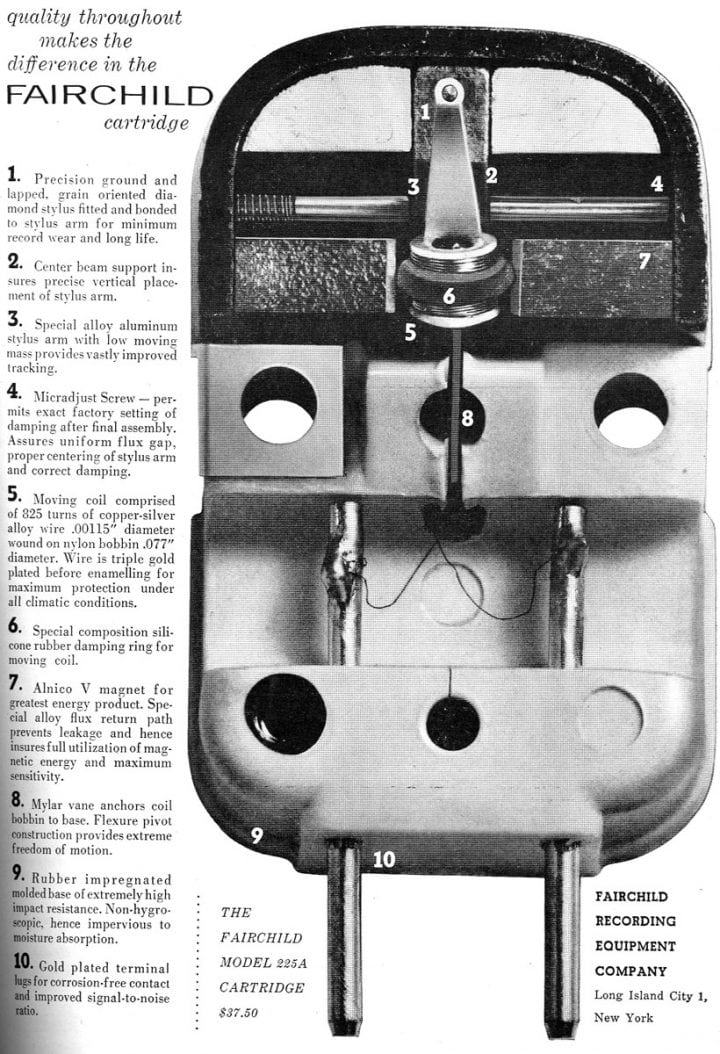
 

The Fairchild 225A, shown above, was Grado’s first audio design. He brought a watchmaker’s standards of precision and quality control to Fairchild. Within a few years, he was off on his own as Grado Labs—still in existence today, still making cartridges, although headphones are the company’s focus these days. Grado’s first cartidges on his own were also moving coils, but he soon developed moving iron cartridges with replaceable styli—the type of cartridges still made in the same brownstone in Brooklyn.

At the dawn of the stereo era, Western Electric/Westrex, developed the model 10A moving coil cartridge, a stereo version of the earlier 9A cartridge. The 10A was designed to play the single groove stereo discs developed by Westrex (discussed back in Copper #44).

The hi-fi boom of the 1950s produced a mass market for mainstream magnetic cartridges, as well as some unique technical developments in record playback. We’ll discuss both in the next issue.

More from Issue 66

View All Articles in Issue 66

Search Copper Magazine

#231 Piano Prodigy Jude Kofie Releases His Debut Album On Octave Records by Frank Doris Jun 01, 2026 #231 Underappreciated Artists, Part Two: City Boy by Rich Isaacs Jun 01, 2026 #231 Music and the Art of Creation: Talking With Saxophonist Rob Scheps by Joe Caplan Jun 01, 2026 #231 How to Play in a Rock Band, 24: Further Adventures at the 2026 Montauk Music Festival by Frank Doris Jun 01, 2026 #231 Courtney Barnett: Creature of Habit by Wayne Robins Jun 01, 2026 #231 Angine de Poitrine: Interstellar Guitar Rock Saviors Headed for Late-Night TV Pop Stardom? by Mark Lepage Jun 01, 2026 #231 My Impressions of AXPONA 2026, Part One by Frank Doris Jun 01, 2026 #231 2026 La Jolla Concours d'Elegance: Another Aesthetic Feast by B. Jan Montana Jun 01, 2026 #231 Country Music Icon Jo Dee Messina’s Bridges: A New Beginning by Ray Chelstowski Jun 01, 2026 #231 The Luxury Dispatch Hosts a Video Podcast With Ken Kessler by Ken Kessler Jun 01, 2026 #231 The Vinyl Beat: Tracking in the Motor City by Rudy Radelic Jun 01, 2026 #231 Lots of Fun With DSP: The Ferrum Audio WANDLA DAC and Its Tube Mode by Frank Doris Jun 01, 2026 #231 From The Audiophile's Guide: Digital Source Components and Streaming Audio by Paul McGowan Jun 01, 2026 #231 Onkyo’s Monster M-510 power amplifier by The Staff at Just Audio Jun 01, 2026 #231 PS Audio in the News by PS Audio Staff Jun 01, 2026 #231 Naming Convention by Peter Xeni Jun 01, 2026 #231 Les Invisibles by Frank Doris Jun 01, 2026 #231 Wildlife Scene by James Schrimpf Jun 01, 2026 #230 Camaraderie by B. Jan Montana May 04, 2026 #230 AXPONA 2026: A Family Gathering by Paul McGowan May 04, 2026 #230 Pianist Ryan Benthall Explores Jazz Realms and Far Beyond With Divine Sky by Frank Doris May 04, 2026 #230 The Vinyl Beat in AXPONA-Land by Rudy Radelic May 04, 2026 #230 Teddy Thompson’s Musical Growth Deepens With Never Be the Same by Ray Chelstowski May 04, 2026 #230 More Fun in the Sun: Florida Audio Expo, Part Two by Frank Doris May 04, 2026 #230 CanJam NYC 2026 Show Report: Heady Sound, Part Two by Frank Doris and Harris Fogel May 04, 2026 #230 Sonic Youth On Murray Street by Wayne Robins May 04, 2026 #230 Graffeo Coffee: A Symphony of Sensory Experience by Joe Caplan May 04, 2026 #230 The Saul Authority: The Story of Hi-Fi Pioneer Saul Marantz by Olivier Meunier-Plante May 04, 2026 #230 How to Play in a Rock Band, 23: Encounters With Famous Musicians, Part Two by Frank Doris May 04, 2026 #230 An Outlier in the Rack: A Vintage BIC Beam Box by The Staff at Just Audio May 04, 2026 #230 PS Audio in the News by PS Audio Staff May 04, 2026 #230 A Cautionary Tale by Rich Isaacs May 04, 2026 #230 Reel-to-Reel Roots, Part 33 (Revised): Ken Kessler Reports On the 2026 (British) AudioJumble by Ken Kessler May 04, 2026 #230 Text Messaging by Frank Doris May 04, 2026 #230 The Audiophile Rat Race by Peter Xeni May 04, 2026 #230 On the Rocks by Rich Isaacs May 04, 2026 #229 The Earliest Stars of Country Music, Part Three by Jeff Weiner Apr 06, 2026 #229 The Healing Power of Music and Sound at the Omega Institute by Joe Caplan Apr 06, 2026 #229 CanJam NYC 2026 Show Report: Heady Sound, Part One by Frank Doris Apr 06, 2026 #229 Florida Audio Expo 2026: Warming Up to High-End Audio, Part One by Frank Doris Apr 06, 2026 #229 Quick Takes: Anne Bisson, Sam Morrison, The Velvet Underground, and the Stooges by Frank Doris Apr 06, 2026 #229 The Vinyl Beat: New Arrivals, and Old Audio Show Demo Scores to Settle by Rudy Radelic Apr 06, 2026 #229 Harvard Gets a High-End Audio Education by Frank Doris Apr 06, 2026 #229 No Country for Old Knees by B. Jan Montana Apr 06, 2026 #229 How To Play in A Rock Band, 22: Encounters With Famous Musicians, Part 1 by Frank Doris Apr 06, 2026 #229 The Soulful Grooves of Guinea-Bissau by Steve Kindig Apr 06, 2026 #229 Four-Hand Piano Performance at Its Finest by Stephan Haberthür Apr 06, 2026

50 Ways to Read a Record Part 2

50 Ways to Read a Record Part 2

In his last column, Jay Jay French mentioned the optical phono cartridge cartridge made by DS Audio in Japan. Ironically, “DS” stands for “Digital Stream”…go figure.

When you hear of an optical method of record playback, it’s easy to assume that it’s one of the laser-scanning methods that have been proposed and built over the decades—and we’ll get to those designs, eventually—but that’s not the case here. The DS cartridges track the record with a standard diamond stylus/cantilever asssembly. Inside their bodies, the cartridges contain an LED light source which is aimed at a photocell, and between those two elements is the cartridge’s cantilever. As the cartridge tracks the record, the output of the photocell is modulated by the cantilever movement, generating an output voltage which represents what’s in that squiggly groove.

Magnetic cartridges are velocity-sensing, so both increases in frequency and groove excursion cause the voltage output to increase. Photo cartridges like the DS and strain-gauge cartridges (Win, Soundsmith, others) are amplitude-sensing, responding only to the stylus’ movement. The DS and strain-gauge cartridges thus require their own particular equalization—a standard phono pre won’t work.

Here’s the interesting part about this technology: it’s not new. Philco, of all people, brought out the “Beam of Light” cartridge system on a number of products in 1941. It utilized a sapphire stylus mounted on a mirror, modulating light from a bulb—no LEDs there! They also had a 7-function wireless remote control called the “Mystery Control”—again, in 1941. You can take a look at both technologies here; on that page are links to two YouTube videos, one pretty uneventful one showing the cartridge at work, the other showing the remote in use.

From the ’40s through the ’60s (at least), the inexpensive cartridges found on most portable phonographs and other low-end turntables were of the ceramic or crystal type. Those cartridges utilized a simple piezoelectric generating element  which had much higher output than magnetic cartridges, and a simple RC network provided compliance to the RIAA compensation spec. More or less, anyway—within a couple dB. Hey, they were cheap.

The post-WWII era saw the reinvention of the phono cartridge. The arrival of the  microgroove LP record required the design of not just smaller styli, but the design of better tracking cartridges that would limit record wear. Stronger magnetic materials developed during the war led to smaller, lighter weight magnetic cartridges. The first major development in cartridges after the war were the VR (variable reluctance) cartridges introduced by GE in 1947, which are still highly regarded by fans of vintage audio. The cantilever moved between two pole pieces of the magnetic structure, varying flux-density of the circuit and generating a voltage in a coil. The VR cartridges originally had fixed styli; later variants had “turnover” styli for both microgroove and 78, or replaceable single styli, and in 1958, stereo versions hit the market.

The term “variable reluctance” refers to a principle of signal-generation, not a specific type of cartridge construction. To clarify: the major forms of magnetic cartridge construction are moving iron, moving magnet, and moving coil—and the moving iron types would be considered variable reluctance cartridges, as they utilize a moving element to modulate the flux in the magnetic circuit, generating a voltage.

Ortofon in Denmark had never abandoned the moving coil cartridge, which in the ’50s  were sold in the US under the brand name ESL. One of the first to revive the type in post-war America was designer Joseph Grado, whose name was later long associated with moving iron cartridges. Grado was an opera singer, watchmaker and inventor; he was also a friend of hi-fi pioneer Saul Marantz, who introduced Grado to Sherman Fairchild.

Fairchild was a multimillionaire serial entrepreneur who founded dozens of companies in many  fields including aircraft, aerial photography, and the Fairchild Recording Equipment Corporation, devoted to products for professional and broadcast audio. The Recording Equipment Corporation, based in Long Island City,  also dabbled in home hi-fi—and that’s where Grado went.


The Fairchild 225A, shown above, was Grado’s first audio design. He brought a watchmaker’s standards of precision and quality control to Fairchild. Within a few years, he was off on his own as Grado Labs—still in existence today, still making cartridges, although headphones are the company’s focus these days. Grado’s first cartidges on his own were also moving coils, but he soon developed moving iron cartridges with replaceable styli—the type of cartridges still made in the same brownstone in Brooklyn.

At the dawn of the stereo era, Western Electric/Westrex, developed the model 10A moving coil cartridge, a stereo version of the earlier 9A cartridge. The 10A was designed to play the single groove stereo discs developed by Westrex (discussed back in Copper #44).

The hi-fi boom of the 1950s produced a mass market for mainstream magnetic cartridges, as well as some unique technical developments in record playback. We’ll discuss both in the next issue.

0 comments

Leave a comment

0 Comments

Your avatar

Loading comments...

🗑️ Delete Comment

Enter moderator password to delete this comment:

✏️ Edit Comment

Enter your email to verify ownership: